Review examines mosquito microbes and malaria parasites in lab and animal studies
The reported effects varied by microbial strain, mosquito species, and experimental setting, with no human evidence assessed.
Very low evidenceReviewInterpret with caution
Medical disclaimer: This article summarizes research findings and is for informational purposes only. It is not medical advice.
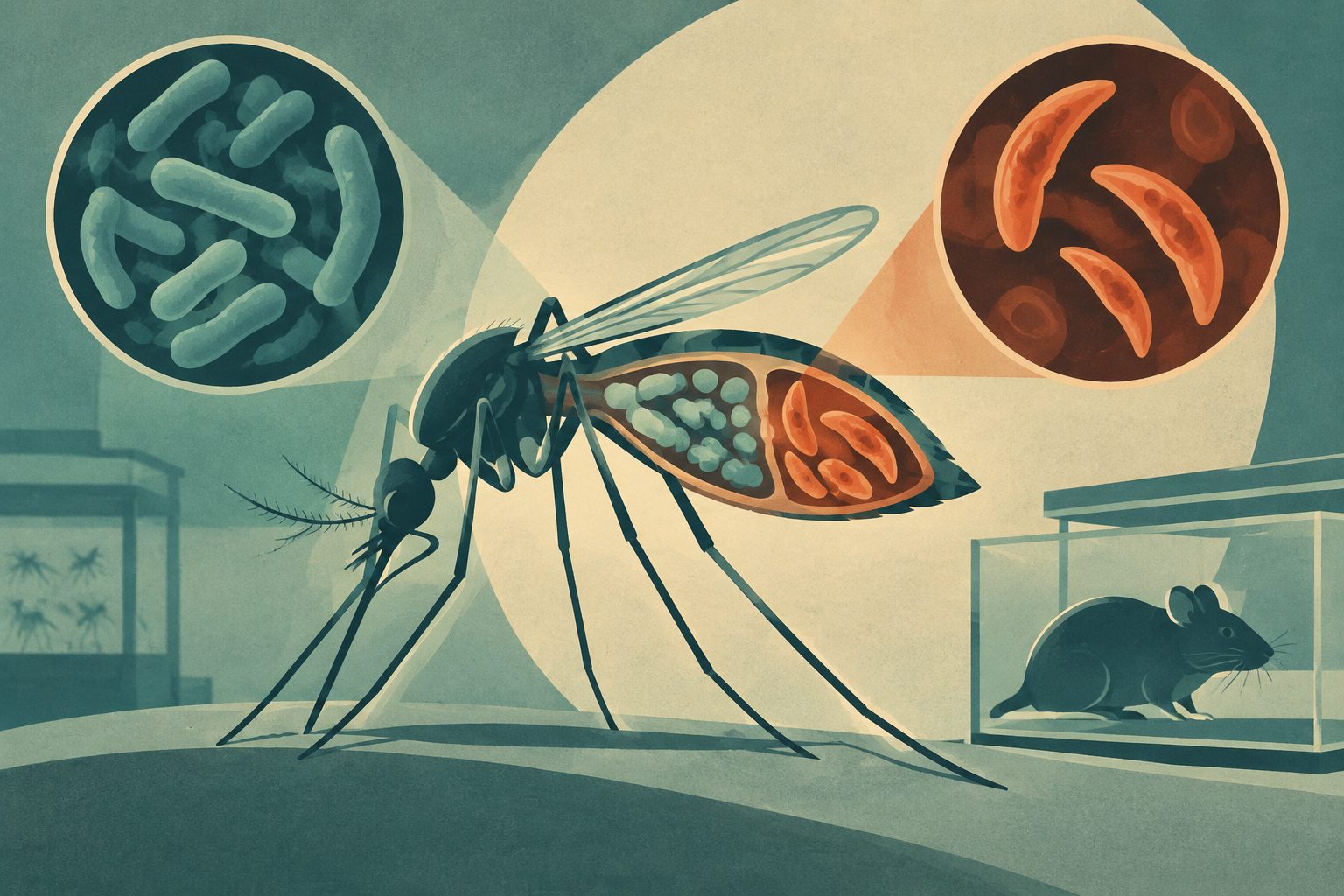
Editorial illustration — not from the study.
Researchers searched PubMed, Scopus, and Google Scholar for studies published from 2000 through 2026. They focused especially on microbes in mosquito salivary glands and used a narrative synthesis, with risk of bias assessed using a tool designed for animal studies.
The review reported reductions or other changes in parasite levels for some microbial strains, while other strains showed no clear relationship. Some experiments involving Microsporidia, Serratia, or engineered mosquito symbionts reported substantial parasite or transmission blocking, but these results were obtained in experimental models and have not established benefit in human populations.
What the review covered
The researchers asked how the microbiota of Anopheles mosquitoes affects the development of P. falciparum sporozoites, the parasite stage involved in malaria transmission. They conducted a systematic search of PubMed, Scopus, and Google Scholar covering 2000–2026. Forty-one studies met the inclusion criteria. Results were combined narratively under PRISMA guidance, and risk of bias was assessed with SYRCLE’s tool for animal studies. The review gave particular attention to the mosquito salivary gland microbiome.
Key conclusions
The reported effects differed among microbial strains and mosquito species. The abstract reports that Wolbachia strain wAlbB was associated with a 3.4- to 3.7-fold decrease in sporozoite numbers, while wAnga-Mali had a negative correlation with 95% presence; no correlation was reported for wAnmo in Anopheles moucheti.
Microsporidia MB was reported across studies from African countries with prevalence ranging from 1% to 57%, and the review describes no fitness costs in those studies. In one experiment, outer-membrane vesicles from Serratia ureilytica Su_YN1 carrying AmLip inhibited about 98% of parasites. Engineered symbionts produced 93% transmission blocking in mouse models. These findings are reported results from mosquito, laboratory, and animal research; they do not show that these approaches work in humans or in routine malaria-control programs.
Who this may apply to
These findings apply most directly to the mosquito species, microbial strains, parasite systems, and experimental models represented in the included studies. The mouse results apply to mice, and laboratory findings apply to those laboratory conditions; neither establishes effects in people. No patient population or human malaria-control program was studied, so the review does not show that these microbial approaches are effective, safe, or feasible for human use or field deployment.
The significance
Malaria transmission depends in part on parasite development inside Anopheles mosquitoes, so mosquito-associated microbes could be relevant to future vector-control research. The review helps organize evidence about which microbial strains and mechanisms have been studied. However, the strongest numerical results described here came from experimental systems, including mice, and may not translate to human malaria outcomes, mosquito populations in the field, environmental safety, or practical public-health effectiveness.
Limitations & evidence assessment
The abstract provides limited detail about the quality, consistency, and results of the individual 41 studies. The evidence was synthesized narratively rather than through a pooled quantitative estimate, and the included work involved animal, mosquito, or laboratory models rather than human participants. Results varied by microbial strain, mosquito species, and context, which limits broad conclusions. As with any review, the conclusions also depend on the studies that were found and included; the abstract does not report whether publication bias or substantial differences between studies were formally assessed.
Why this evidence level: This is a systematic review, but the evidence summarized comes from mosquito, laboratory, engineered-symbiont, and mouse models rather than human studies. The findings therefore provide early biological evidence and do not establish effects in people or real-world malaria control.
Evidence levels are editorial estimates derived from study metadata — they are not clinical appraisals.
// Source
Frontiers in Insect Science · 2026 · DOI: 10.3389/finsc.2026.1958166
A study of illicit alcohol in two Ugandan cities found that alcohol strength was inconsistent and sometimes under-declared, reaching 44.2%. Some spirits contained methanol above safe limits, while opaque beers showed bacterial contamination and many production and retail sites had poor sanitation.
Researchers found that bacterial surface-layer proteins can evolve through modular changes and gene transfer, producing different outer structures. In closely related bacteria with the same type of surface layer, only pathogens showed resistance to the antimicrobial molecules LL-37 and lysozyme.
Researchers traced how AlphaFold 3 turns evolutionary differences among related protein sequences into three-dimensional structure predictions. They found that evolutionary diversity matters more than simply adding more sequences, helping explain both the system’s strengths and some of its failures.