Review examines AI tools for finding and forecasting atrial fibrillation
The review reports promising ECG-based results but says benefits for patients, including fewer strokes, remain unproven.
Low evidenceReviewInterpret with caution
Medical disclaimer: This article summarizes research findings and is for informational purposes only. It is not medical advice.
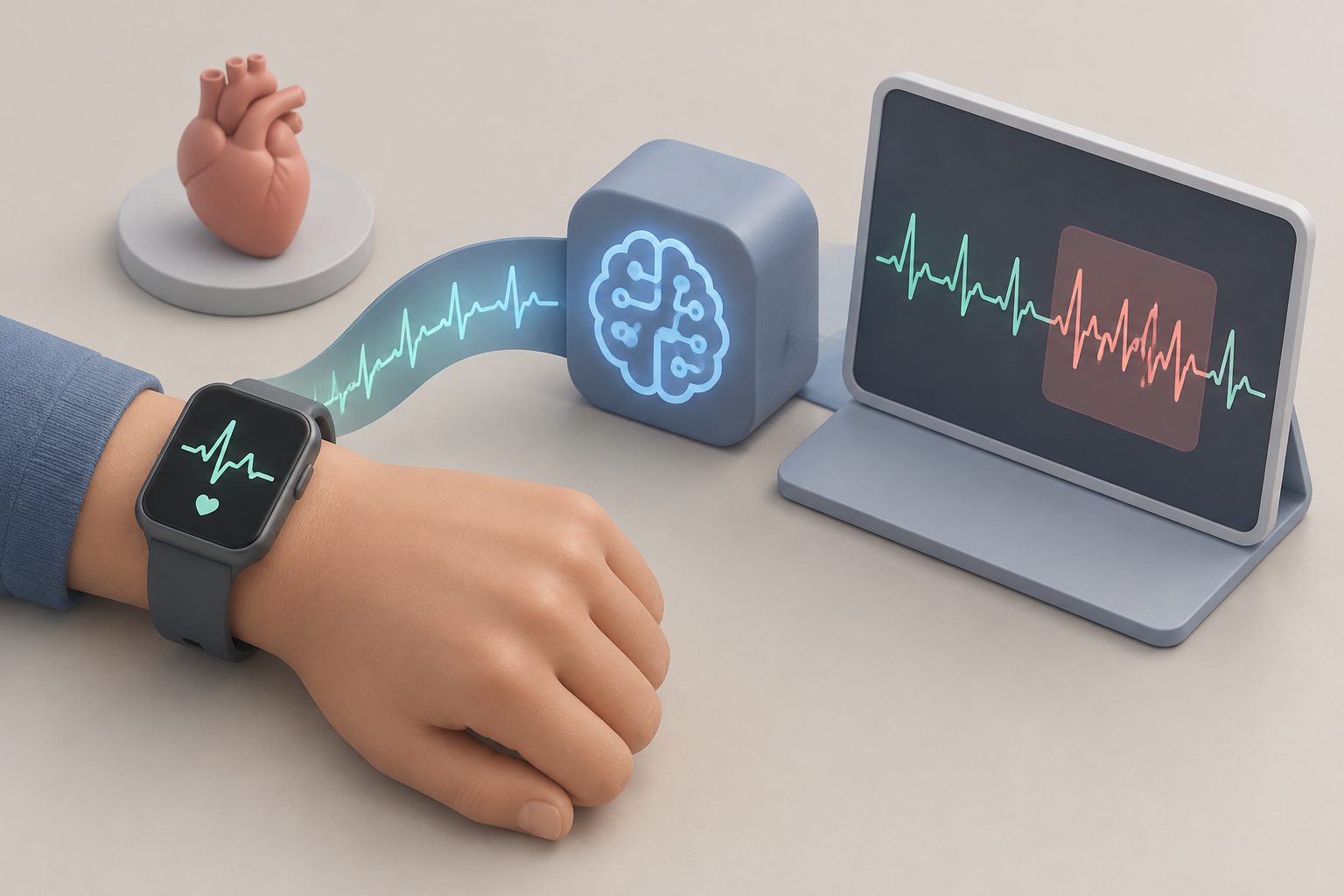
Editorial illustration — not from the study.
The review describes research using artificial intelligence to identify atrial fibrillation from single-lead or 12-lead electrocardiograms, as well as from signals collected by some consumer wearables. It also examines models that look for patterns during a normal rhythm that may be linked with atrial fibrillation developing later.
Reported results were generally encouraging, including high accuracy for classifying existing atrial fibrillation and lower accuracy for predicting future cases. However, the review notes false alarms, readings that cannot be classified, limited testing outside the original research settings, and a lack of randomized trials showing fewer strokes or other improved patient outcomes.
The question reviewed
The authors conducted a narrative review of existing research on artificial intelligence and deep-learning analysis of electrocardiograms for detecting or predicting atrial fibrillation. The review considered standard single-lead and 12-lead ECGs, wearable-device signals such as photoplethysmography and single-lead ECG, and prediction models applied to ECGs recorded during normal heart rhythm. The abstract does not state the number of studies reviewed, the total number of participants, or the exact search and selection methods. Because this is a review, it is not itself a new experiment involving a defined group of patients or an animal or laboratory model.
Key conclusions
The review reports that some deep-learning systems classified atrial fibrillation on ECG recordings with area-under-the-curve values above 0.97, described as similar to cardiologist-level performance in the studies summarized. Models looking for an ECG pattern associated with atrial fibrillation during normal rhythm had an area under the curve of about 0.87. Consumer wearables using photoplethysmography or single-lead ECG were reported to have pooled sensitivity and specificity of about 95%. Models predicting newly developing atrial fibrillation reached area-under-the-curve values of 0.78 to 0.85 and had been tested prospectively. These are summaries of prior research, not results from a new trial in this review, and they do not establish that use of the tools improves outcomes.
Who this is relevant to
The findings may be relevant to researchers and health systems evaluating ECG or wearable-device artificial intelligence in populations similar to those represented in the underlying studies. The abstract does not identify those populations in enough detail, so applicability to particular age groups, ethnic groups, people with other heart conditions, or people using specific devices is unknown. The review should not be interpreted as showing that these tools provide the same accuracy in every setting or that they improve outcomes for all people with possible atrial fibrillation.
What this could mean
Earlier identification of atrial fibrillation could be clinically relevant because the rhythm can be intermittent and may cause no noticeable symptoms. The review suggests that artificial intelligence may help analyze large numbers of ECG or wearable recordings and may identify people who warrant further assessment. However, the practical benefit remains uncertain: the abstract states that no trials have shown a reduction in stroke, and the review does not establish that an artificial-intelligence result alone is sufficient for diagnosis or patient care.
Limitations & evidence assessment
The main limitation is the narrative-review design: the abstract does not provide enough information to judge how studies were found, selected, or compared, and it does not report a study count or total sample size. The underlying research may differ in devices, populations, definitions, and testing settings, which can affect reported accuracy. The review specifically notes false-positive results, unclassifiable recordings, limited external validity, and a lack of trials showing improved patient outcomes such as fewer strokes. Prospective validation is mentioned, but the abstract does not give enough detail about follow-up, comparison groups, or whether the models were tested across diverse populations. These findings describe performance measures, not proven clinical benefit.
Why this evidence level: This is a narrative review rather than a new clinical trial or a systematic review with fully described methods. It summarizes findings from earlier studies, but the abstract provides limited information about the populations, methods, and quality of those studies.
Evidence levels are editorial estimates derived from study metadata — they are not clinical appraisals.
// Source
Journal of Education Health and Sport · 2026 · DOI: 10.12775/jehs.2026.95.76576
Researchers combined genetic data from more than 1 million human participants to study factors associated with endometriosis. They identified 58 genomic regions, including 27 not previously reported, and used additional molecular analyses to implicate 314 genes. These findings point to possible biological pathways for further research, but they do not establish causes or demonstrate that any treatment will work.
Researchers systematically reviewed laboratory studies of how temperature affects the time it takes arboviruses to become transmissible inside mosquitoes. Across 53 studies covering 17 viruses, higher temperatures were generally linked with greater transmission efficiency and a shorter time to infectiousness for Zika and West Nile viruses, while results for several other viruses were unclear.
This systematic review and meta-analysis examined whether ultra-low-dose computed tomography (CT) can detect pulmonary, or lung, nodules while using less radiation than standard-dose CT. Across 42 studies involving 15,792 patients, pooled sensitivity for nodule detection was 91.9%, but results varied greatly between studies. The review also found that ultra-low-dose CT used an average effective dose of 0.22 millisieverts (mSv), while detection was less reliable for some small or hazy nodules and in patients with a high body mass index.