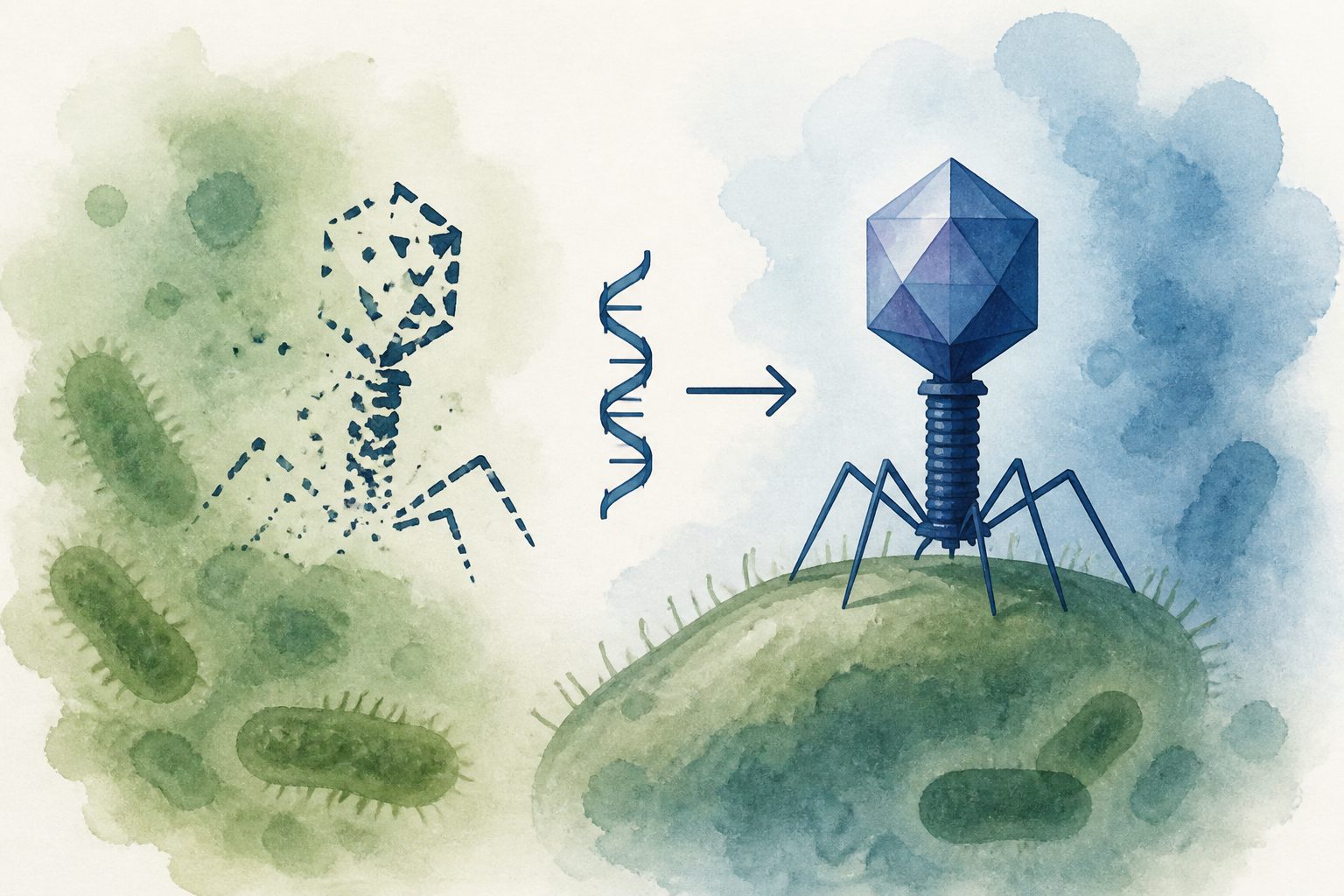
A synthetic version of the bacteria-infecting phage PRR1 showed the biological and structural traits recorded for its historical form.
Physical collections of bacterial strains and related genetic elements can be lost over time, making older experiments difficult to reproduce. In this study, researchers used the digital sequence of PRR1 to reconstruct the phage, a virus that infects bacteria and depends on a plasmid in its host.
The team then examined the reconstructed particles genetically, biologically and with high-resolution microscopy. The abstract reports that the synthetic PRR1 showed biological and structural characteristics identical to those documented for the wild-type phage.
Evidence and caveats
The conclusion is based on genetic tests, biological or trait-based tests, and ultrastructural examination of the reconstructed phage. The abstract does not provide the individual test results, sample sizes, reconstruction procedures, or details of how closely the historical and synthetic traits were compared. It also describes PRR1 as having evidently been lost from many repositories, rather than documenting the status of every culture collection.