Refugee women in Malawi described how poverty and violence reinforce each other
Interviews in Dzaleka camp linked abandonment, survival marriages and caregiving burdens to barriers to safety and justice.
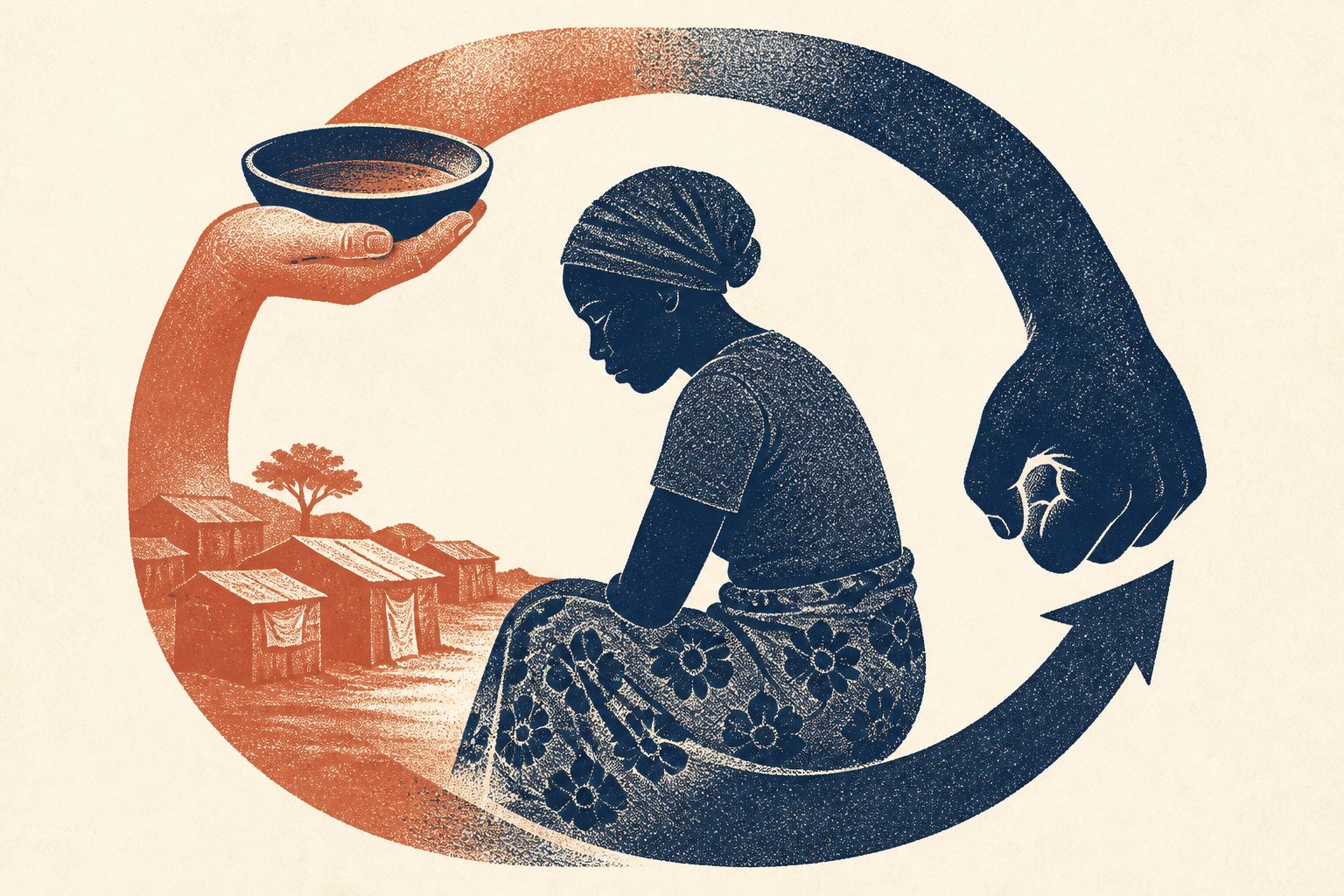
Editorial illustration — not from the study.
Researchers analyzed nine focus group discussions with 50 childbearing-aged refugee women living in Dzaleka Refugee Camp in Malawi. The discussions explored gender-based violence, relationships, health and social services, and access to justice and support.
The researchers identified three connected parts of gendered poverty: abandonment and single motherhood, marriage entered as a way to obtain protection or basic resources, and the constraints of caring for children. They describe these pressures as interacting with institutional failures, creating a cycle that can deepen women’s vulnerability.
How the cycle works
The women described partners abandoning them and leaving them responsible for children, which pushed them into severe financial insecurity. Some said they entered relationships or marriages during flight or in the camp to obtain protection, food or other basic needs. The study describes these unions as sometimes shaped by coercion, rape, debt or economic necessity rather than free choice.
Participants also described childcare and other caregiving responsibilities as limiting their ability to seek safety, work or support. The researchers found that institutional responses often did not provide adequate protection or justice and could reproduce existing power imbalances. The study’s conclusion additionally identifies reports of men with resources bribing officials to avoid justice, although the excerpts do not provide details on how often this occurred.
Why connected support matters
The findings suggest that addressing violence among refugee women requires more than responding to individual incidents. Policies and services may also need to address abandonment, economic dependence, caregiving responsibilities and barriers to justice together. The researchers argue for culturally appropriate and integrated support that responds to these overlapping social and structural pressures.
Evidence and caveats
This was a qualitative sub-study based on nine focus group discussions with 50 refugee women who had previously been pregnant and lived in Dzaleka Refugee Camp. The discussions were conducted from October 2024 to June 2025, and the data were analyzed for recurring themes. Participants were recruited through purposive and snowball sampling, initially with help from a community advocate who worked with survivors of gender-based violence.
Because the study involved one camp and a qualitative sample, its findings cannot be assumed to represent all refugee women or other humanitarian settings. Recruitment may have favored women who were more connected to services or more willing to discuss their experiences. Self-reported accounts may also have been affected by memory, stigma, fear of retaliation or mistrust. The study did not collect data on sexual orientation, gender identity beyond cisgender women or disability status, and it does not address refugee men, LGBTQ+ refugees or resettled refugees in high-income settings.
// Source
Journal of Interpersonal Violence · 2026 · DOI: 10.1177/08862605261485297
People have fished for tuna for about 44,000 years and billfish for about 10,000 years, according to a global review of archaeological evidence. But sustained, intensive fishing in offshore and oceanic waters appears to have developed mainly during the past 200 years.
People considering whether to leave flood-prone coastal communities weigh disastrous flooding and rising costs alongside crime, healthcare and proximity to family and friends. In a survey of 182 respondents, most said they would not relocate, while others said they would move immediately or in the future.
A study of eight managers found that they preferred human coaches for reflective questioning, even though they welcomed that approach from a person. When the same coaching protocol came from an AI system, they wanted it to provide answers instead.