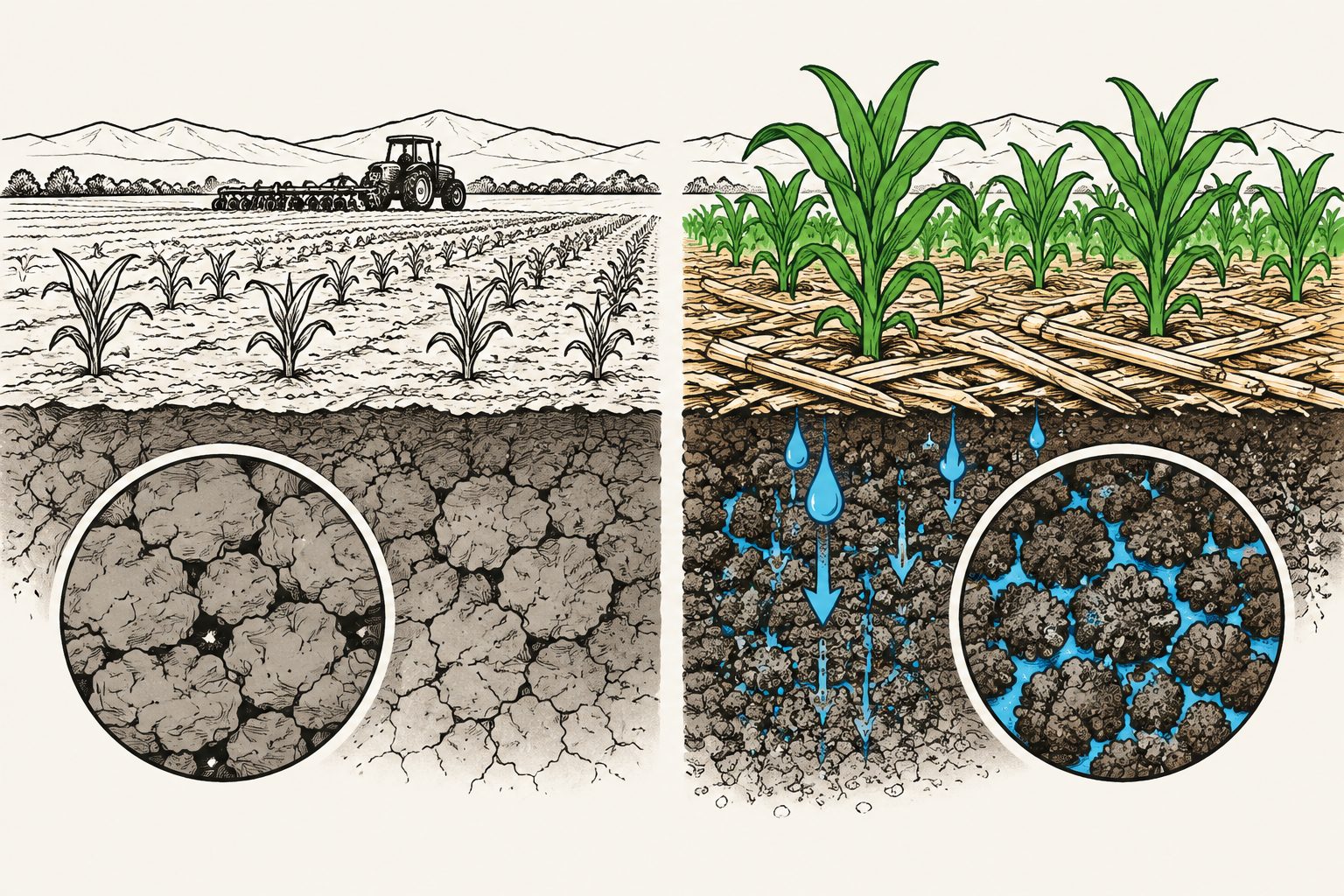
Drought and rewetting cycles can alter how soil microbes process nitrogen, affecting trace-gas emissions such as nitrous oxide (a potent greenhouse gas) and nitric oxide. To test how this interacts with soil texture, the study used co-located plots with fine, medium, and coarse soils under the same wheat-growing conditions, while withholding rain or keeping ambient rainfall.
Biology2 months ago
Rain “pulses” after drought drive nitrogen gas spikes more than soil type
A field experiment in Mediterranean wheat found that rewetting events caused short-lived surges of nitrous oxide and nitric oxide, while soil texture mattered less than drought history.

Nitrogen gas pulses after rain
Drought reduced in-season trace-gas emissions across all soil textures, even though droughted soils accumulated more inorganic nitrogen. Rewetting triggered large, short-lived emission pulses, with nitrous oxide (N2O) and nitric oxide (NO) increasing by up to 12× and 200×, respectively, compared with conditions without rewetting; these pulses accounted for up to 18% of seasonal totals. The size of pulses declined across successive rewetting events, consistent with progressively lower available “substrate” for gas production. Fine-textured soils accumulated up to 7× more inorganic nitrogen than medium- and coarse-textured soils, but this did not translate into proportionally higher rewetting emissions, indicating constraints on how readily the nitrogen could be converted to gases. The study also reported apparent N2O emission factors ranging from 2.5% to 12.0%, higher than commonly cited dryland benchmarks. A key part of the experimental setting involved partial crop failure, creating an “orphaned N” situation where fertilizer-derived inorganic nitrogen accumulated under low plant uptake, allowing measurement under a worst-case plant-sink-failure scenario.
Timing outweighs soil texture
The results point to timing—when dry soils get rewetted—rather than soil texture, as a major control on episodic nitrogen gas losses in drought-stressed dryland croplands. As drought-induced crop failures rise in Mediterranean agroecosystems, the study suggests that “orphaned N” could contribute to nitrogen losses that are not yet well captured in regional nitrogen budgets.
Field experiment, with crop-failure context
This conclusion comes from a year-long rainfall manipulation field experiment with co-located soils of three contrasting textures and the same wheat cropping under controlled drought versus ambient-rain treatments, with repeated measurements of soil CO2, N2O, and NO fluxes and inorganic nitrogen pools. However, emissions were measured under an unusual outcome: combined drought stress and herbivory led to partial crop failure, creating an “orphaned N” system. That worst-case plant uptake scenario may not match typical years with fully functioning crops, even though the authors argue it reflects a growing risk. The abstract also does not specify replication counts, locations, or how widely the findings generalize beyond the experimental site and conditions.
// Source
Agriculture Ecosystems & Environment · 2026 · DOI: 10.1016/j.agee.2026.110680
Authors: Isaac Yagle, Basigeri Pavithra, Vasily I. Grabovsky, Sindhu Jagadamma, Ryan Ackett, Sean M. Schaeffer, Debasish Saha, Ilya Gelfand
Institutions: University of Tennessee at Knoxville, Ben-Gurion University of the Negev, Knoxville College