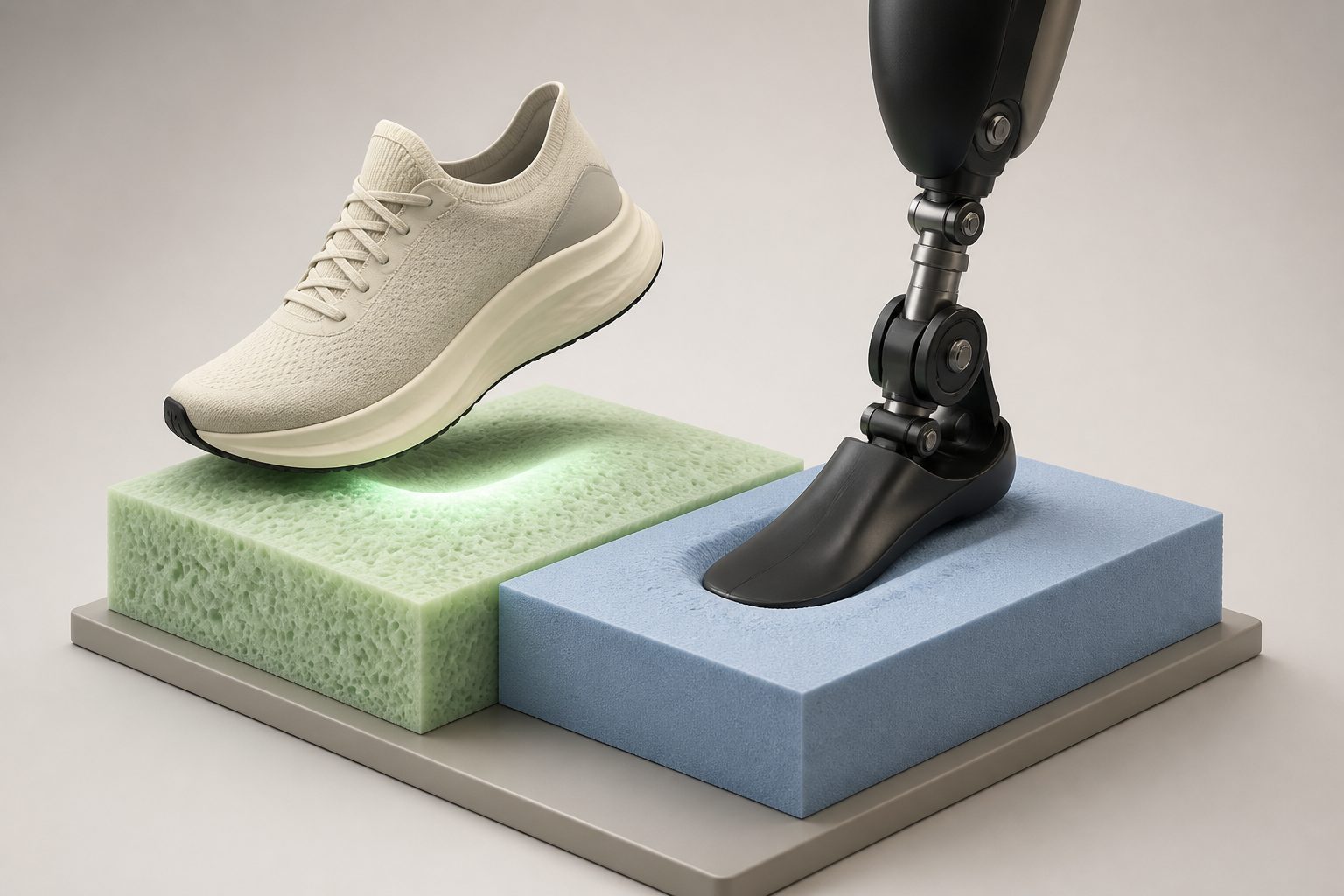
Tests of two ultra-light foams found similar resistance to compression but large differences when stretched or pushed sideways.
The study combined mechanical tests with machine learning to examine two very low-density foams used in high-performance racing shoes. Both foams were highly compressible, showed little sideways deformation and had low energy loss during repeated loading, features linked to cushioning and energy return.
The foams had similar stiffness when compressed, but one was 42% stiffer when stretched and had nearly twice the stiffness under sideways loading. The researchers used these measurements to build compact mathematical models that closely matched the foams’ behavior across several types of loading.
How the foams behaved
Across tests involving stretching, compression and sideways loading, both foams showed a strong difference between their responses to tension and compression. They showed little sideways deformation, consistent with an effective Poisson’s ratio close to zero, and low hysteresis, meaning that relatively little energy was lost during loading and unloading.
At a strain rate of 0.25 per second, the foams had similar compressive stiffness: 268±16 kilopascals for one and 299±29 kilopascals for the other. Their tensile stiffnesses were 884±69 and 623±96 kilopascals, a 42% difference, while their shear stiffnesses were 219±20 and 117±24 kilopascals. Reported vertical energy return was 83.3±1.5% and 88.9±1.8%.
The researchers combined neural networks with sparse regression to produce compact, interpretable models of the foams. These models matched the test results closely across all loading modes, with R² values near one.
Why the differences matter
The models could be incorporated into gait-level simulations that use high-performance racing shoes to estimate running economy, performance effects and injury risks for individual athletes. The approach may also help model similar ultra-light foams in wearable technology, soft robotics and energy-efficient mobility systems.
The findings also show why compression tests alone may not fully describe how racing-shoe foams behave: the two materials were similar under compression but differed substantially when stretched or loaded sideways.
Evidence and limits
The evidence comes from laboratory mechanical tests of two foams and mathematical models fitted to those measurements. The models reproduced the tested material responses closely, but the study did not report tests in runners or direct measurements of running economy, performance improvements or injuries.
The abstract does not identify the shoe brands or explain how the two foams were selected. The proposed athlete-specific applications therefore remain a modeling possibility rather than a demonstrated clinical or performance result.
// Source
Engineering With Computers · 2026 · DOI: 10.1007/s00366-026-02398-y
Authors: Jeremy A. McCulloch, Scott L. Delp, Ellen Kuhl
Institutions: Stanford University