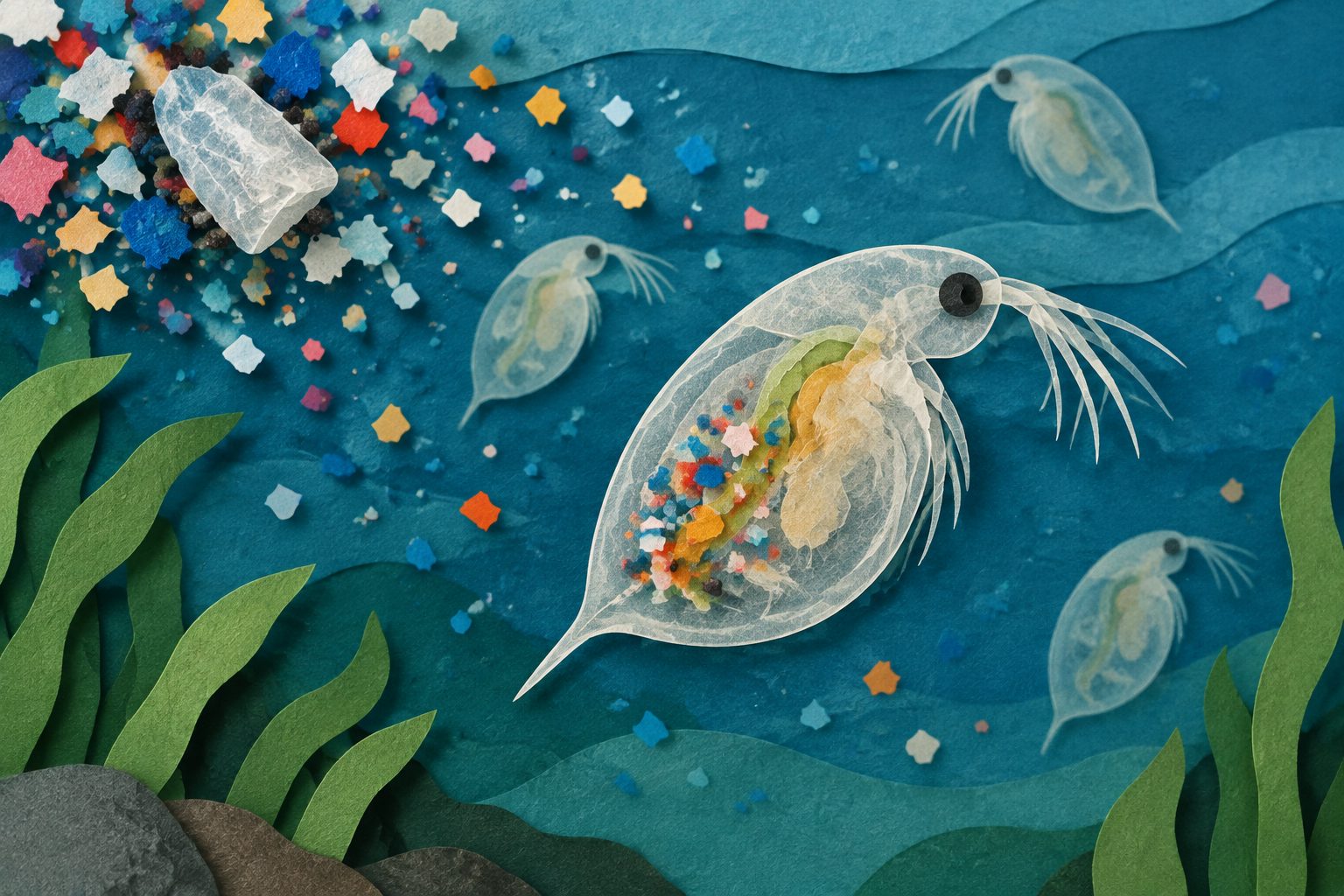
Polystyrene and polylactic acid particles changed how pyrene and methyl chlorpyrifos affected Daphnia magna in laboratory experiments.
Researchers tested 250-nanometer particles made of polystyrene and polylactic acid together with pyrene, a polycyclic aromatic hydrocarbon, and methyl chlorpyrifos, an organophosphate pesticide. They first measured how the contaminants attached to the two plastics, then assessed effects on Daphnia magna in acute and chronic toxicity tests.
Pyrene formed a single surface layer on both plastics under the study conditions, while methyl chlorpyrifos showed a pattern consistent with more varied, multilayer attachment. When the water fleas were exposed to plastic particles carrying the contaminants, acute immobilization increased. Longer exposures affected survival and reproduction, especially with contaminated polystyrene.
What happened to the water fleas
Coexposure to microplastics and either contaminant increased immobilization compared with exposure to the contaminant or particles alone. When the water fleas were exposed only to the contaminant left in the water after it had attached to the particles, the measured EC50 values increased, consistent with the lower contaminant concentration in the water.
Chronic tests found significant effects on Daphnia survival and reproduction when the particles carried contaminants. These effects were more pronounced with polystyrene than with polylactic acid under the treatment-specific EC10 exposure conditions. The adsorption analysis also showed that contaminant behavior depended on the chemical, its concentration and the type of plastic.
Evidence and caveats
This was a controlled laboratory study using acute and chronic toxicity tests with Daphnia magna, along with adsorption experiments and mathematical models of contaminant attachment. The experiments used 250-nanometer polystyrene and polylactic acid particles, and the sorption experiments were conducted in triplicate. The excerpts do not provide the full toxicity sample sizes, exposure concentrations or effect estimates. Because the work used selected plastics, contaminants and laboratory conditions, it does not by itself establish how strongly the same effects occur in natural water bodies.