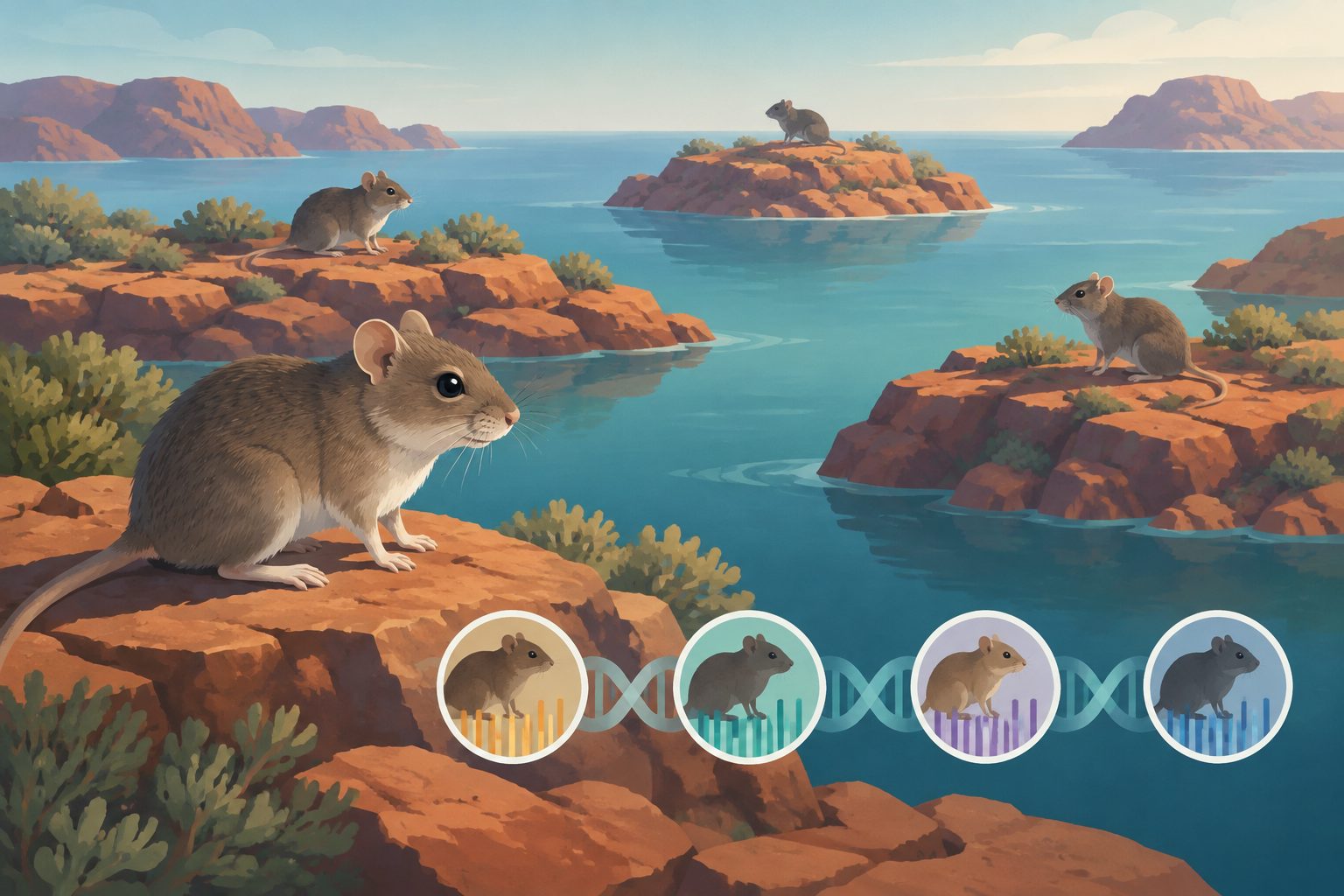
The endemic Australian rodents live in separated populations with smaller genetic reserves on islands and limited prospects for recolonisation.
Researchers combined demographic, physical and genetic data to examine the Kimberley rock-rat, a habitat specialist found in north-west Australia and 16 nearby islands. The animals consistently preferred moist rocky gullies with boulders and vine-forest vegetation, while activity and movement varied strongly by season and breeding occurred throughout the year.
Island rock-rats were smaller than mainland animals, and genetic analyses found smaller effective population sizes on islands. Nearby localities tended to be genetically similar, but some groups appear to have been isolated since before the last ice age. Less reliable wet seasons, longer dry periods, introduced predators such as feral cats and more frequent fires could add pressure to these already separated populations.
Separated rock-rat populations
The Kimberley rock-rat is confined to the extreme north-west of Australia and 16 adjacent islands that were connected to the mainland during the last ice age. Those islands became isolated about 6,500 years ago, and their present populations are considered remnants of the former mainland distribution.
Capture rates were high on islands, but genetic analyses showed that island populations had smaller effective population sizes than the mainland population. The animals preferred moist, rocky gullies with boulder substrates and vine-forest plants. Their activity and movement changed markedly with the seasons, although breeding took place throughout the year. The study found no differences between the sexes in body form, while skull measurements showed that island animals were dwarfed, rather than becoming larger as is common in some related rodents.
Genetic similarities were strongest among nearby localities, while some groups appear to have remained separated since before the last glacial maximum. The researchers also identified less reliable wet-season conditions, longer dry periods, introduced species including feral cats and increased fire as pressures that could reduce population viability.
Evidence and caveats
The study integrates observations of population numbers and movement with body measurements and genetic analyses. These lines of evidence support a pattern of habitat specialisation, long-term population separation and smaller genetic reserves on islands.
The abstract does not provide sample sizes, extinction rates or estimates of how much each threat contributes to population decline. The effects of changing wet seasons, longer dry periods, introduced predators and fire are identified as potential or likely pressures rather than quantified impacts in this study. The findings describe population structure and vulnerability; they do not establish that any particular local population has already gone extinct.
// Source
Australian Mammalogy · 2026 · DOI: 10.1071/am26016
Authors: L. H. Schmitt, Richard A. How, Celeste H. Wale, Gregory Cozens, Peter B. S. Spencer, Mark A. Cowan
Institutions: The University of Western Australia, Murdoch University, Australian Museum, Western Australian Museum, Department of Biodiversity, Conservation and Attractions