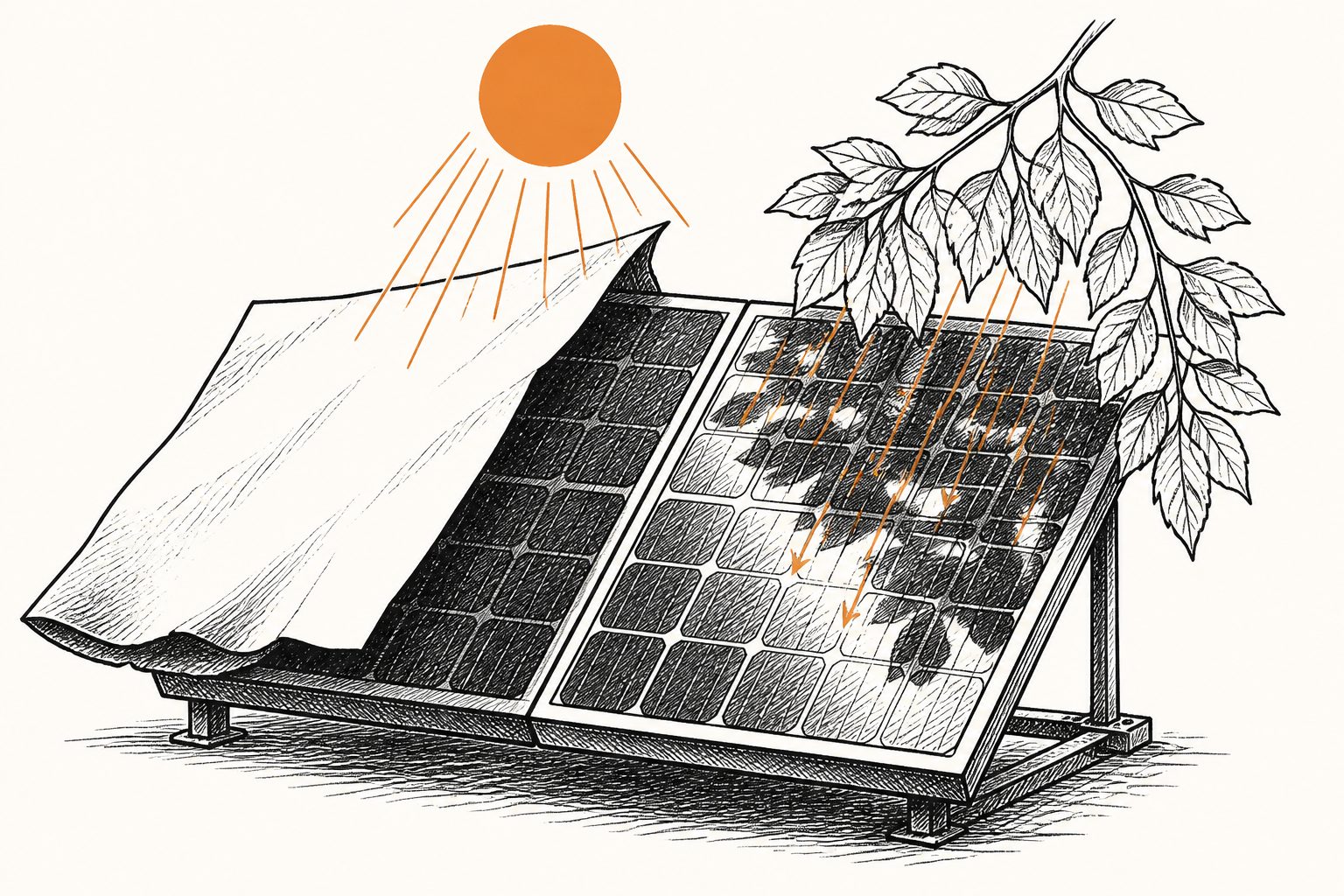
A 40-watt panel produced less electricity as layers of paper or Ficus lyrata leaves were added, with paper causing the larger losses.
Researchers tested a fixed, tilted solar panel under unshaded conditions and under one, two and three layers of paper or Ficus lyrata leaves. Measurements were taken hourly from 9 a.m. to 5 p.m. in clear weather over 80 days at a site in Kansanga, Kampala.
The unshaded panel had the highest average voltage, current, power output and efficiency. As more layers were added, both materials reduced performance, but paper caused the larger losses, which the researchers attribute to its lower light transmission compared with leaves.
Paper caused larger losses
The unshaded panel produced average values of 24.85 volts, 1.22 amps, 30.24 watts and 12.61% efficiency. With leaf shading, average power output fell from 15.28 watts to 7.45 watts and efficiency fell from 5.70% to 2.90%; current declined from 0.64 amps with one leaf layer to 0.32 amps with three layers.
Paper caused larger losses. Average current fell from 0.43 amps with one paper layer to 0.21 amps with three layers, while power output declined from 10.35 watts to 4.80 watts and efficiency from 4.21% to 1.88%. Regression analysis found that paper shading accounted for 35.3% of the variation in panel efficiency, compared with 9.1% for leaf shading. Paper and leaves accounted for 14.4% and 12.8% of the variation in power output, respectively.
How the test was done
This was a controlled experiment using one 40-watt monocrystalline panel at one site in Kansanga, Kampala. Researchers compared unshaded conditions with directly applied layers of paper and Ficus lyrata leaves during clear-weather measurements taken over 80 days. They used electrical, temperature and sunlight measurements alongside descriptive statistics, correlations, regression and analysis of variance.
The test did not examine other panel technologies, additional shading materials or long-term effects of shading in real-world installations. The researchers also noted that changes in sunlight, panel-cell temperature and ambient conditions affected the results. The article reports different unshaded efficiency values in different sections—12.61% in the abstract and 23.88% in the results and conclusion—so the efficiency figures should be interpreted with that reporting inconsistency in mind.