Tests on a standard autonomous-driving dataset found that using both types of sensors worked better than relying on either one alone.
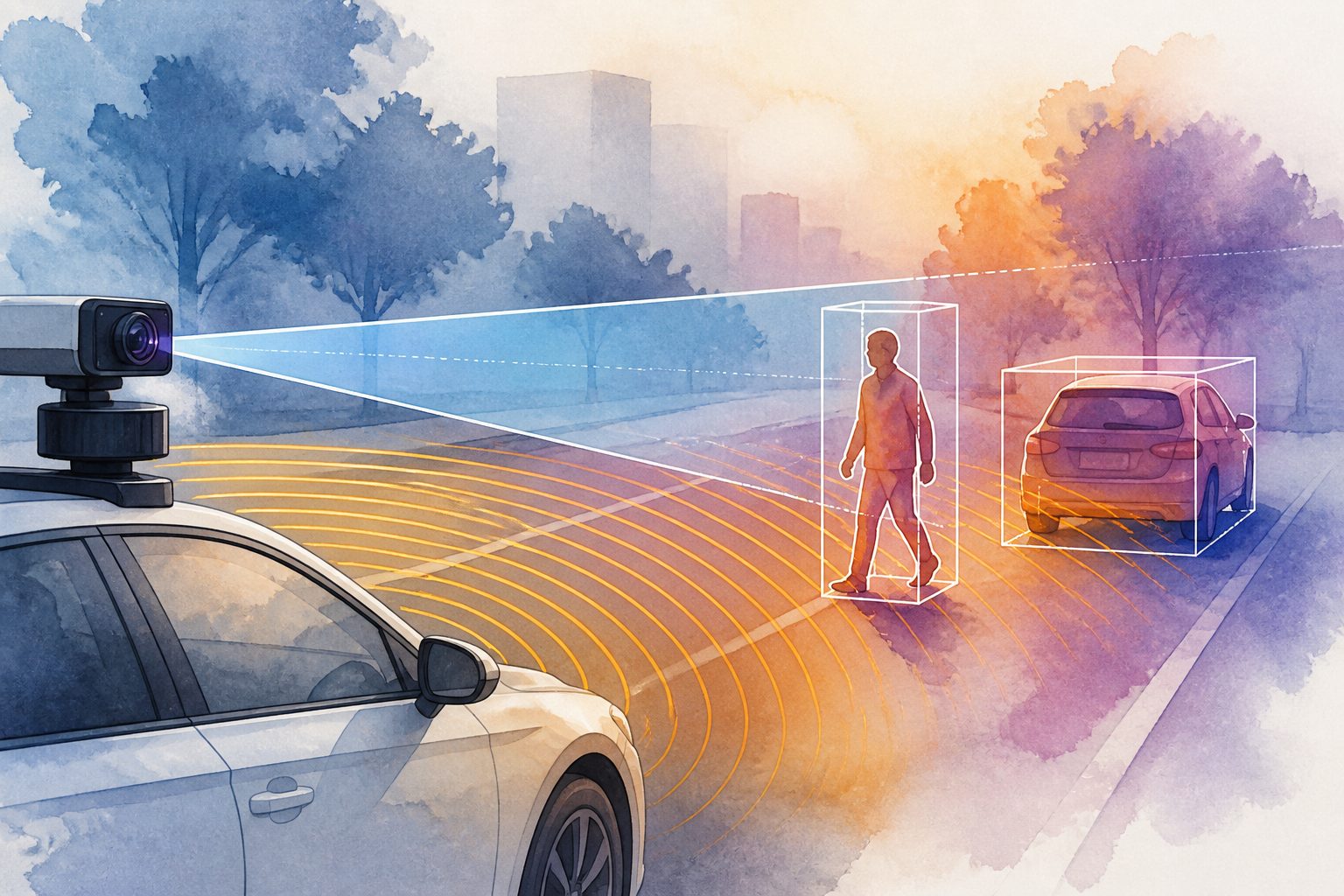
Researchers developed a system that combines camera images with radar data to detect objects in three dimensions around an autonomous vehicle. It converts visual information into a 3D form before combining it with radar-based features.
In tests on the nuScenes dataset, the combined system performed better than systems using only a camera or only radar. Its performance was also competitive with other leading camera–radar fusion methods, although the abstract does not report numerical results.
How camera and radar worked together
The researchers used a deep neural network to extract features from camera images, then transformed those features into 3D space with a Cross-Domain Spatial Matching step. They fused the transformed camera information with radar-derived features to create a shared 3D representation of objects.
On the nuScenes dataset, the method outperformed single-sensor camera and radar systems. It achieved competitive performance compared with other leading sensor-fusion methods. The abstract does not give specific accuracy or detection scores.
// Source
Scientific Reports · 2026 · DOI: 10.1038/s41598-026-66505-1
Authors: Daniel Dworak, Mateusz Komorkiewicz, Paweł Skruch, Jerzy Baranowski
Institutions: AGH University of Krakow