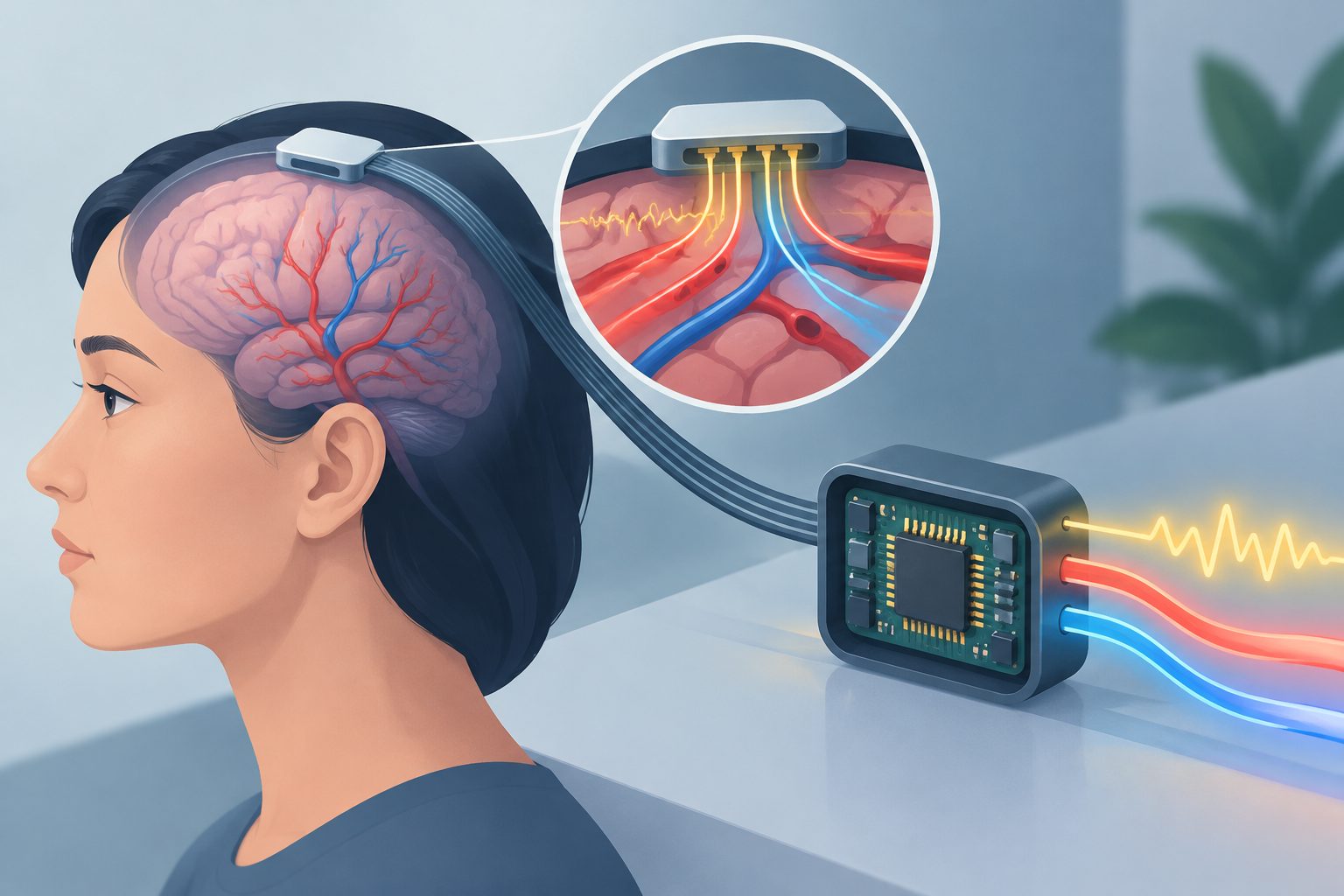
A mixed-signal system is designed to measure tiny, fast electrical signals and larger, slower blood-flow signals with low interference.
The proposed system uses separate conditioning paths for the two types of brain signals. One path is designed for microvolt-scale electrical signals with bandwidths reaching the kilohertz range, while the other handles millivolt-scale blood-flow signals below 10 hertz. Both paths feed the same mixed-signal conversion stage so they can be sampled in sync.
The design combines adjustable gain, frequency-selective filtering and a low-noise amplifier to limit saturation, timing errors and interference between the paths. The authors say experimental tests with simulated brain signals demonstrated concurrent operation, including sub-microvolt input-referred noise and stable tracking of the slower blood-flow signals.
Evidence and open questions
The evidence comes from circuit analysis, design simulations or models, and experimental tests using brain-signal emulation. The abstract does not provide exact crosstalk levels, power consumption, test sample sizes or details of recordings from living people. It therefore supports the performance of the proposed front end under the reported test conditions, but does not establish clinical performance or performance across different hardware and biological recording settings.
// Source
Progress in Electronics and Communication Engineering · 2026 · DOI: 10.31838/x87e9c54
Authors: M.Karpagam
Institutions: SRM Institute of Science and Technology