New review finds less urine protein with some kidney drugs in type 1 diabetes
The pooled evidence found no clear difference in yearly kidney-function change and identified higher risks of low blood sugar and diabetic ketoacidosis.
High evidenceReviewInterpret with caution
Medical disclaimer: This article summarizes research findings and is for informational purposes only. It is not medical advice.
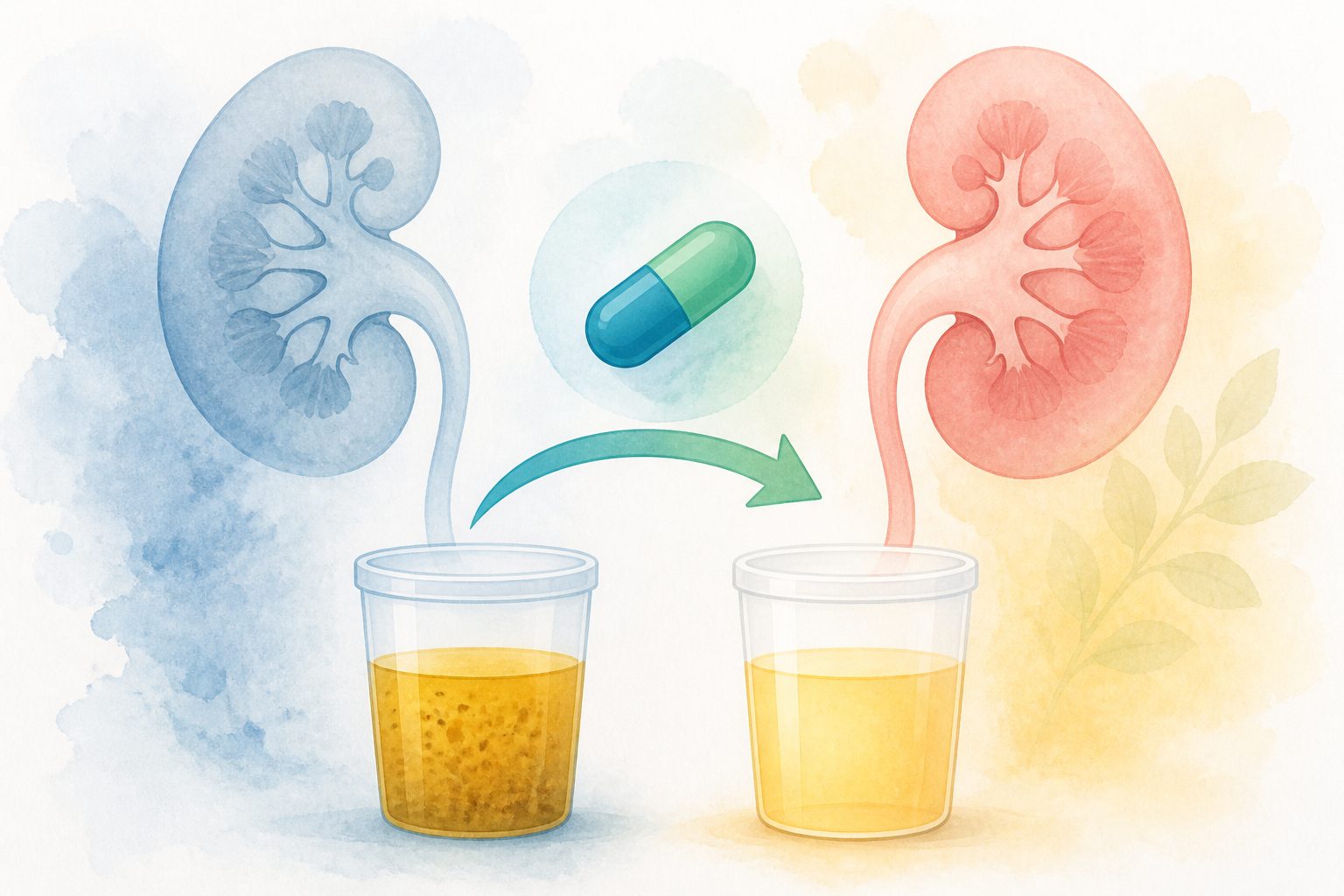
Editorial illustration — not from the study.
Researchers searched seven medical databases for randomized trials testing renin–angiotensin system inhibitors, sodium–glucose cotransporter 2 inhibitors, mineralocorticoid receptor antagonists, or glucagon-like peptide 1 receptor agonists in adults with type 1 diabetes. The review focused on urine albumin levels, estimated kidney filtration, and safety outcomes.
Across the included studies, treatment was associated with about 45% less urine albumin than placebo in the relevant pooled analysis. The authors said this result appeared to be driven mainly by sodium–glucose cotransporter 2 inhibitor studies; evidence for renin–angiotensin system inhibitors was limited and not statistically significant when considered separately. The analysis also found higher risks of hypoglycemia and diabetic ketoacidosis.
The question reviewed
The researchers conducted a systematic review and meta-analysis of randomized controlled trials in adults aged 18 or older with type 1 diabetes. They searched Medline, EMBASE, Cochrane CENTRAL, CINAHL, Global Health, LILACS, and Scopus from their beginnings through April 11, 2025. Of 7,151 unique records identified, 41 trials were included. The review examined renin–angiotensin system inhibitors, sodium–glucose cotransporter 2 inhibitors, mineralocorticoid receptor antagonists, and glucagon-like peptide 1 receptor agonists, looking mainly at changes in the urine albumin-to-creatinine ratio, estimated glomerular filtration rate, and safety outcomes.
Key conclusions
In the pooled analysis, sodium–glucose cotransporter 2 inhibitors or renin–angiotensin system inhibitors were associated with a 45% reduction in urine albumin-to-creatinine ratio compared with placebo (geometric mean ratio 0.55; 95% confidence interval 0.32 to 0.94). The authors reported that this finding appeared to be driven mainly by sodium–glucose cotransporter 2 inhibitor trials, while evidence for renin–angiotensin system inhibitors alone was limited and not statistically significant. There was no clear difference between treatment groups and placebo in the annual change in estimated kidney filtration rate. The pooled analysis found a small increase in hypoglycemia risk (relative risk 1.03; 95% confidence interval 1.01 to 1.05) and a higher risk of diabetic ketoacidosis (relative risk 1.97; 95% confidence interval 1.33 to 2.93). No eligible trials of nonsteroidal or other mineralocorticoid receptor antagonists met the review's inclusion criteria, so their effects could not be assessed from this evidence.
Who this may apply to
These findings are most relevant to adults with type 1 diabetes who resemble participants in the included randomized trials. The abstract does not establish whether the results apply to children, people without kidney disease, or people with different levels of kidney impairment, and it does not provide evidence for people with type 2 diabetes. Because this was a pooled analysis of multiple trials with incomplete information about their populations and follow-up, the results should not be interpreted as individualized medical guidance.
What this could mean
Kidney disease is an important complication of type 1 diabetes, and the review addresses whether newer drug classes have evidence for changing kidney-related outcomes in this population. The findings suggest that reductions in urine albumin were seen in some trial data, but they do not show a clear improvement in the yearly rate of kidney-function change. The increased risks of hypoglycemia and diabetic ketoacidosis are important safety findings. The results do not establish that any particular drug is appropriate for an individual person.
Limitations & evidence assessment
The review included randomized trials, but the authors reported limited evidence for some drug classes, especially renin–angiotensin system inhibitors when analyzed separately. No eligible mineralocorticoid receptor antagonist trials were found, so conclusions cannot be drawn for that class. The abstract does not provide the total number of participants, the duration of follow-up, or details about how similar the individual trials were, so the precision and long-term meaning of the pooled results are uncertain. The review measured urine albumin and estimated kidney filtration; these outcomes do not necessarily demonstrate a long-term reduction in kidney failure. The authors stated that dedicated randomized trials in people with type 1 diabetes are needed to clarify both effectiveness and safety.
Why this evidence level: Systematic review aggregating primary studies with explicit methodology.
Evidence levels are editorial estimates derived from study metadata — they are not clinical appraisals.
// Source
Diabetes Obesity and Metabolism · 2026 · DOI: 10.1111/dom.71337
Researchers analysed double-blind randomised trials of adults with major depressive disorder to compare 10 antidepressants with placebo during the first eight weeks of treatment. Some medicines were associated with longer QTc intervals, a heart rhythm measurement, but the analysis did not find higher rates of early major cardiovascular events or non-suicidal death compared with placebo.
Researchers studied 4,695 very preterm infants in Sweden and compared outcomes among those who did and did not receive a three-strain probiotic supplement. Probiotic exposure was associated with lower rates of death and necrotizing enterocolitis, a serious intestinal disease, but was not clearly associated with culture-confirmed sepsis.
This narrative review examined research on oral effects reported in people taking systemic isotretinoin for acne. It found that reduced saliva, dry mouth, chapped lips, and other dryness-related symptoms were the most consistent findings, while evidence about cavities and gum health was less uniform.