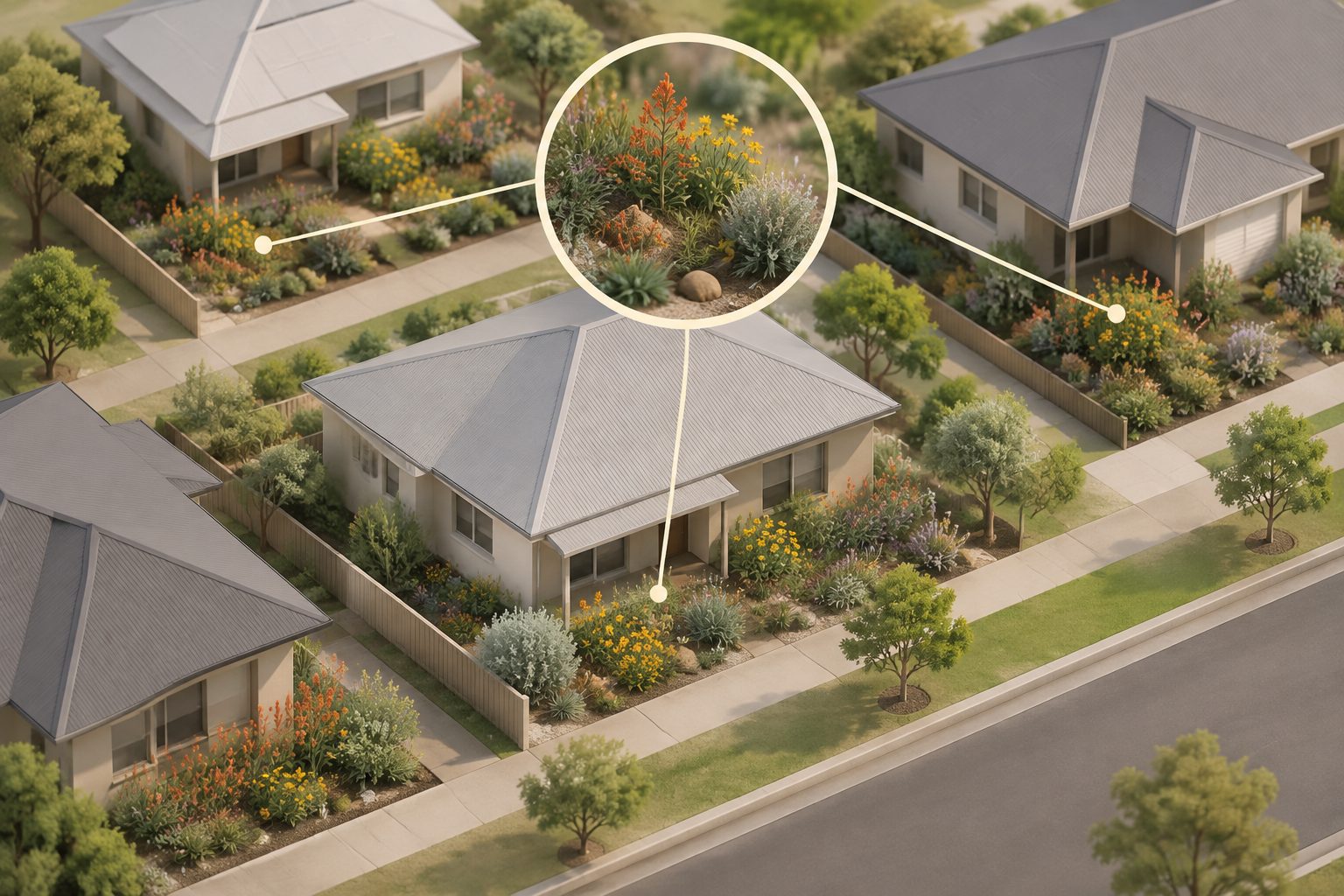
An audit of two Western Australian communities found neighborhood gardens were linked to later adoptions, while many gardeners did not use government support programs.
Researchers audited native gardens planted on residential verges in the Town of Claremont and the suburb of Daglish in Western Australia. They used the timing and location of adoptions to examine whether existing gardens were associated with later conversions nearby, and surveyed people who had adopted verge gardens about their motivations.
The analysis found that the presence of nearby gardens was associated with a higher probability of later adoption. Depending on the community and the level of nearby garden influence, the estimated probability increased by four to 44 times compared with areas without previous conversions. Aesthetics was the most commonly reported motivation, followed by benefits for wildlife and biodiversity, water saving and reduced mowing.
How gardens spread
The physical audit found native verge gardens on 11% of eligible verges in Claremont and 18% in Daglish. Hazard-model analysis showed that existing gardens were associated with later conversions of nearby, previously unconverted verges. Comparing no nearby conversions with the highest level of measured influence, the estimated annual probability of adoption increased fourfold in Daglish and 44-fold in Claremont.
The adopter survey also pointed to neighborhood norms as an important motivation. Aesthetics ranked as the main reason for planting, followed by wildlife and biodiversity, water saving and lower maintenance. In the audited areas, 87% of conversions in Claremont and 39% in Daglish occurred without participation in a government support program. Among survey respondents, 13% in Claremont and 61% in Daglish reported using such a program.
Why neighborhood gardens matter
The findings suggest that visible gardens may help shift neighborhood expectations and encourage additional verge conversions. For local governments with limited budgets, the researchers propose working with residents in strategically chosen locations to create demonstration gardens and promote the gardens' appearance and biodiversity value, rather than relying only on financial support.
This approach could help councils target efforts to increase native planting on verges, which the study describes as public land that can contribute to urban biodiversity and water-saving goals. The results do not establish that demonstration gardens will outperform subsidies, but they indicate that neighborhood influence may be useful alongside formal support programs.
Evidence and limits
The study combined a physical audit, a survey of verge-garden adopters and a hazard model that examined adoption over time and space. The model found an association between nearby existing gardens and later adoptions, consistent with neighborhood influence, but this observational design cannot by itself show that one garden caused a neighbor to plant one.
The evidence comes from two case-study areas in the Perth region, so adoption rates and estimated effects may not apply elsewhere. The survey covered people who had already adopted verge gardens and therefore does not directly represent residents who chose not to adopt. The study also did not compare demonstration gardens and financial subsidies in a controlled experiment.
// Source
Global Environmental Change · 2026 · DOI: 10.1016/j.gloenvcha.2026.103242
Authors: Claire Doll, Sharon Koitut, Michael P. Burton, Curtis L. Rollins
Institutions: The University of Western Australia