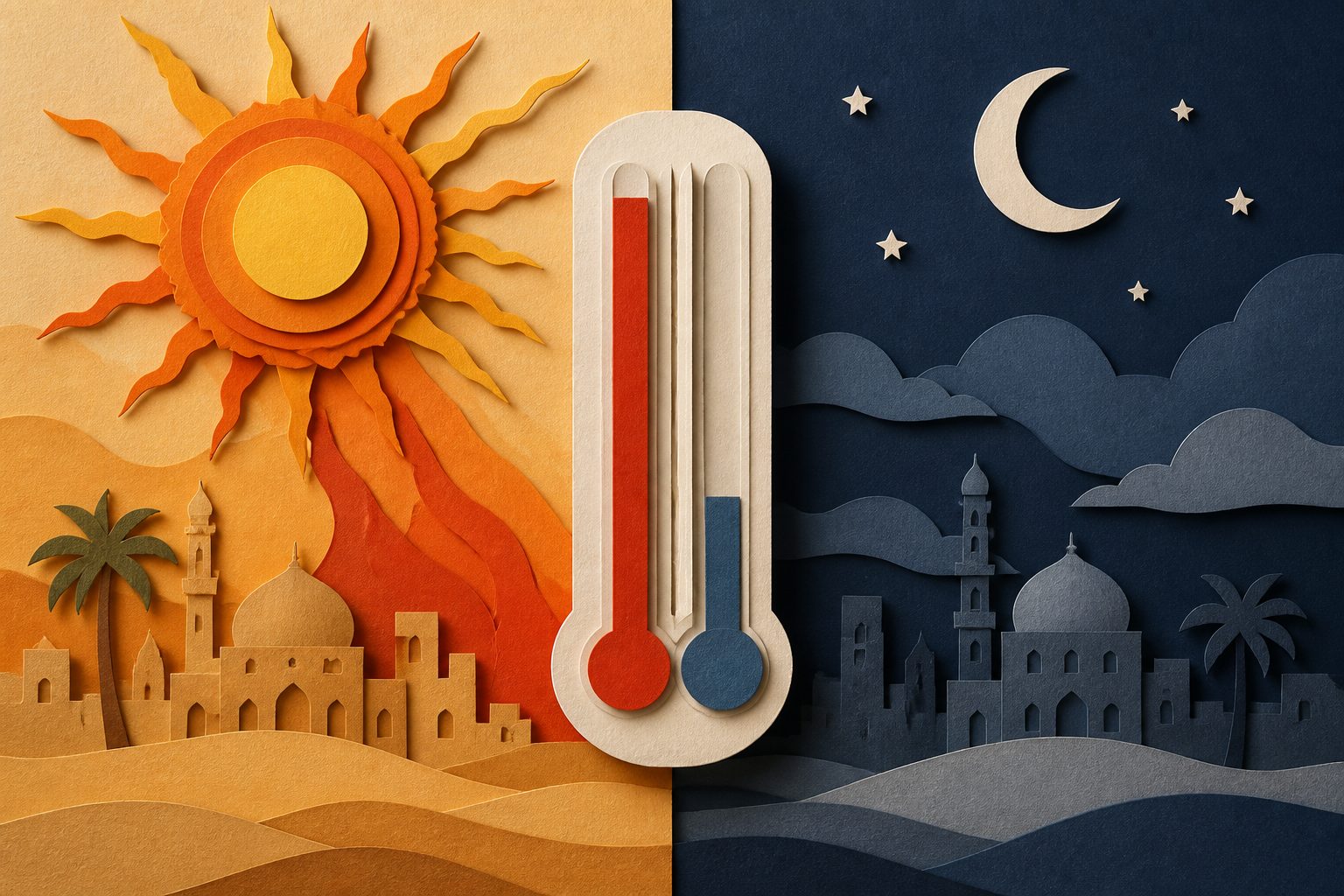
Climate projections show stronger daytime warming across the region, while some areas may see larger increases in nighttime extremes.
Researchers examined four measures of unusually high temperatures in projections for the Middle East, comparing daytime and nighttime changes with the 1985–2014 period. They used projections from six climate models, refined with an AI-based method, for three future periods under three greenhouse-gas emission scenarios.
By the late 21st century, the largest changes occurred in summer under the highest-emissions scenario, SSP5-8.5. The study found that heat extremes become more frequent and more intense, with patterns varying across the region rather than changing uniformly.
How day and night change
Both daytime and nighttime temperature extremes are projected to strengthen substantially. In the late-century period from 2075 to 2100 under SSP5-8.5, the regional average increase in the daytime warm-days measure was 73.93 percentage points, compared with 65.87 percentage points for the nighttime measure. The daytime extreme-temperature maximum increased by 11.22 °C, while the nighttime maximum increased by 7.06 °C, relative to 1985–2014.
The Arabian Peninsula consistently emerged as the main hotspot of amplification. Overall, projected changes were daytime-dominated at the regional scale, but specific subregions retained nighttime-dominated responses. In summer under SSP5-8.5, the frequency-based measures showed widespread exceedance of historical warm thresholds, while the intensity-based measures showed large increases in the magnitude of the hottest temperatures.
// Source
Scientific Reports · 2026 · DOI: 10.1038/s41598-026-68572-w
Authors: Younes Khosravi, Taha B. M. J. Ouarda
Institutions: Institut National de la Recherche Scientifique