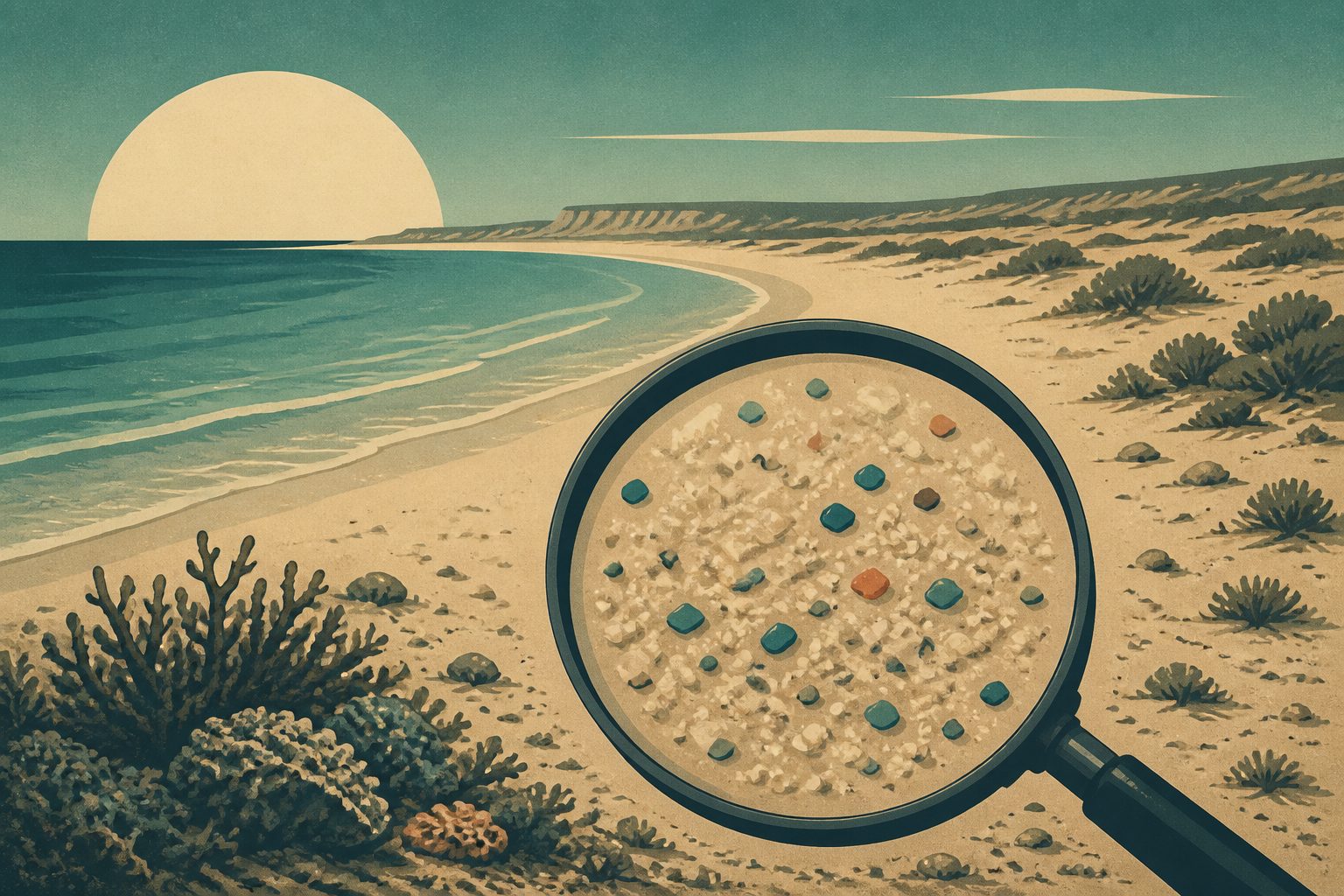
The particles were detected at all seven study sites, with manufactured fibres making up most of the microplastics found.
Researchers conducted the first quantitative assessment of microplastic contamination along the Ningaloo Coast, sampling seven remote and urbanised beaches. Microplastics were detected at every site and in 88% of samples, at concentrations ranging from zero to 8.5 particles per litre of sediment processed.
Manufactured fibres were the most common form, accounting for 72.4% of particles. Polyethylene terephthalate and polypropylene were the most common plastics. Concentrations varied between beaches and were higher on north-west-facing beaches, near boat ramps and in relation to the distance from townships.
What the beach samples showed
Microplastics were present at all seven beaches studied and in 88% of samples. Concentrations ranged from 0 to 8.5 microplastics per litre and were relatively low compared with many urbanised coastlines.
The amount of microplastic differed significantly between sites. Higher concentrations were associated with proximity to boat ramps, distance from townships and beach aspect, with north-west-facing beaches having higher concentrations. Manufactured fibres made up 72.4% of the particles. The main polymers were polyethylene terephthalate, at 38.2%, and polypropylene, at 20.2%.
The researchers found no relationship between the type or shape of microplastics and the site-specific factors they examined. They say the particles may come partly from local human activities, while natural processes may influence where they accumulate.
Why the findings matter
The findings show that protected and relatively remote coastlines can still receive microplastic pollution. The differences between beaches suggest that areas used by people, including access points near boat ramps, may warrant particular attention in future monitoring and management.
The study establishes a baseline for the Ningaloo Coast World Heritage Area. That baseline can help researchers track changes over time and assess targeted efforts to reduce inputs at high-use locations.
Evidence and limits
This was a field study based on sediment collected from seven beaches. Researchers separated suspected particles and examined them with microscopy and infrared spectroscopy, a method used to identify plastic polymers. The study provides a first quantitative baseline for the area rather than an experiment that tests the source of the pollution.
The results do not establish exactly where the microplastics came from. Although local human activities are identified as a possible source, natural processes also affect their distribution. The findings come from the sampled beaches and cannot by themselves describe contamination across the entire coast or show how levels may change over time.
// Source
Marine Pollution Bulletin · 2026 · DOI: 10.1016/j.marpolbul.2026.120326
Authors: Naomi Hill, Marina Santana, Renae Hovey, Cherie A. Motti, Catarina Serra-Gonçalves, Geoffrey D. Yau, Samantha Jaworski, Ronen Galaiduk
Institutions: The University of Western Australia, James Cook University, Australian Institute of Marine Science, AIMS@JCU