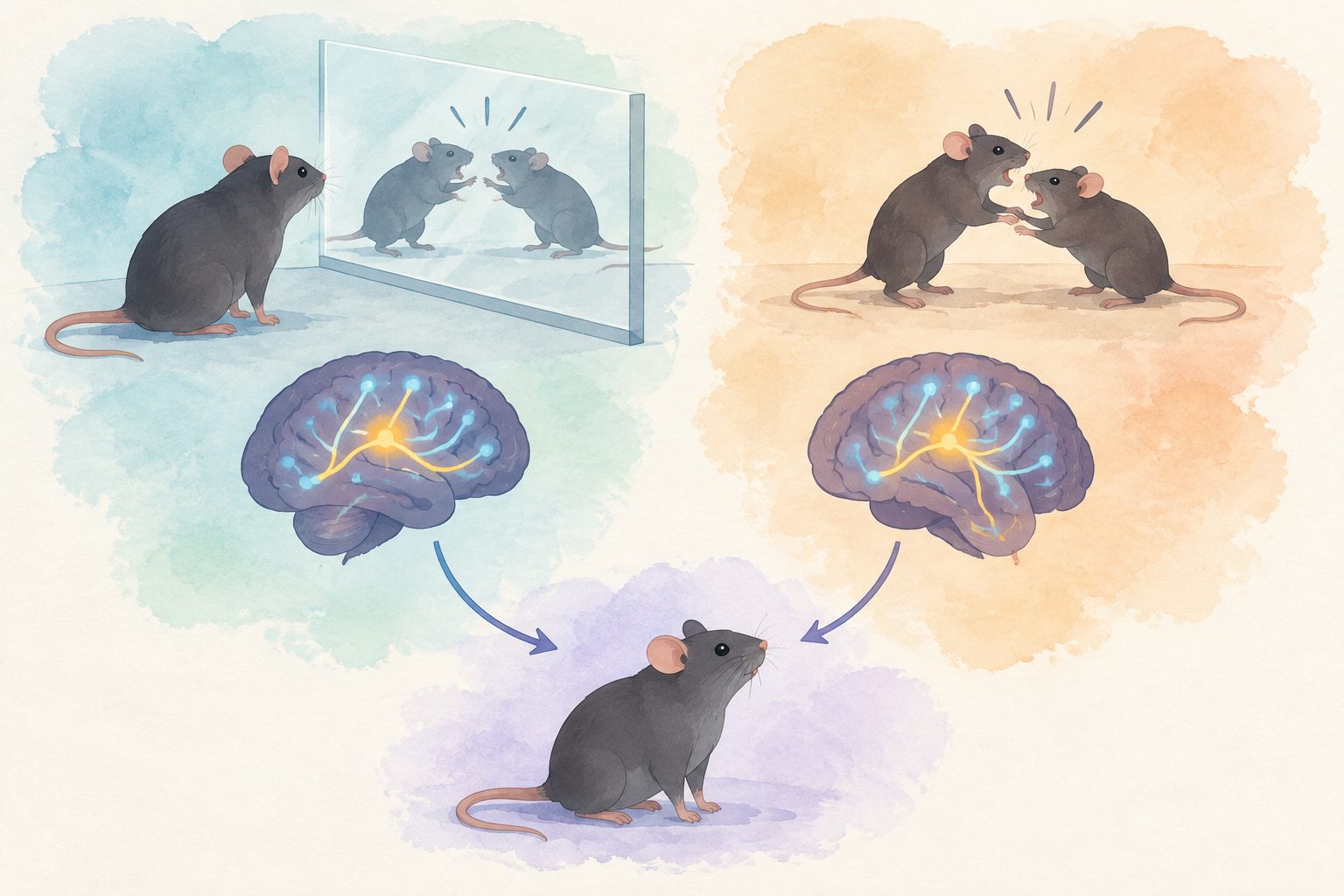
Watching other mice fight produced persistent changes in behavior and brain activity that appeared again in a new aggression test.
Researchers compared mice trained through direct aggression experience with mice that only watched aggressive encounters, along with mice that received no such training. They recorded activity across brain networks involved in social behavior and learning while the animals trained and later faced a novel aggression test.
Both direct experience and observation produced a shared behavioral strategy that was absent in untrained mice. Observation also produced widespread brain activity resembling direct experience, although signals linked to reward and threat learning differed between the groups.
What watching aggression changed
Mice that observed aggression showed a distinctive behavioral pattern that was also found in mice with direct aggression experience. The pattern was not present in mice without training and remained evident in a new, challenging aggression context.
During observation, many brain networks involved in generating behavior became active in ways that resembled direct experience. The two groups differed in activity related to reward and threat learning. After training, their neural activity became more similar in the new context, and network-level analysis identified lasting shared changes in a core aggression network, including reduced coordination between inhibitory signals and a key hypothalamic output region. The researchers report that this experience-like activity during observation can engage a shared form of brain plasticity and bias behavior toward defensive strategies in a new situation.
Evidence and caveats
The study used longitudinal recordings of cell types across subcortical brain networks in mice, comparing direct aggression experience, aggression observation and no training. The researchers combined brain recordings with behavioral analysis and tested the animals in a new aggression context.
The evidence comes from an animal study, so it does not establish that the same changes occur in people. The abstract does not report the number of animals, the duration of the lasting changes or how broadly the findings apply beyond the tested aggression behaviors and contexts. Network modeling identifies shared changes but does not, from the abstract alone, establish that every identified change is necessary for the behavior.