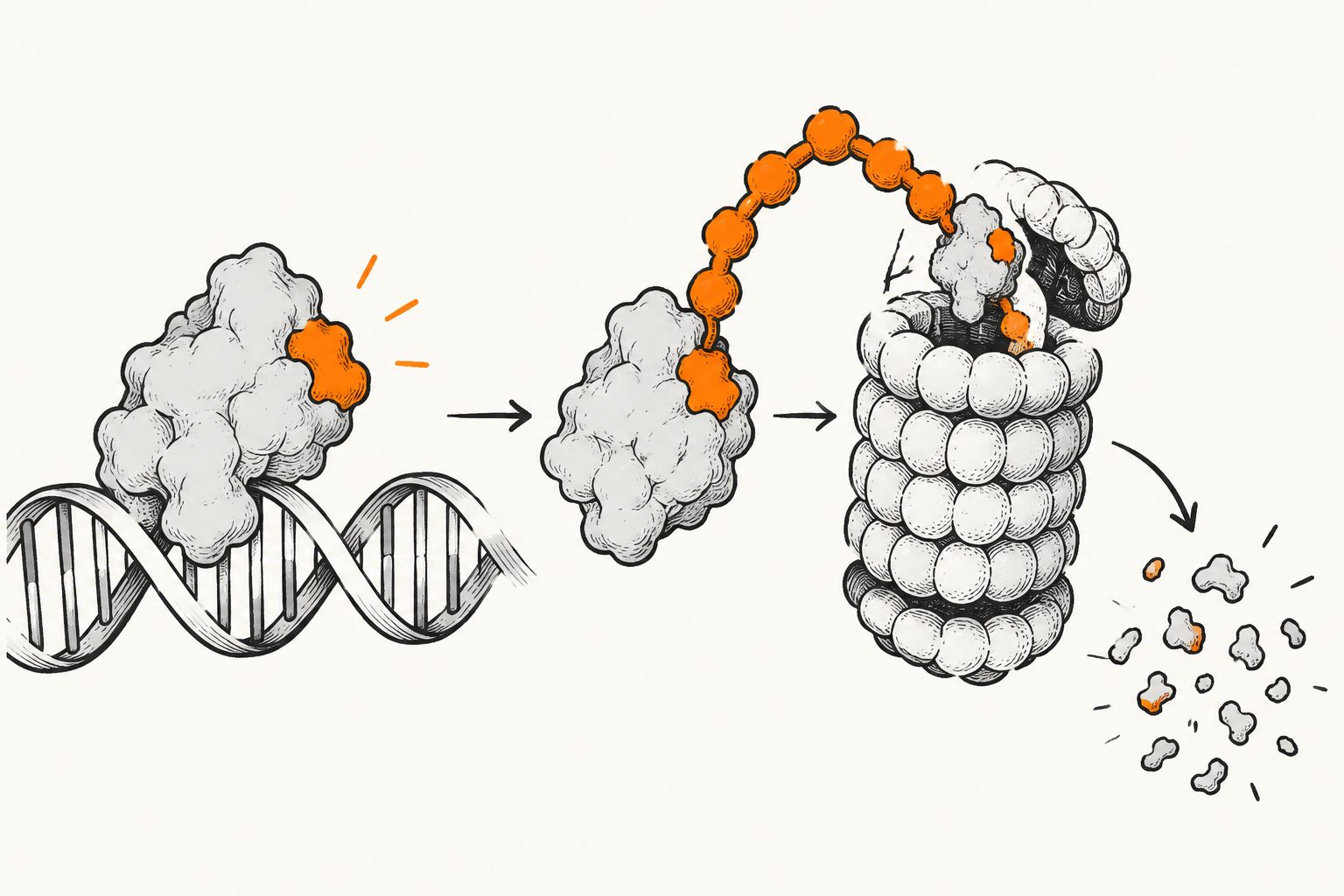
A survey of all 1,626 human transcription factors found thousands of protein-degradation signals, including ones revealed when zinc-finger regions unfold.
The study tested 62,992 short segments, or tiles, from human transcription factors in human cells. By measuring how much of each fluorescent protein fragment remained—and how that changed when the proteasome or ubiquitin pathway was blocked—the researchers identified degradation signals, known as degrons, and examined how their activity varied between cellular compartments.
Most active signals were associated with hydrophobic sequences, often in structured parts of transcription factors, where they may act as quality-control signals after a protein unfolds. Signals in exposed or intrinsically disordered regions also affected the abundance of full-length transcription factors. In one example, the melanoma-linked H323Y mutation in ZNF140 was associated with unfolding of a zinc-finger region and exposure of a buried degradation signal.
What the survey found
The researchers mapped degrons across all 1,626 human transcription factors and identified thousands of known and previously unidentified signals. Signals in exposed or intrinsically disordered regions regulated the cellular abundance of transcription factors, while many other signals were found in structured regions and appeared to become active when those regions were destabilized.
The most common somatic mutations linked to skin cutaneous melanoma were reported to cause unfolding and exposure of a buried degron in zinc fingers. The study specifically describes the H323Y mutation in ZNF140 as exposing a hydrophobic region that can trigger proteasomal degradation. The researchers also found examples of signals that act differently in the nucleus and cytosol, although most signals appeared to work in both compartments. More than 60% of predicted transcriptional activation domains overlapped with strong degrons; acidic residues in the remaining activating regions reduced degron activity.
Evidence and limits
The researchers used a large library of 30-residue fragments from 1,626 transcription factors, fused to a fluorescent reporter and tested in HEK293T cells. They sorted cells according to reporter abundance and used inhibitors of the proteasome, ubiquitin activation and related pathways to assess whether low abundance reflected protein degradation. They also examined selected signals in full-length transcription factors and analyzed nuclear and cytosolic activity.
This was primarily a high-throughput fragment-based cellular study, so the activity of every signal was not tested in its complete native protein or across many cell types. Only a limited number of fragments were tested in both the nucleus and cytosol, making compartment-specific differences difficult to identify comprehensively. The authors also note that some signals may be processed through degradation routes that do not depend on ubiquitin, although the tested library was mainly stabilized by blocking ubiquitin activation. The melanoma-related mechanistic example is specifically established for ZNF140 H323Y; broader effects of other mutations remain less directly defined in the provided evidence.