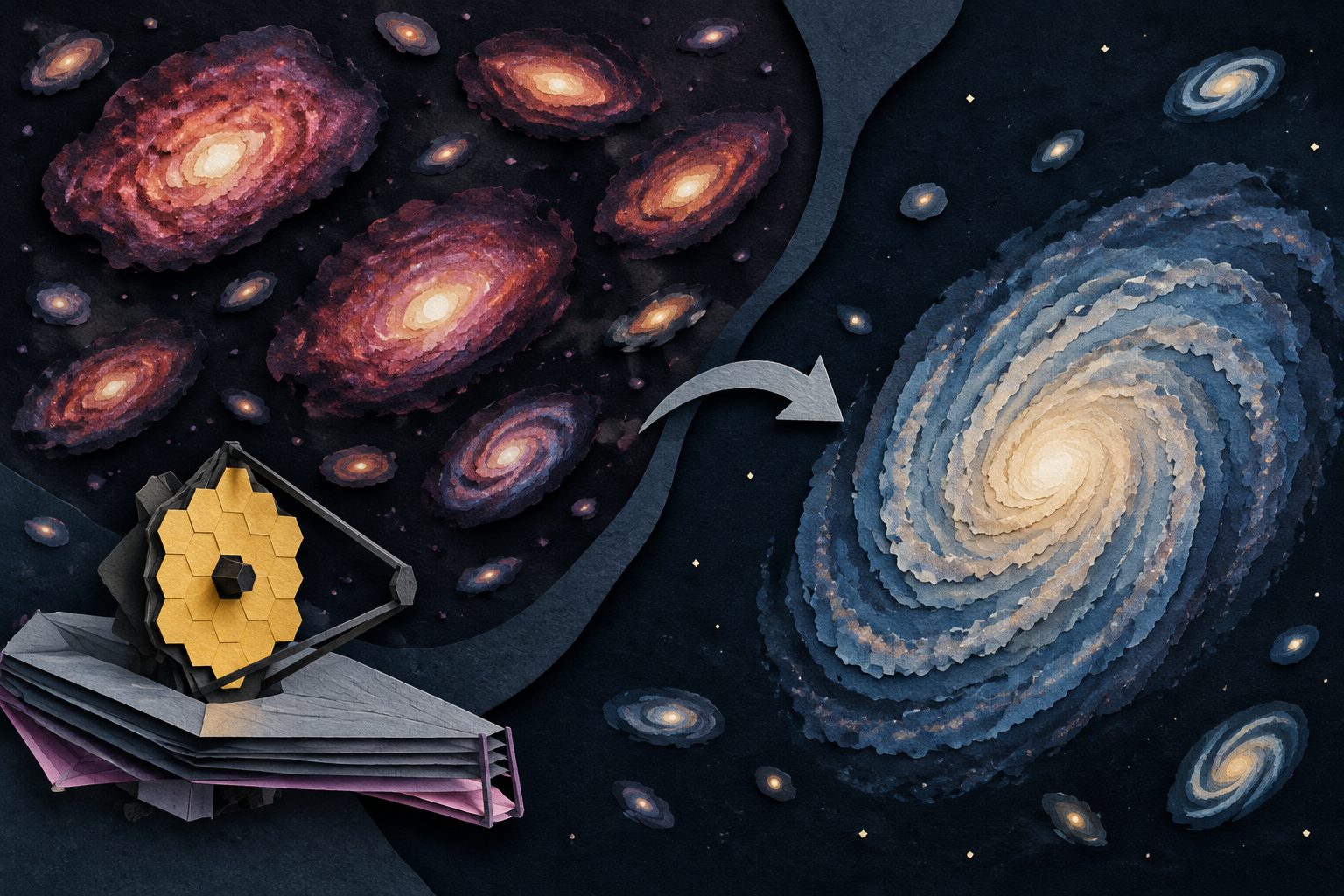
A simulation suggests that the galaxies selected as especially massive in the early universe are usually not direct ancestors of the most massive galaxies today.
Researchers applied five published James Webb Space Telescope near-infrared color selections to simulated galaxies with synthetic, dust-affected observations. One selection was more inclusive and reliable than the others, but it identified only 1 of 18 simulated galaxies at redshift about 5 with at least 100 billion solar masses in stars. The other 17 were, on average, about 0.5 magnitudes bluer than the selection allowed under the simulation’s dust model.
The researchers also traced selected galaxies forward in time. Of 186 galaxies selected at redshift 5, 79 remained intact until the present day, and only eight grew beyond 1 trillion solar masses. The galaxies that did become among the most massive today generally gained much of their mass through mergers at relatively late times, at redshifts below about 0.2.
Which galaxies the colors find
The study found that published James Webb Space Telescope near-infrared color cuts generally do not recover the most massive simulated galaxies at redshift 5. The researchers developed a magnitude-dependent color selection using three near-infrared filters that produced a more complete sample in TNG300 while excluding dusty, lower-mass galaxies selected by some published criteria.
The selected high-redshift galaxies usually had lower star-formation rates and lived in less massive dark-matter halos than the earlier ancestors of galaxies exceeding 1 trillion solar masses at the present day. Across descendants of selected galaxies at redshifts 7, 4 and 2, the most massive early galaxies rarely became the most massive galaxies by redshift 0. Substantial late-time merger-driven growth was generally associated with those that did.
Simulation evidence and caveats
This is a simulation-based study, not a direct census of observed galaxies. The researchers used the TNG300 cosmological simulation, synthetic dust-attenuated near-infrared photometry and merger trees to test five observational selection methods and follow selected galaxies over time. The conclusions therefore depend on how the simulation and its dust model represent real galaxies. In particular, comparisons with observed ultraviolet colors suggest that dust attenuation in the simulated massive galaxies may be underestimated, so the reported recovery of the most massive galaxies should be regarded as a lower limit. The improved color selection was tested in TNG300 and has not, in the information provided, been established as a complete selection for the real universe.