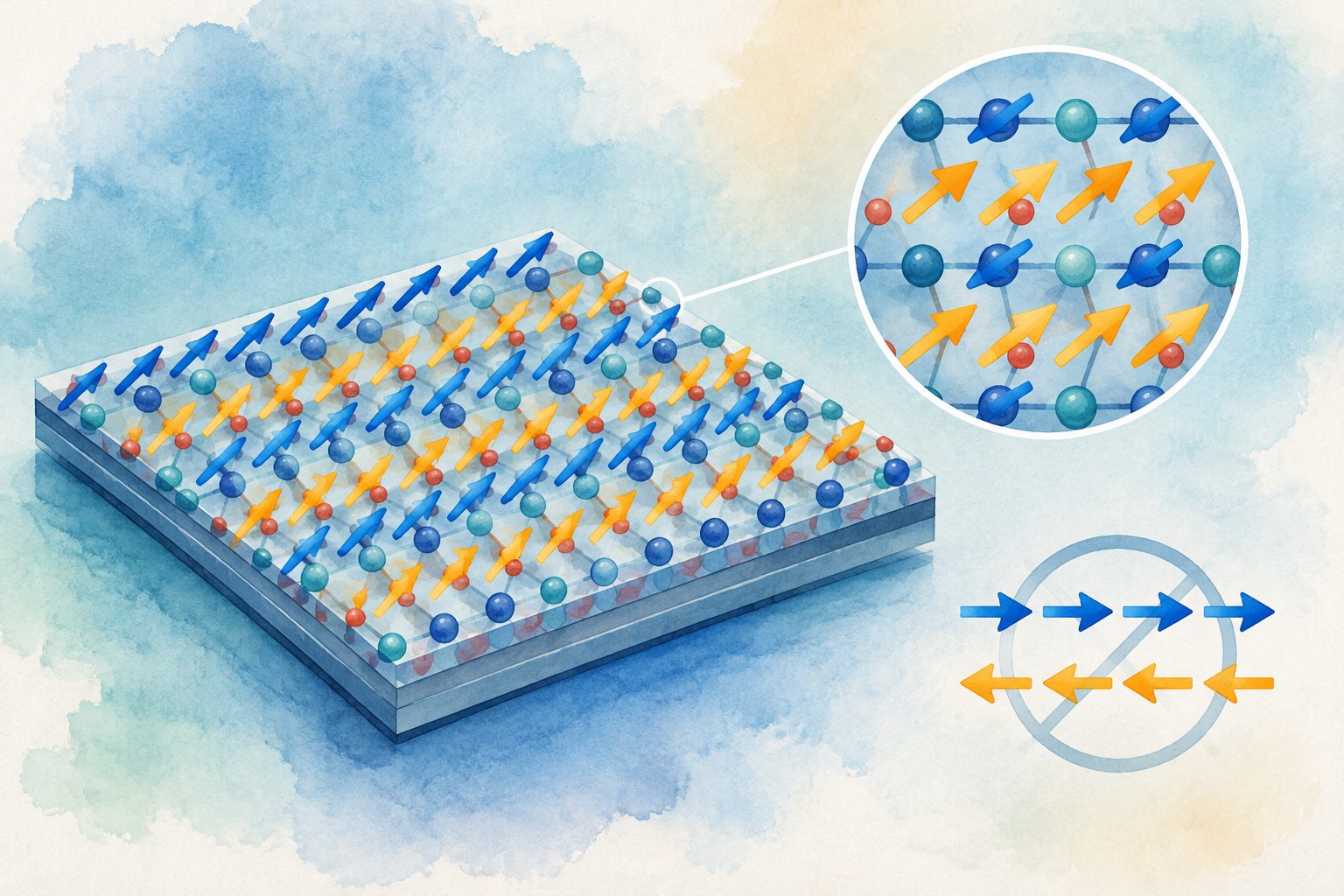
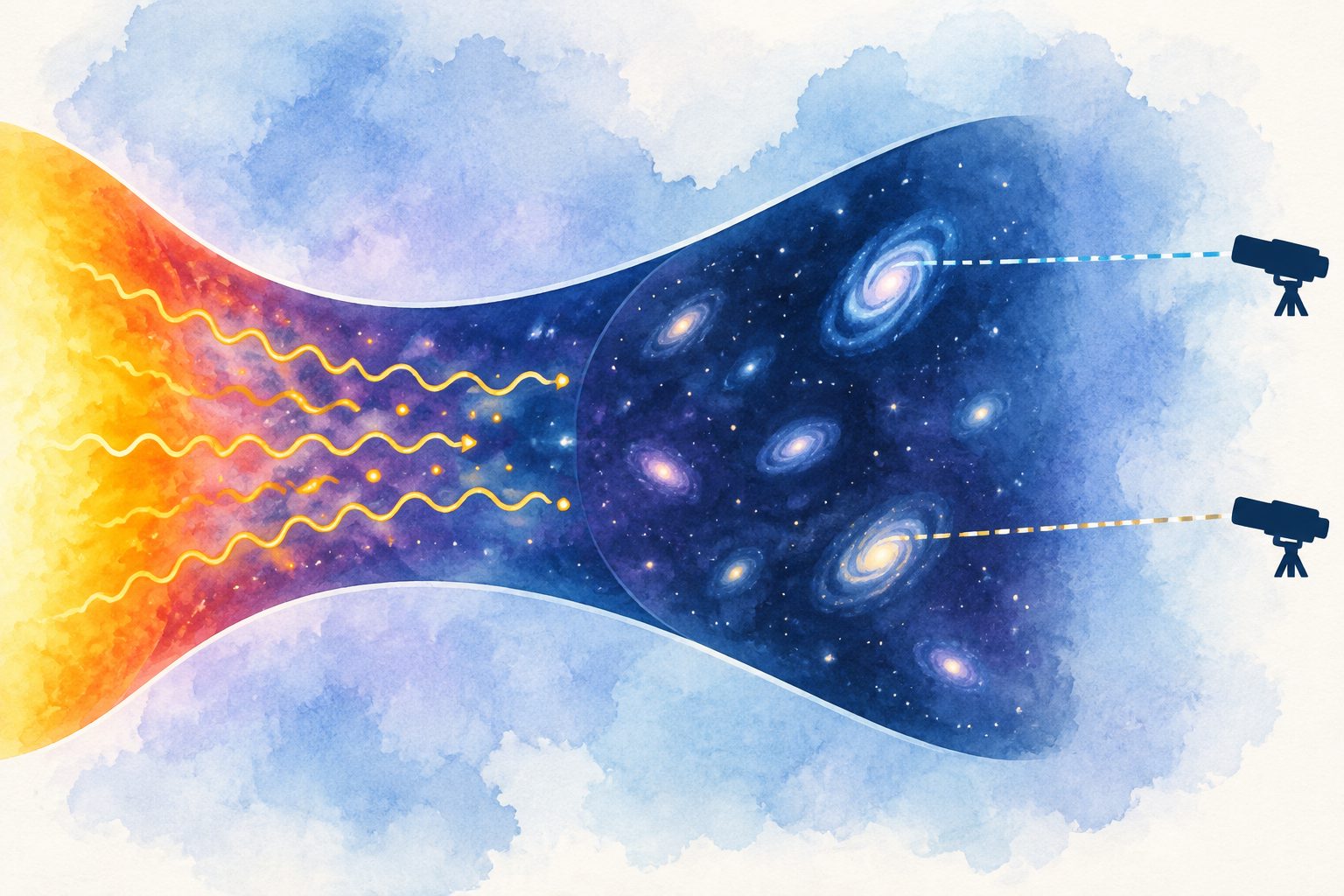
An exact mathematical model shows how a system that begins farther from equilibrium can overtake one that starts closer.
The study examines an overdamped particle moving in a two-dimensional, radially symmetric potential with two stable locations. The researchers chose a piecewise mathematical form for the potential that allowed them to solve the relaxation problem exactly, calculating the system’s relaxation modes and how strongly each mode contributes after a temperature change.
They found that the contribution of the slowest relaxation mode can vary non-monotonically with the initial temperature. When the outer minimum of the potential is lower than the inner minimum, this difference can produce a crossing in the Kullback–Leibler divergence, a measure of how far a probability distribution is from equilibrium: the initially hotter system can then become closer to equilibrium sooner.
How the faster relaxation appears
The model describes a particle in a two-dimensional bistable potential, with one minimum at the origin and another farther away. For isotropic systems initially at equilibrium, the researchers calculated the relaxation spectrum and eigenmodes exactly by mapping the governing Fokker–Planck equation to a Schrödinger-type problem.
Their analysis showed that the amplitude of the slowest mode depends non-monotonically on the initial temperature. A non-monotonic amplitude is necessary but not sufficient for the Mpemba effect, as defined here by a crossing of the Kullback–Leibler divergence. The crossing also requires a sufficiently large contrast between the slowest modes. For parameter choices in which the outer minimum is lower than the inner one, the model exhibits the effect. When the two minima have equal height, the study reports that neither the Mpemba effect nor its inverse occurs; when the outer minimum is higher, the effect does not occur.
// Source
Physical review. E · 2026 · DOI: 10.1103/xp77-16vt
Authors: Hisao Hayakawa, Satoshi Takada