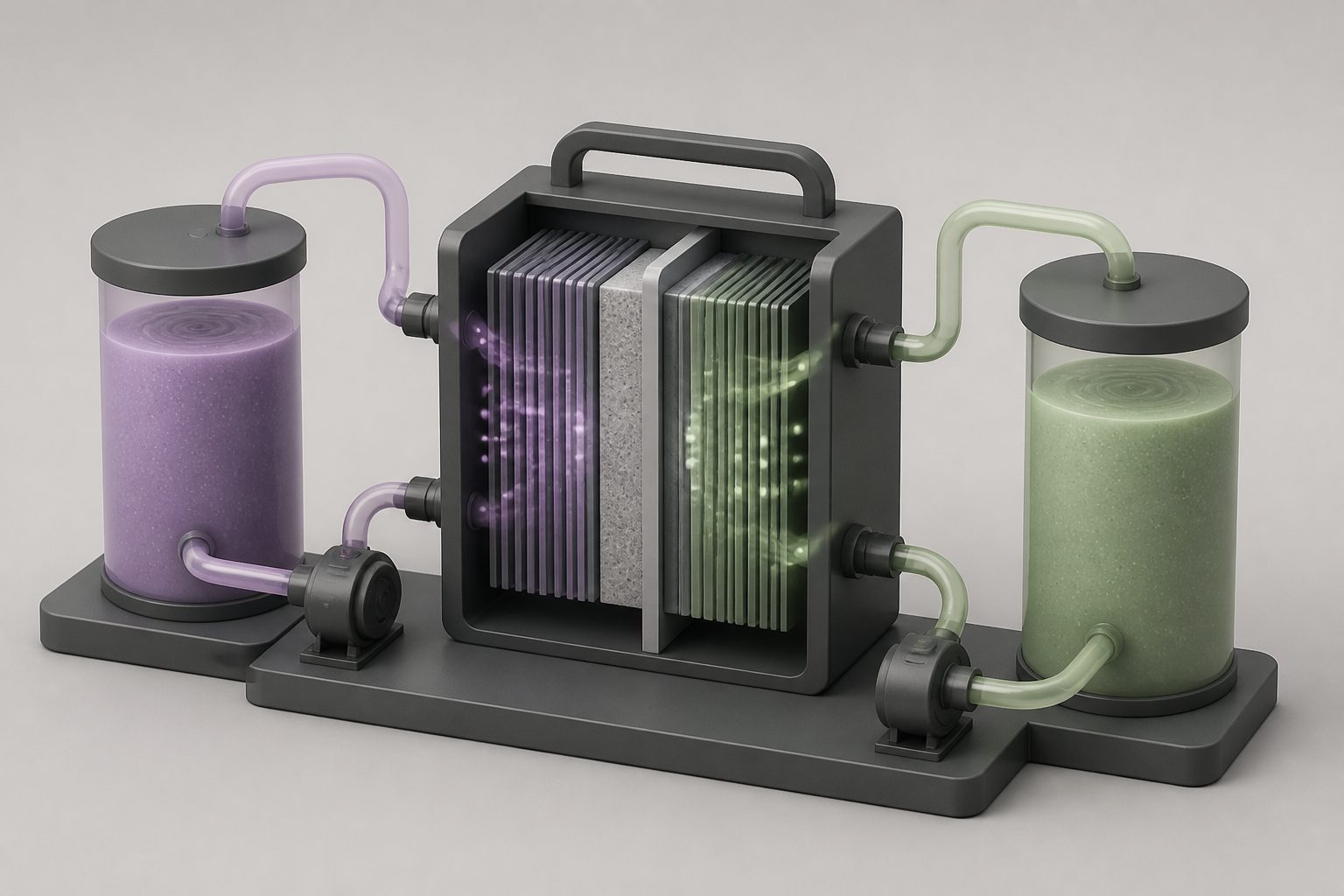
A manganese dioxide slurry raised the electrolyte’s capacity and enabled stable operation at 30 milliamps per square centimetre.
The researchers added a high concentration of manganese dioxide to a conventional manganese electrolyte. This approach increased the concentration of soluble manganese species to 3.76 moles per litre and avoided the sulfate-related solubility limit that normally restricts manganese sulfate electrolytes.
During the second charging cycle, a chemical reaction involving the newly formed manganese dioxide changed the battery’s main redox reaction from solid manganese dioxide and dissolved manganese ions to dissolved manganese ions in two oxidation states. The shift increased the discharge voltage and allowed stable operation at 30 milliamps per square centimetre.
What the manganese slurry does
The manganese dioxide semi-solid slurry electrolyte reached a specific capacity of 156.2 ampere-hours per litre of catholyte. That is a 409% increase compared with reported manganese sulfate-based electrolytes. The electrolyte contained 3.76 moles per litre of soluble manganese species, compared with the solubility limit of 1 mole per litre or less for manganese sulfate in conventional sulfuric acid electrolytes.
The researchers report that reverse disproportionation of manganese dioxide produced during the second charging cycle changed the redox mechanism from the manganese dioxide solid/manganese ion pair to a solution-phase manganese ion/manganese ion pair. This raised the discharge voltage and enabled stable operation at 30 milliamps per square centimetre, 30 times the current density reported for manganese-based semi-solid flow batteries.
Why the design matters
Flow batteries store energy in liquid electrolytes and are being studied for large-scale energy storage. Increasing the amount of electrochemically active manganese in the electrolyte can raise the energy stored in a given electrolyte volume, while higher operating current densities can support more compact power systems.
The results provide a design strategy for manganese-based semi-solid slurry electrolytes that addresses both limited manganese solubility and slow reaction rates. The abstract presents this as a step toward improving the use of these batteries for grid-scale renewable energy storage, but it does not establish performance in a full-scale system.
Evidence and limits
This is an experimental research article reporting electrolyte composition, specific capacity, a change in reaction mechanism and operation at a stated current density. The 409% comparison is against reported manganese sulfate-based electrolytes, and the 30-fold comparison is against reported manganese-based semi-solid flow batteries; neither figure necessarily represents a percentage increase in the complete battery’s stored energy or overall performance.
The abstract does not report the duration of stable operation, cycle life, full-cell energy efficiency, system size or performance outside the tested conditions. It also does not provide enough information to assess how the design would perform at grid scale.