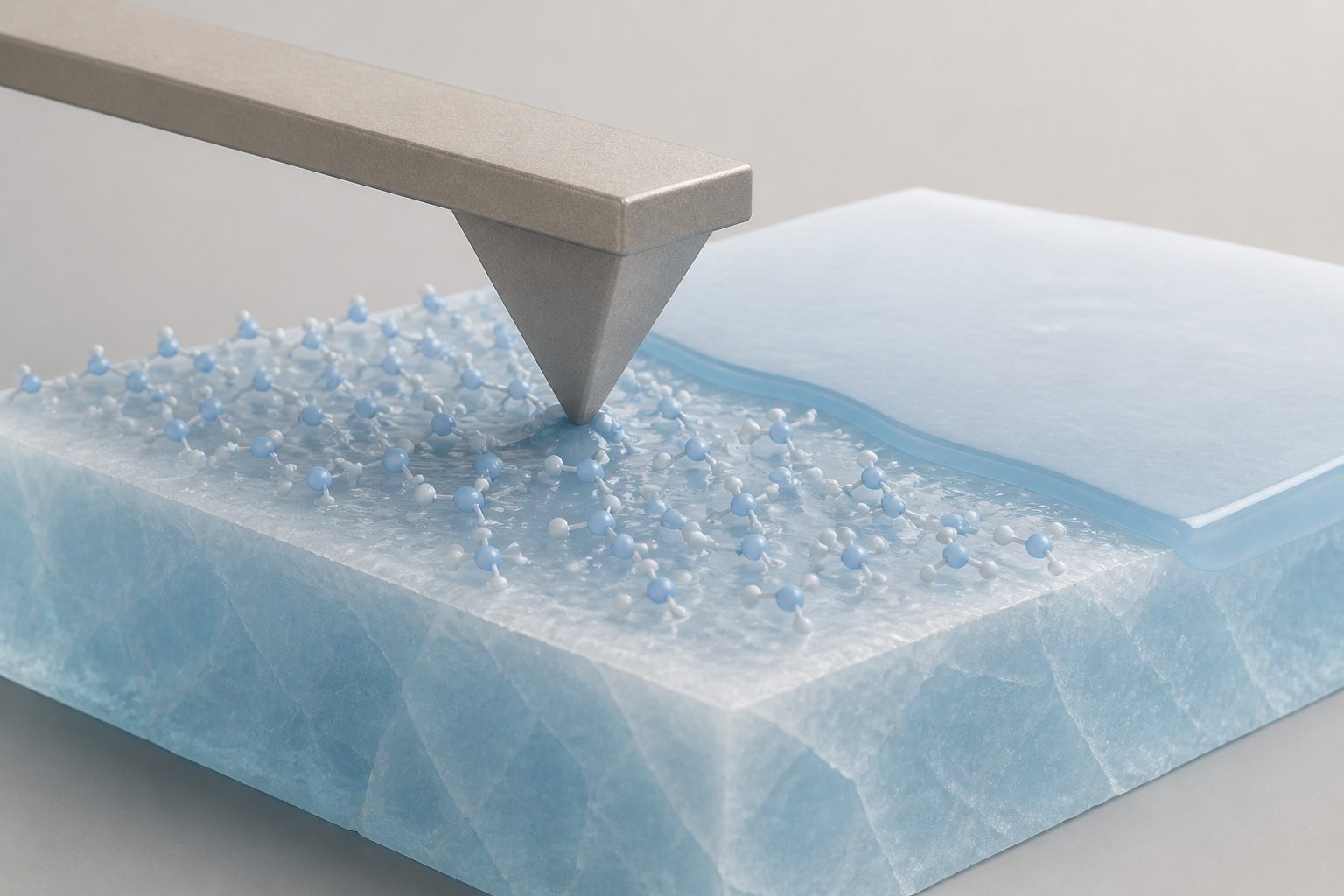
Spectroscopy and simulations link ice’s low friction to disordered water molecules at the surface and identify diamond-like carbon coatings that reduce it further.
Researchers used rheometry, Raman spectroscopy, X-ray photoelectron spectroscopy and sum frequency generation spectroscopy to examine how ice friction changes with sliding speed, contact pressure and temperature. They also used molecular dynamics simulations to visualize how water molecules behave at the interface.
The results associate low friction with loosely structured water molecules whose hydrogen-bond network is disordered. The researchers found that three diamond-like carbon coatings—hydrogenated carbon, silicon-doped carbon and tungsten-carbide-doped carbon—reduced friction on ice compared with bearing steel, with reductions of 21.5%, 38.7% and 58.6%, respectively.
How water lowers ice friction
The study identifies loosely structured interfacial water molecules as an important contributor to ice’s low friction. These molecules have a liquid-like arrangement and a disordered hydrogen-bond network, which the researchers say promotes low shear between surfaces. Molecular dynamics simulations directly visualized this contribution.
The researchers also found that three diamond-like carbon coatings produced ultralow friction on ice compared with SUJ2 bearing steel. A hydrogenated carbon coating reduced the friction coefficient by 21.5%, a silicon-doped coating by 38.7% and a tungsten-carbide-doped coating by 58.6%. The authors also describe graphitization—the formation of graphite-like carbon—as part of the conventional low-friction mechanism for these coatings.
Evidence and limits
The evidence combines laboratory friction measurements with rheometry, Raman spectroscopy, X-ray photoelectron spectroscopy and sum frequency generation spectroscopy, as well as molecular dynamics simulations. Together, these methods support the proposed link between interfacial water structure and low friction.
The abstract does not report sample sizes, the exact ranges of sliding speeds, pressures or temperatures, or the detailed test conditions. It also does not provide field tests on sports equipment or icebreakers, so the reported reductions should not be assumed to apply directly to all real-world uses.
// Source
Friction · 2026 · DOI: 10.26599/frict.2026.9441304
Authors: Yuan Liu, Chang Dong, Linyuan Guo, Xinchun Chen, Liran Ma
Institutions: Tsinghua University