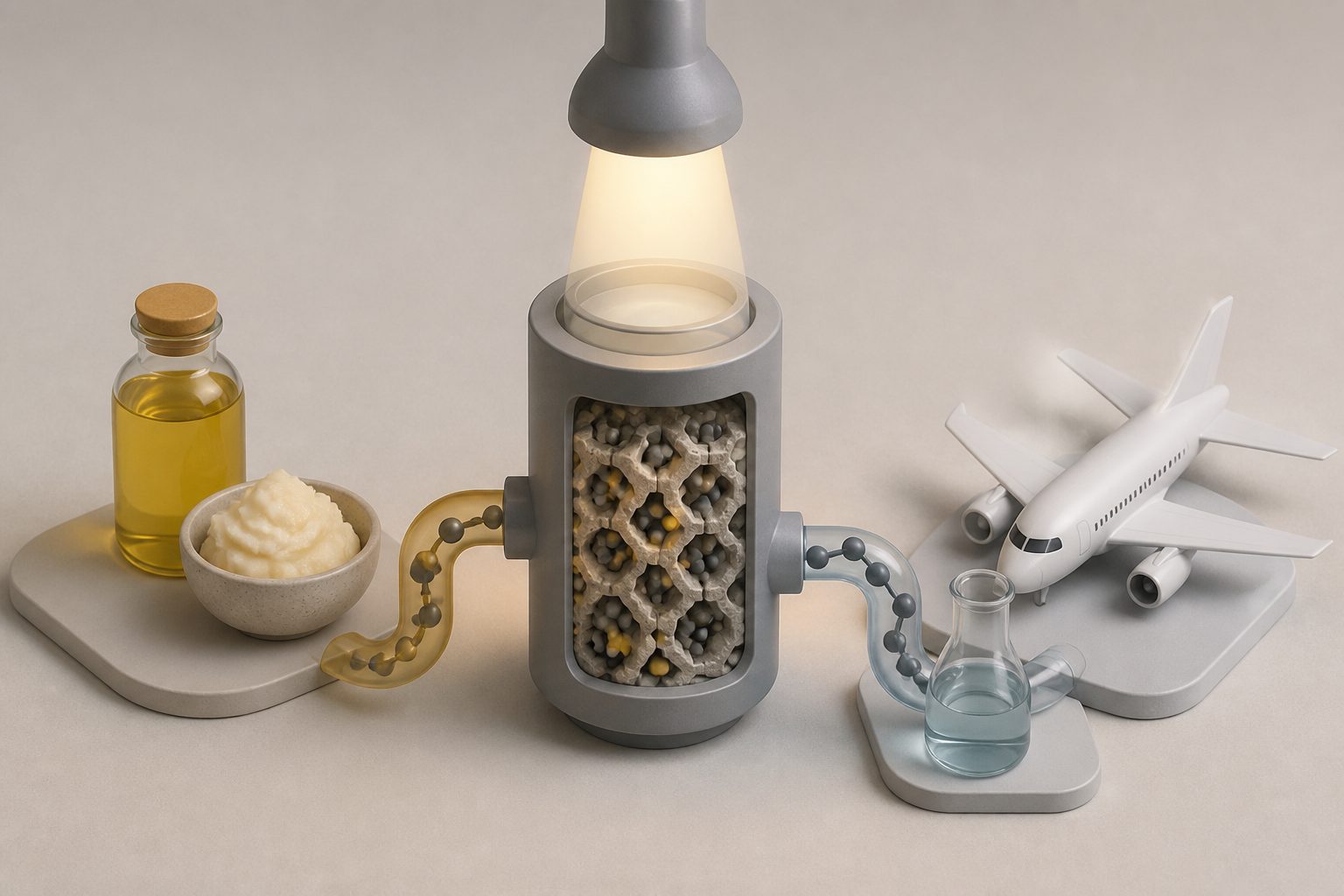
A metal-free process used visible light to convert fatty-acid compounds into hydrocarbons in the range used for sustainable aviation fuels.
The process starts with compounds made from C10–C18 fatty acids. Under visible light, a hydrogen-donating compound both activates the reaction and helps remove carbon dioxide from the fatty-acid-derived molecules, avoiding metal catalysts and added hydrogen gas.
Saturated starting materials reached conversions above 99% and produced straight-chain hydrocarbons with yields of up to 83%. A one-pot version, applied directly to several real lipid-based biomasses, produced overall yields between 31% and 79%.
What the light process produced
The researchers used an in situ electron donor–acceptor complex to drive photodecarboxylation—the light-assisted removal of carbon dioxide from fatty-acid-derived compounds. The reaction used visible light, isopropyl alcohol as the solvent, ambient temperature and atmospheric pressure, and did not require a metal catalyst or molecular hydrogen.
For saturated substrates, conversions exceeded 99%, with the resulting straight-chain hydrocarbons produced in yields of up to 83%. Changing the fatty-acid chain length affected efficiency: C9–C17 hydrocarbons were obtained in yields ranging from 52% to 83%. Unsaturated C18 starting materials produced the corresponding olefins in moderate yields of up to 48%.
The researchers also tested a one-pot process with a range of real lipid-based biomasses. It maintained conversions above 90% and gave overall yields of 31% to 79%. The reaction could be driven with solar irradiation.
Why the process matters
Sustainable aviation fuel production needs ways to convert renewable oils and fats into hydrocarbons that can fit existing fuel systems. This work describes a route that avoids metal catalysts and molecular hydrogen and operates under relatively mild conditions, while showing that the process can be applied to real lipid-based materials rather than only purified laboratory substrates.
The findings support further evaluation of light-driven, potentially solar-powered routes for producing aviation-fuel-range hydrocarbons. The reported yields varied with the starting material, and the abstract does not establish how the products perform in aircraft fuel blends or how the process compares with industrial production in cost, energy use or emissions.
Evidence and caveats
This is a journal research article reporting laboratory experiments on fatty-acid-derived compounds and several real lipid-based biomasses. The results include reaction conversions and product yields under the stated conditions. The abstract does not report the scale of the reactions, long-term operation, fuel-performance tests, life-cycle emissions, economic analysis or comparisons with established sustainable aviation fuel processes. Unsaturated substrates also gave lower yields than the saturated examples, reaching up to 48%.
// Source
Biomass and Bioenergy · 2026 · DOI: 10.1016/j.biombioe.2026.110041
Authors: Elon F. Silva, Gabriel P. de Aguiar, Pedro H. do N. Silva, Thays L. Lemos, Jhulia G. L. Pereira, Monique E. S. de A. Furtado, Jhonatan F. Câmara, Amanda Duarte Gondim, Carlos A. Martínez-Huitle, Elisama V. dos Santos, Aruzza Mabel de Morais Araújo, Aécia Seleide Dantas dos Anjos, Lívia N. Cavalcanti
Institutions: Universidade Federal do Rio Grande do Norte