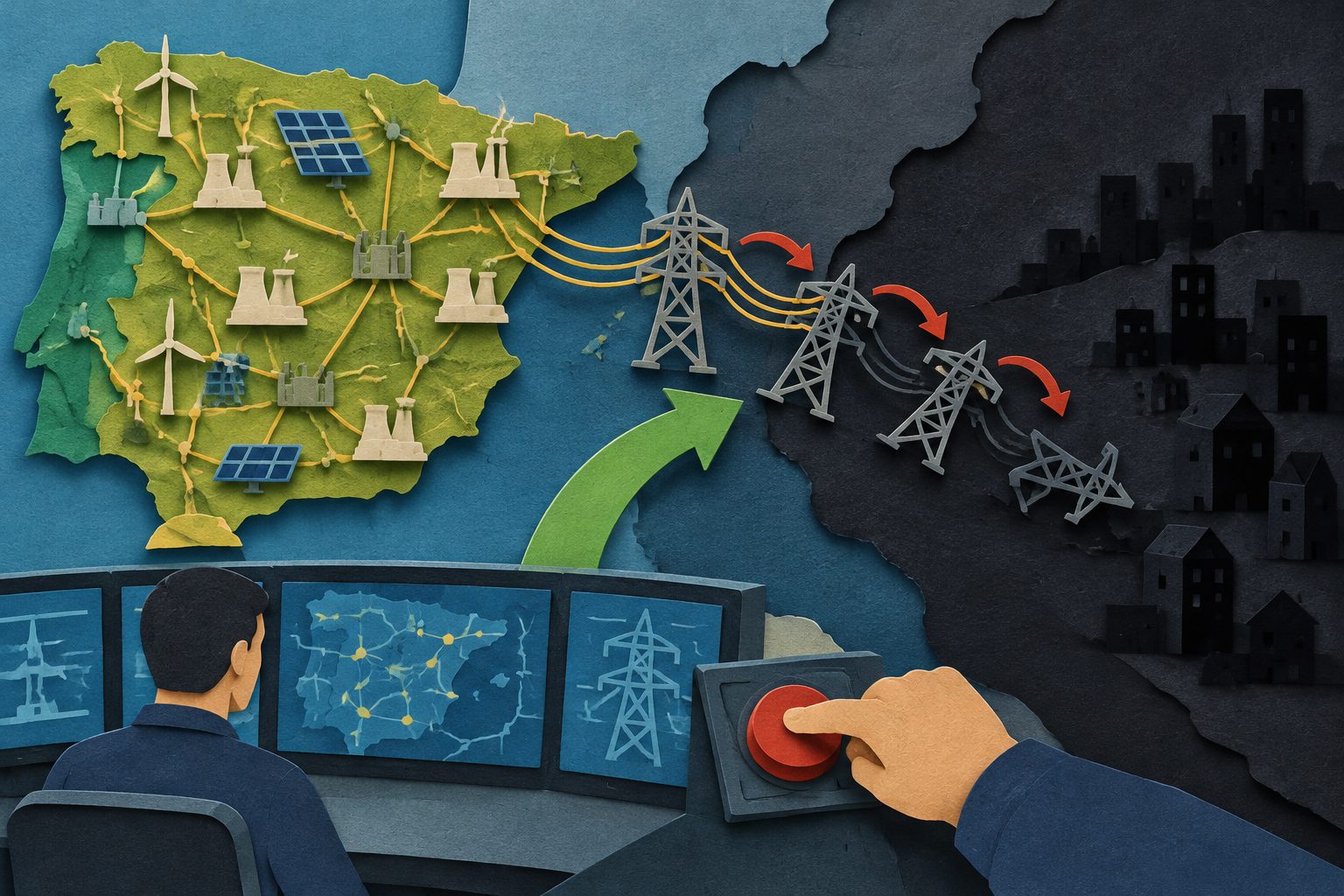
A protection-aware power-grid model reproduced the blackout’s feedback and identified rapid reactive-power changes that could keep voltages below trip settings.
The researchers modeled the grid, its voltage controls, generators, inverters, protection systems and other equipment as a changing system rather than checking voltage only at a single steady state. For each possible trip, ramp, switching action or other disturbance, the method calculated the voltages seen by overvoltage relays during the short period before controls could respond.
In a 2,000-bus model designed to reproduce the mechanism of the 2025 Iberian blackout, the simulation showed the feedback described in the incident report: protected voltages approached trip levels, an initial trip removed reactive absorption, and later trips spread the overvoltage sequence. The method also identified missing data that prevented a firm safety conclusion.
What the model found
The protection-aware screening method predicted which candidate events could lead to a secondary trip during the relay time window. Across the reported validation cases, it flagged every event that caused a secondary trip within that window and did not label as safe any plant that tripped during the same period.
In benchmark systems, the method found fast reactive-power actions that kept relay-measured voltages below their settings and prevented the trips within the relay window whenever it judged such actions feasible. The study also ranked proposed operator actions by their effect on protected voltage margins and separated cases into safe, risky, conservative and data-limited categories. The results were checked against nonlinear time-domain simulations.
Why fast control matters
The work focuses attention on the voltage measured where protection equipment actually operates, including inside plants or other downstream locations that may not match transmission-level measurements. That could help operators identify situations in which a grid appears acceptable under conventional checks but is vulnerable to a rapid protection-driven cascade.
The proposed response is fast reactive-power control: changing reactive power, which helps manage voltage, quickly enough to keep relay measurements below their trip settings. The study does not show that the method would prevent every blackout, but it provides a way to screen candidate events and test possible actions before running more computationally intensive simulations.
Evidence and caveats
This is a modeling and simulation study, tested on several benchmark systems and a 2,000-bus model that reproduces the reported mechanism of the Iberian blackout. Its results were validated with nonlinear time-domain simulations, and the implementation and replication materials are publicly available.
The method can miss events that are not included in its finite library of candidate trips, ramps, switching actions or other disturbances. It treats equipment and control modes as fixed during each short assessment window, so longer time periods require repeated updates. Its additive screening approach is deliberately conservative to avoid unsafe false negatives and can therefore produce false positives. Finally, missing relay thresholds, measurement locations, controller modes, tap positions or reactive-absorption data can widen uncertainty and turn a case into a data-limited result rather than a certified safe one.
// Source
Applied Energy · 2026 · DOI: 10.1016/j.apenergy.2026.129216
Authors: Abdallah Alalem Albustami, Ahmad Taha
Institutions: Vanderbilt University