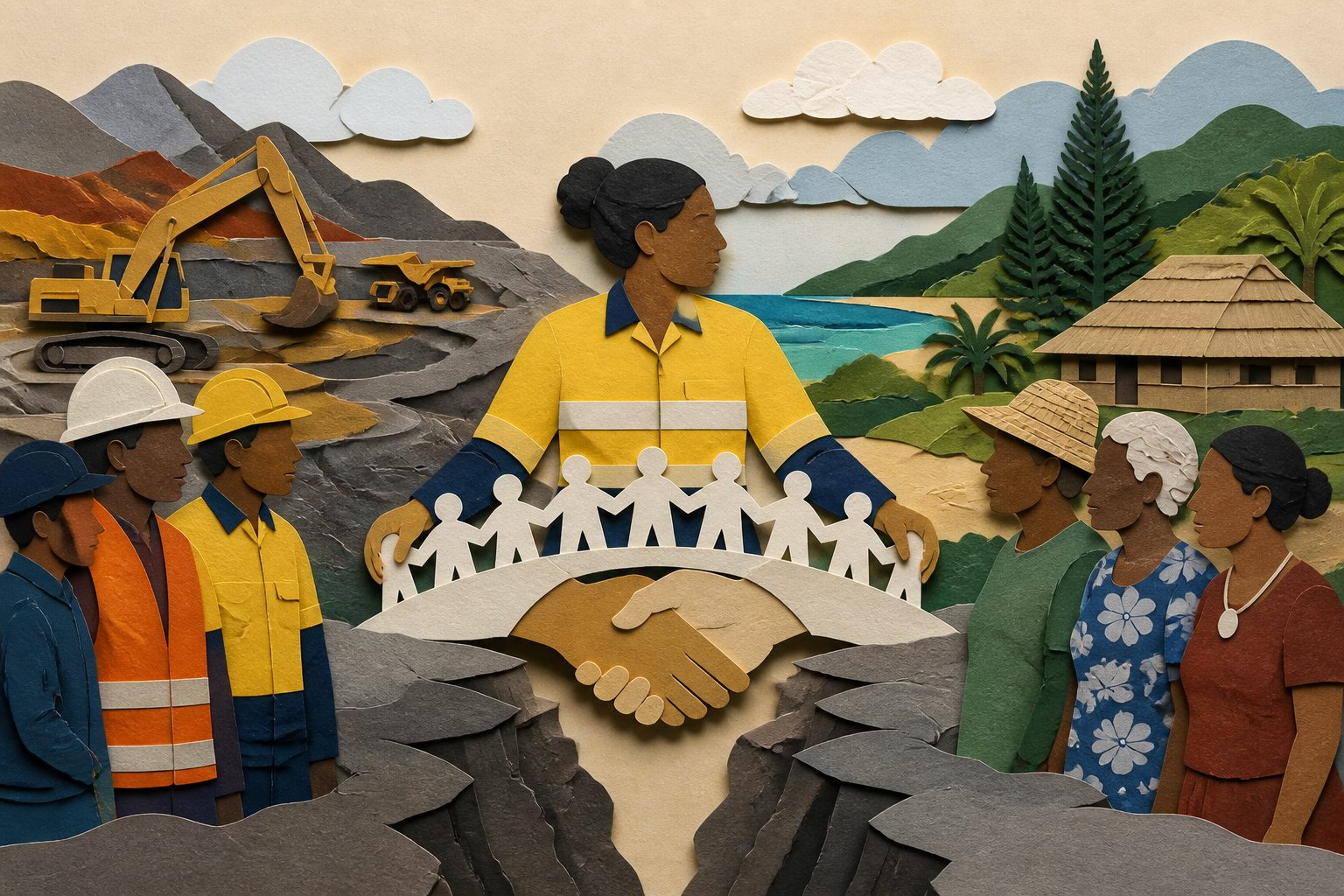
Researchers examine how corporate staff broker compensation, development and relations with communities around nickel mining.
Nickel extraction has shaped Kanaky New Caledonia’s social, political and colonial history for 150 years. Since the 2000s, transnational mining companies have brought approaches such as impact and benefit agreements, corporate social responsibility and the idea of a “social licence to operate.”
The study focuses on the officers who put these approaches into practice. Drawing on research from 2008 to 2022, it examines their career histories across firms and sectors and describes them as intermediaries who help anchor companies locally, broker compensation and development, and influence institutional arrangements around mining.
What the officers do
The analysis presents corporate social-responsibility officers as a distinct kind of intermediary. Unlike traditional development brokers, they work toward making mining companies locally accepted and established. Their work extends beyond development projects to include compensation, social peace and the design of institutions, giving them a diplomatic role as well.
The officers also help define where mining is understood to have impacts and which arenas—local and territory-wide—are involved in responding to those impacts. In this way, their brokerage helps reshape the social and political spaces connected to mining in Kanaky New Caledonia.
Why these roles matter
The study shows that mining disputes are shaped not only by extraction itself, but also by the people who translate corporate approaches into local relationships and arrangements. By linking compensation, development, conflict management and institutional design, these officers can influence how mining companies engage with communities and how mining impacts are defined.
This places corporate social-responsibility work within the wider political and colonial/decolonial history of nickel mining in New Caledonia, rather than treating it as a separate administrative function.
Evidence and limits
The article is based on research conducted between 2008 and 2022, especially the social biographies of corporate social-responsibility officers working across firms and sectors. It is an anthropological analysis of roles, relationships and spatial effects, rather than a quantitative assessment of outcomes.
The abstract does not give the number of officers studied or provide numerical estimates of changes in disputes, compensation or political influence. It therefore supports an analysis of how brokerage operates and what roles officers take on, but does not establish how widespread these effects are across all mining operations or communities.