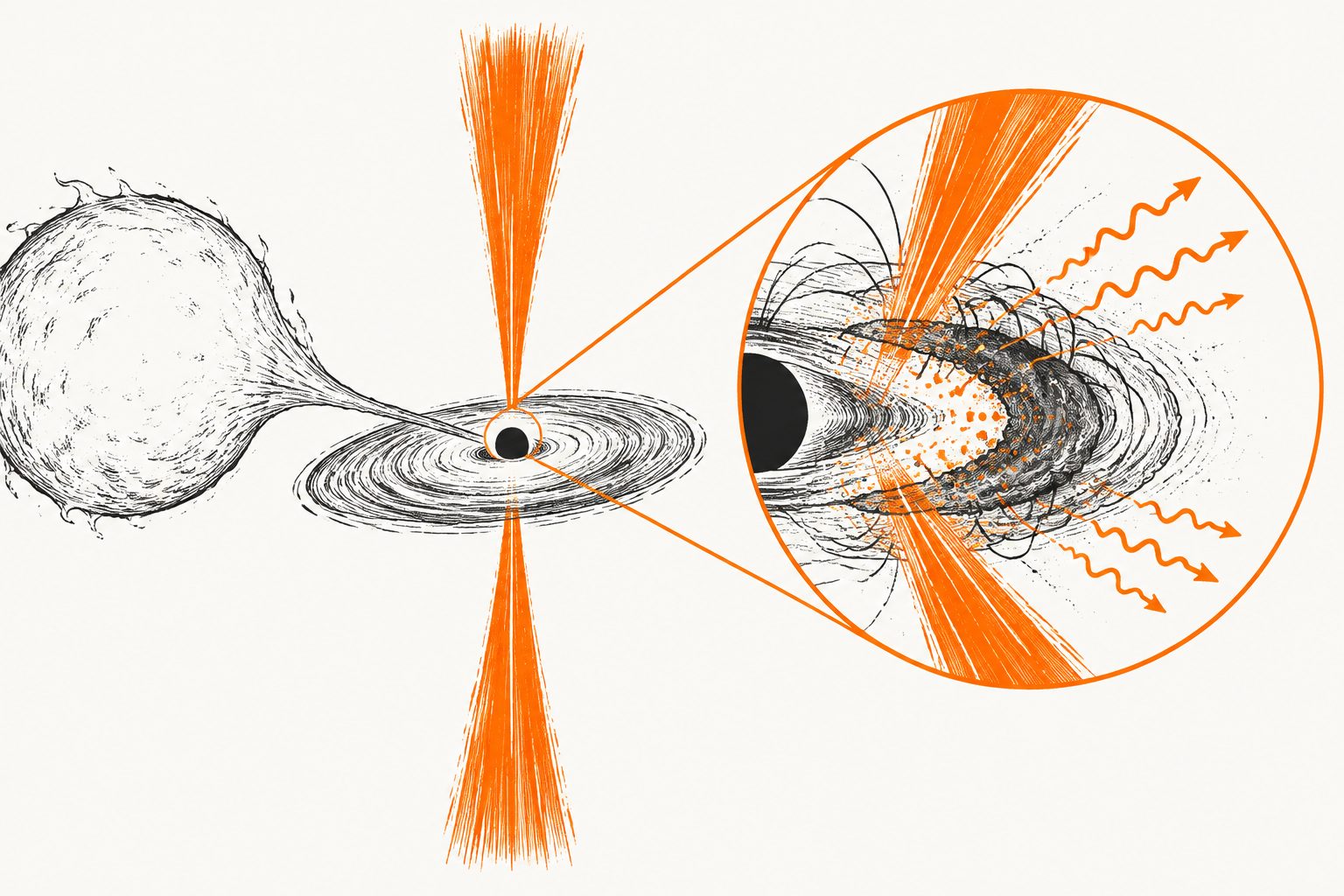
Computer models of Cygnus X-1 and Cygnus X-3 link their most energetic light to compact jet regions, where neutrinos may be difficult to detect.
Researchers used the Astrophysical Multimessenger Emission Simulator to model photons and neutrinos from the two microquasars. The calculations included a compact region in or near the jet, as well as larger, more static regions where particles escaping the jet could interact with their surroundings.
The models can reproduce the systems' lower-energy emission and their observed gamma rays above about 0.1 PeV. Depending on where the emission occurs, the gamma rays could result from collisions involving protons and photons or from collisions between protons and other particles. The models predict different behavior in the still poorly constrained 0.1–10 TeV range, including a deep dip, a weaker suppression or a power-law spectrum.
Where the gamma rays form
The modeling suggests that particle acceleration in the jet is highly efficient. For Cygnus X-1 and Cygnus X-3, the highest-energy gamma rays can be produced in different ways depending on the emission region: proton–photon interactions in a compact region, or proton–particle interactions in a more extended external region.
The predicted variability also depends on the source's structure. Compact regions about as large as the binary orbit should produce strong changes in brightness, while larger, static external regions should vary less. The study offers a qualitative explanation for energy-dependent changes in the gamma-ray signal through changes in the jet's apparent motion and the absorption of gamma rays by surrounding light.
For Cygnus X-3, explaining the observed emission at PeV energies favors a compact jet region with a magnetic field of roughly 100 gauss. The models also find that cooling of the particles that produce neutrinos reduces the predicted neutrino flux, making detection harder than earlier expectations. In the specific modeled cases, the calculated gamma-ray spectra could reproduce the observations, but the radio emission was suppressed by absorption and likely came from a more distant region.
Why the hidden regions matter
The results give astronomers several observable ways to distinguish between hidden, compact emission regions and larger external zones. Measurements of variability and of the spectrum between 0.1 and 10 TeV could help test where the highest-energy gamma rays originate and whether proton–photon or proton–particle interactions dominate.
The predicted neutrino suppression is also important for interpreting nondetections: these systems may produce high-energy gamma rays without producing an equally easy-to-see neutrino signal. The work therefore connects the gamma-ray behavior of Cygnus X-1 and Cygnus X-3 with the conditions inside their jets.
Model evidence and limits
This is a numerical modeling study, not a direct measurement of the emission regions. The researchers tested three idealized arrangements of jet, inner and external regions and adjusted physical parameters to reproduce the available multiwavelength data. More than one arrangement can fit the observations, so the current data do not uniquely identify the gamma-ray production site or interaction process.
The 0.1–10 TeV spectrum is poorly constrained, making the different predictions difficult to assess at present. The paper also describes its explanation of energy-dependent modulation as qualitative. Its magnetic-field estimates are model dependent, and the modeled radio emission was not reproduced because of free-free absorption. The neutrino conclusion is likewise a prediction of these models after accounting for particle cooling, rather than a neutrino detection.