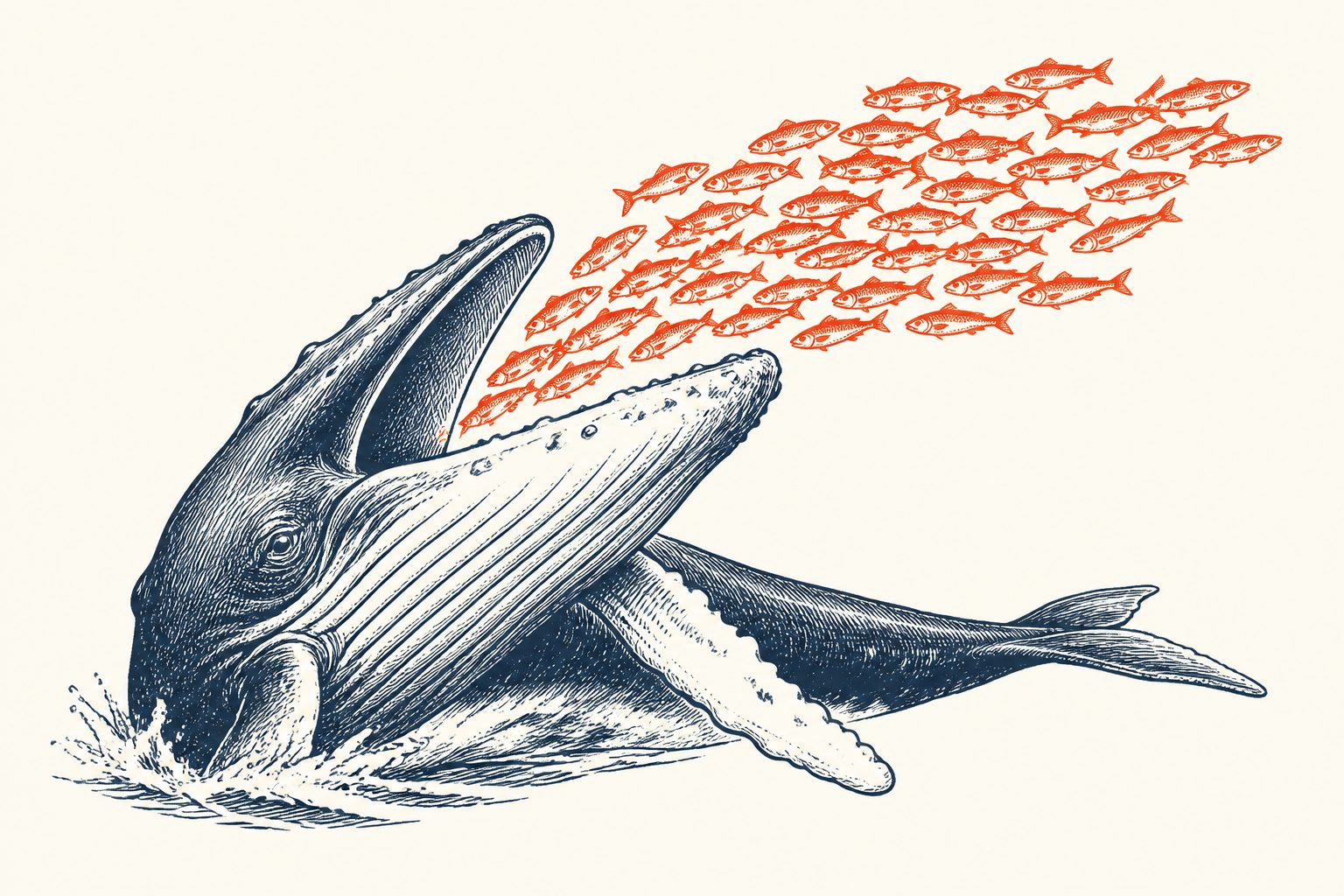
A study in eastern Queen Charlotte Strait found that herring supported over half of the estimated annual energy needs of several humpback whale groups.
Researchers observed humpback whales and herring schools in eastern Queen Charlotte Strait during field seasons in 2012 and 2013. They used whale feeding observations, underwater video and measurements of herring schools to estimate herring consumption, then combined those estimates with a model of the whales’ energy needs.
The results indicated that herring provided over half of the estimated annual energy requirements of non-reproductive females, pregnant females, juvenile males and adult males. Juvenile and lactating females obtained between 25% and 50% of their estimated requirements from herring.
Herring’s share of whale energy
The researchers carried out 26 focal follows of 14 individuals in 2012 and 21 focal follows of 15 individuals in 2013. Adults averaged 2.84 lunge-feeding events per hour, pregnant females 2.83, juvenile whales 1.82 and lactating females 2.33. All sampled bait balls that humpback whales later fed on were made up of herring.
Using these observations in a bioenergetic model, the study estimated that non-reproductive females, pregnant females, juvenile males and adult males met more than 50% of their annual energy requirements through herring. Juvenile and lactating females met between 25% and 50% of their estimated requirements. The herring were all under 15 centimetres long, indicating that the whales were feeding on a particular young age class of herring.
Evidence and caveats
This was an observational study based on focal follows of feeding whales, underwater video and acoustic recordings, conducted in eastern Queen Charlotte Strait during parts of 2012 and 2013. The researchers estimated consumption and energy needs indirectly with a bioenergetic model rather than measuring whales’ energy use directly.
The study included 47 focal follows involving 29 individuals. Researchers could not reliably distinguish adult males from some non-reproductive females in the field, and the sex of most juvenile whales was unknown, so some groups were combined for parts of the analysis. Whales were observed during daylight, and no feeding events were detected in 20 hours of analysed nighttime recordings; the model therefore assumed that feeding occurred only during daylight. The reported shares are estimates for the study area and observed periods, not direct measurements of every whale’s annual diet.
// Source
Summit (Simon Fraser University) · 2026 · DOI: 10.13140/rg.2.2.34065.60002
Authors: Christie J. McMillan