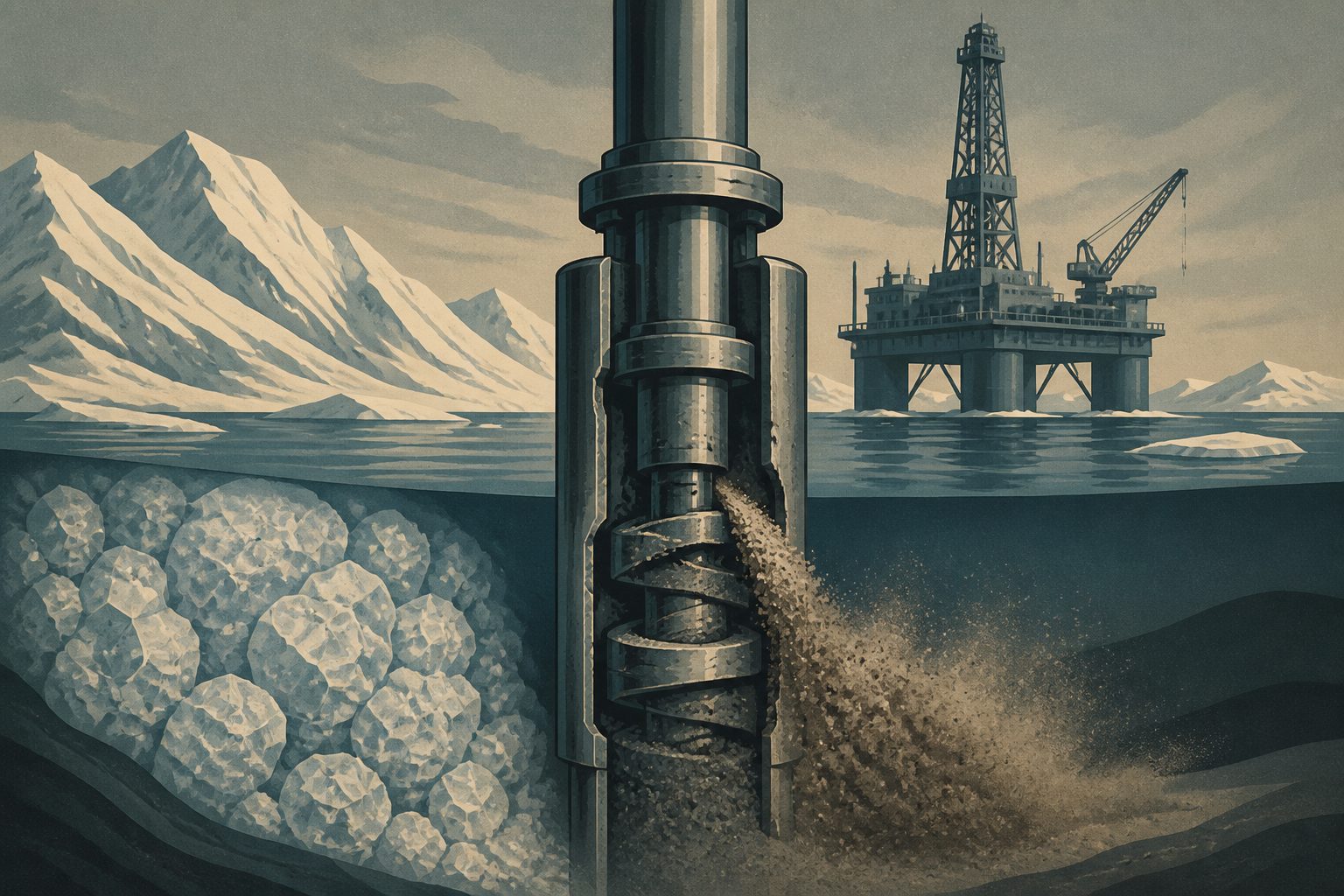
The 2023–24 trial produced gas steadily for 60 days, but gas surges, fine sediment and equipment problems limited the test.
The JOGMEC-DOE-USGS Collaborative Gas Hydrate R&D Project began the test in September 2023. An electric pump operated for two months at a constant bottom-hole pressure, producing about 70 thousand cubic feet of gas and 10 barrels of water per day without a significant change in either rate.
The test later switched to a jet pump, allowing much lower pressure at the well bottom but producing only a limited change in formation pressure. Researchers attributed this result to a low-permeability layer of fine material linked to the sand-control system. Chemical treatment did not remove the layer, and post-test recovery confirmed that the sand-control system had ultimately failed.
What the test found
The test facility operated from September 2023 to July 2024, with 315 days of operation and 64 days without production because of mechanical failures, sand-production problems and replacement of the electric pump with a jet pump.
During electric-pump operation, pressure could not be reduced below about 850 psi, or roughly 400 psi of drawdown, because gas-production surges caused the pump to stop functioning in a condition known as gas lock. The team therefore maintained a constant pressure of about 850 psi for 60 days. Gas production remained near 70 thousand cubic feet per day and water production near 10 barrels per day, with no significant variation.
The test showed no upward or downward trend in production during that period. With the jet pump, pressure at the well bottom was reduced to about 200 psi, but this had only a limited effect on pressure in the formation. Researchers attributed the result to a fine-grained, low-permeability layer associated with the sand-control system. Attempts to remove it with injected chemicals were unsuccessful, leading to higher pressure differences and low productivity. Post-test operations confirmed the ultimate failure of the sand-control system.
// Source
Energy & Fuels · 2026 · DOI: 10.1021/acs.energyfuels.6c01130
Authors: Yoshihiro Nakatsuka, Norihiro Okinaka, Satoshi Ohtsuki, Yutaro Arima, Yusuke Takai, Douglas Cismoski, Patrick Curley, Shahryar Shirzadi, Kyojiro Kawaguchi, H. Sugiyama, Ray M. Boswell, Timothy S. Collett
Institutions: Toyo Engineering (Japan), United States Geological Survey, National Energy Technology Laboratory, Japan Organization for Metals and Energy Security (Japan)