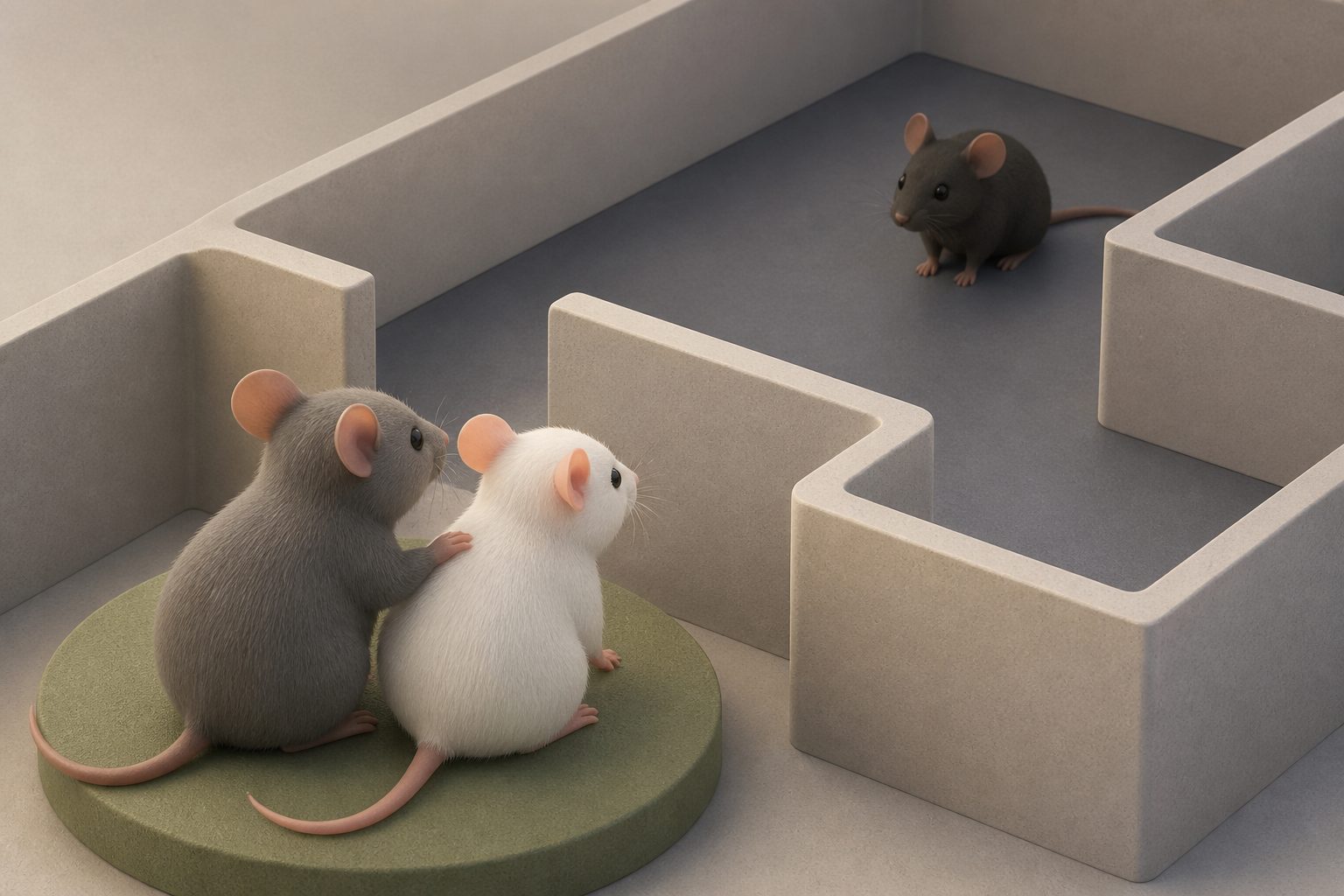
Mice exposed to a familiar partner’s full sensory presence, including physical contact, showed the strongest reduction in fear after conditioning.
Researchers conditioned adult female and male mice to fear contact with an unfamiliar mouse, then housed them for 24 hours either with a familiar cage mate, separated by a transparent partition, or exposed only to the partner’s used bedding. A group of conditioned mice received no buffering companion.
Mice without a companion, or with only visual and/or smell access to one, showed impaired interest in another mouse and continued social fear. Only mice with unrestricted contact with a familiar partner retained normal social preference and showed no social fear in both sexes, with the effect more pronounced in females.
How contact changed fear
Social fear conditioning reduced mice’s interest in a social stimulus without changing their investigation of empty cages, indicating that the effect was specific to social fear rather than a general reduction in exploration. After 24 hours, only mice housed with a familiar partner under full contact conditions showed normal social preference and no social fear.
Restricted contact was not enough. Mice that could see and smell a familiar partner through a partition, or smell the partner through used bedding, did not show the same recovery. Freezing was observed in 0% of conditioned females given full contact, compared with 66.66% of conditioned females without buffering and 50% and 83% of females in the visual-and-olfactory and olfactory-only groups. In males, freezing occurred in 12.50% of mice given full contact, compared with 71% without buffering, 22% with visual and olfactory access, and 56% with olfactory access alone. Conditioned females without buffering also showed reduced fear during the later extinction session; this pattern was not seen in the restricted-contact groups.
Evidence and caveats
This was a controlled animal experiment using adult female and male C57BL/6J mice. Researchers varied the sensory access to familiar cage mates after a social fear-conditioning procedure and assessed social investigation and freezing behavior the next day.
The evidence concerns mice tested in a specific laboratory setup, with buffering lasting overnight and during testing. It does not by itself show whether the same sensory requirements apply to other animals or humans, and the behavioral results do not identify the underlying biological mechanisms. The study was designed to examine social fear rather than longer-term effects of stress or buffering.