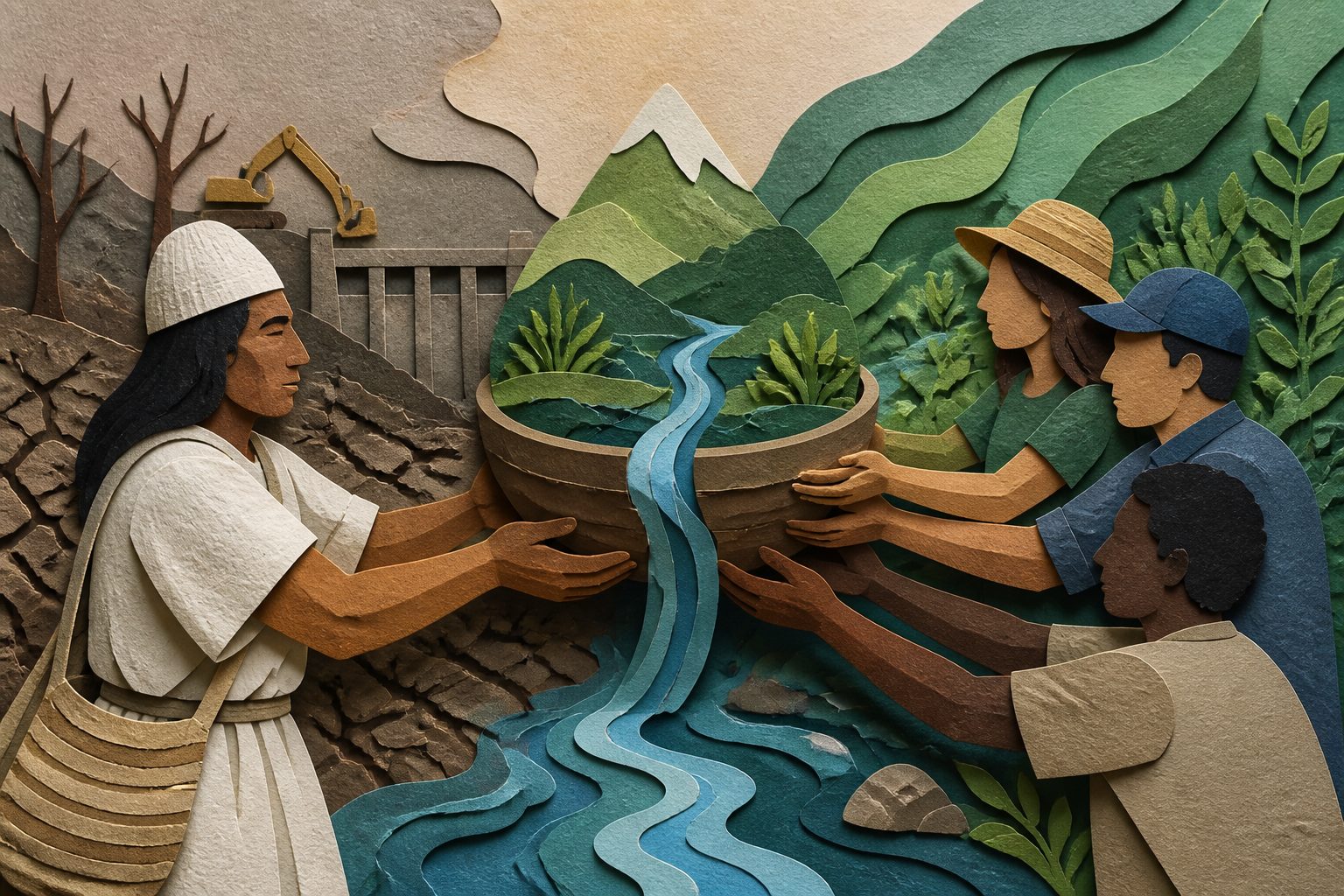
A study in Colombia finds that Indigenous rules help protect water systems, while models point to cooperation with government institutions as the safer path under rising pressure.
Researchers examined water governance in four Arhuaco settlements using surveys, interviews, focus groups, participatory mapping, land-use analysis from 2000 to 2023, and socio-hydrological modeling. They found that water management is mainly guided by spiritual authorities, ritual practices and Indigenous norms, while coordination with government frameworks remains limited.
The study also found declining forest cover and expanding agriculture around sacred sites that support this system of knowledge. Scenarios based only on Indigenous rules reduced the pace of deterioration but did not produce stable conditions as pressures increased; scenarios combining Indigenous knowledge with government mechanisms performed better in the models.
How Arhuaco water rules work
The research took place in San Pablo, Mamarwa, Nabaku and Guananí in the upper Ariguaní River basin. Researchers collected 48 surveys, five interviews with Indigenous leaders, two focus groups with Mamʉs, and two participatory workshops involving 32 people. The surveys produced a TEK Index assessing cultural management, Indigenous norms and government norms; its low added value of 1.28 was interpreted as erosion of institutional effectiveness, not the disappearance of Arhuaco knowledge.
Cultural management was the strongest of the three dimensions, reflecting the importance of the Law of Origin and ritual practices in regulating water. Indigenous norms showed a coherent system of rules and restorative sanctions, but limited ability to address outside pressures. Government norms were weaker, reflecting limited coordination with state water-planning systems.
Land-use analysis showed forest loss and agricultural expansion around sacred sites. The modeling indicated that Indigenous norms alone slow deterioration but do not maintain stable conditions as deforestation, farming expansion and population growth intensify. Co-governance scenarios that combine Indigenous and state arrangements reduced pressure and avoided modeled trajectories in which sacred sites collapse.
Why shared governance matters
The findings suggest that Arhuaco water knowledge works through sacred places, spiritual and political authorities, and rules governing collective responsibilities—not as a standalone technical method. Its ability to support water governance depends on the condition of the forests and sacred sites that sustain it, as well as on the authority to respond to pressures beyond community control.
The study therefore points to water and environmental policies that recognize Indigenous practices, authorities and sacred sites as part of governance. It also supports cooperation between Indigenous and state institutions, without placing one system under the authority of the other, with protections tailored to different parts of the watershed.
Evidence and caveats
The study used a mixed-methods design combining community knowledge, participatory mapping, land-use change analysis and dynamic modeling. The 48 survey participants were selected by Indigenous authorities, so the sample was purposive rather than statistically representative. The land-use analysis documents changes around sacred sites but does not by itself establish that one caused the other. The modeled outcomes are scenario-based: they indicate how different governance arrangements could affect the system under rising pressures, rather than measuring future events directly. The authors also describe ethnohydrological modeling as a tool for dialogue and decision-making, not as a prediction of exactly what will happen.