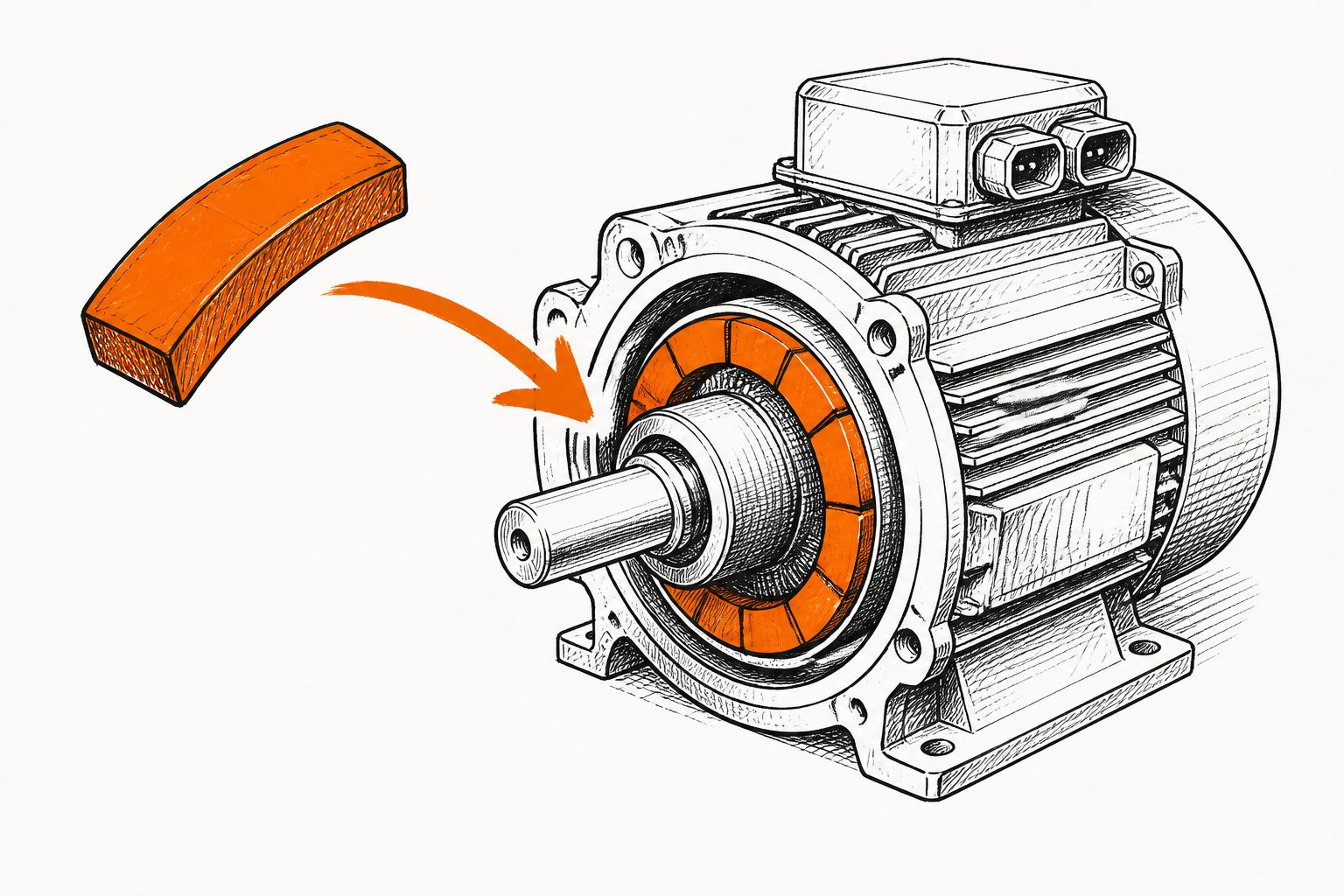
A review finds that several ferrite motor designs can reach the torque and power densities of commercial electric-vehicle motors.
The review compares ferrite-based traction motors with current commercial electric-vehicle motors and assesses ferrite against rare-earth and other emerging permanent magnets. It also examines whether different motor designs can address ferrite’s lower remanence and coercivity, which describe how much magnetic strength a material retains and produces.
The authors identify ferrite as the most practical rare-earth-free option because of its low cost, supply stability and environmental sustainability. They find that spoke-type, ferrite-assisted synchronous reluctance and axial-flux designs can reduce ferrite’s disadvantages, and that recent prototypes have achieved torque and power densities within the range of commercial electric-vehicle motors.
What ferrite motors can do
The review’s comparison identifies ferrite as the most practical alternative to rare-earth magnets for traction motors without rare-earth elements. Ferrite is less costly and has more stable supply prospects, but its remanence and coercivity are lower than those of rare-earth magnets.
The reviewed design studies indicate that spoke-type motors, ferrite-assisted synchronous reluctance motors and axial-flux motors can help offset these limitations. Recent prototypes have demonstrated torque and power densities within the range reported for commercial electric-vehicle motors. Based on the evidence it synthesizes, the review concludes that ferrite-based traction motors are practically viable for electric-vehicle applications.
Evidence and caveats
This is a structured review, not a report of one new motor prototype or a new vehicle test. It combines manufacturers’ datasheets, government and third-party reports, material databases and peer-reviewed studies to compare commercial benchmarks, magnetic materials and motor designs.
The evidence includes prototype results, but the abstract does not provide individual performance figures, test conditions or details on how the prototypes compare across real-world driving cycles. The review supports the practical viability of ferrite-based motors, but it does not establish that every ferrite design will match commercial motors or that these motors are ready for widespread deployment.
// Source
Renewable and Sustainable Energy Reviews · 2026 · DOI: 10.1016/j.rser.2026.117403
Authors: Danyang Cui, Lena Max, Cecilia Boström, Boel Ekergård
Institutions: Uppsala University, University West