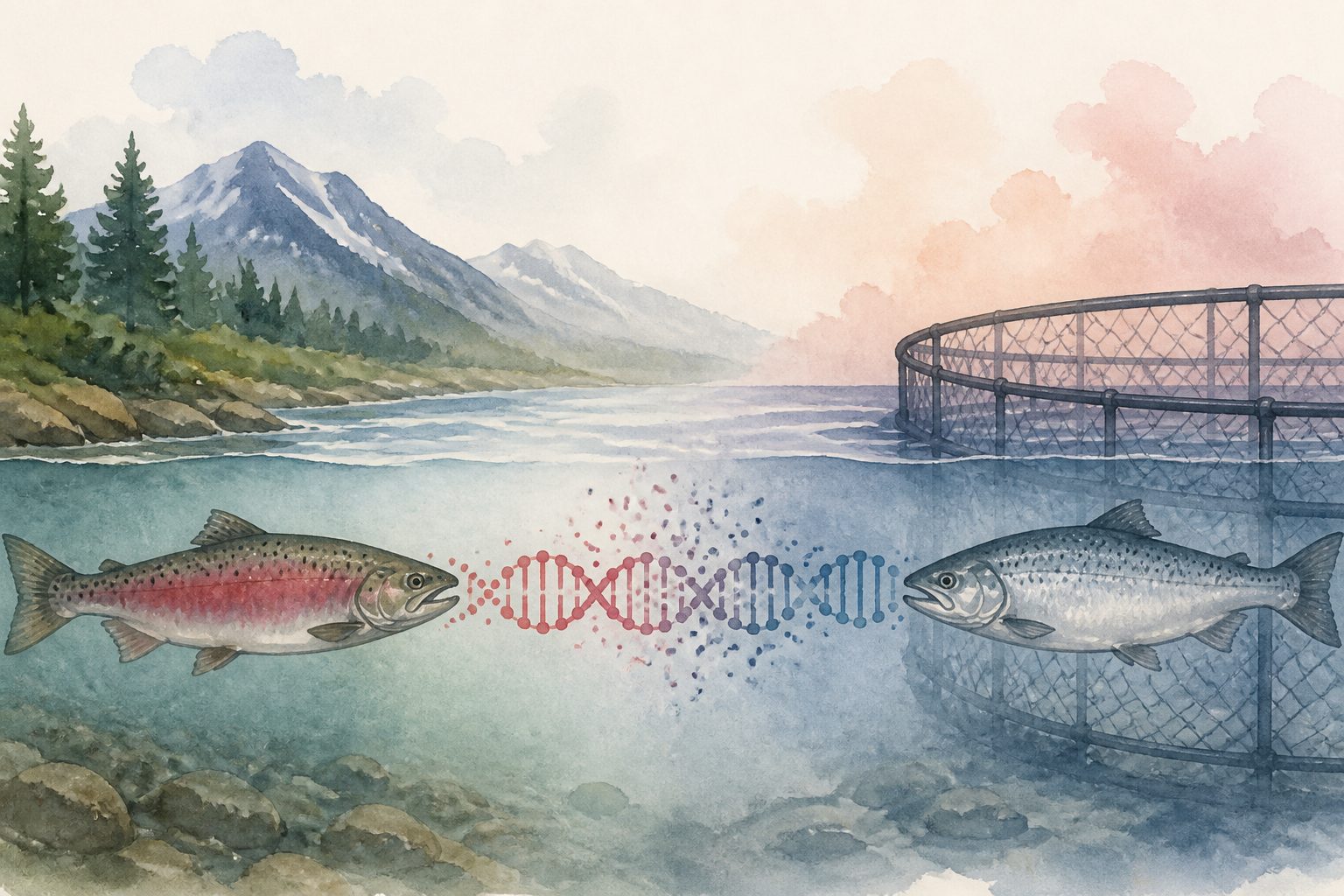
A study of salmon across North America found stronger genetic differences from farmed fish at climate-linked parts of the genome than across the genome overall.
Researchers analyzed genetic and environmental data from 5,208 wild Atlantic salmon samples representing 131 populations across North America, alongside 440 salmon from a North American aquaculture strain. They looked for genetic variants associated with climate and compared wild and farmed fish at those locations.
Climate-linked genetic variation appeared to involve many parts of the genome, including a large chromosomal rearrangement previously associated with climate adaptation. Wild salmon were more genetically distinct from aquaculture salmon at climate-associated locations than across the genome overall, a pattern the researchers say is consistent with domestic introgression potentially eroding local adaptation.
Climate-linked genetic differences
The researchers found evidence that climate adaptation in Atlantic salmon has a polygenic basis, meaning it involves many genetic variants rather than a single gene. One large chromosomal translocation was also among the climate-associated features.
Across North America, genetic differences between wild and aquaculture salmon generally grew with increasing distance from the southern source of North American salmon aquaculture. Wild populations differed from aquaculture salmon by roughly twice as much at climate-associated genetic locations as they did across the genome overall. The authors interpret this pattern as suggesting that introgression from farmed salmon could weaken local climate adaptation and intensify the effects of climate change on wild populations.
Evidence and caveats
The study used a genome–environment association analysis, comparing genetic variation in wild salmon with climate conditions, and compared wild fish with aquaculture salmon at climate-associated genetic locations. It covered 131 wild populations and used a 220,000-marker genetic array.
These results show associations and genetic differences, not a direct test of whether introgressed salmon survive or reproduce less successfully under future climate conditions. The analysis suggests that domestic introgression may erode climate adaptation, but it does not establish that introgression caused the observed differences or quantify its effect on population growth, survival or climate responses.
// Source
Evolutionary Applications · 2026 · DOI: 10.1111/eva.70319
Authors: Hallie Arno, Tony Kess, Steven Duffy, Benjamin Marquis, Samantha Victoria Beck, Sarah J. Lehnert, Ian Fleming, Ian Bradbury
Institutions: Memorial University of Newfoundland, Natural Resources Canada, Fisheries and Oceans Canada, University of the Highlands and Islands, Ontario Forest Research Institute