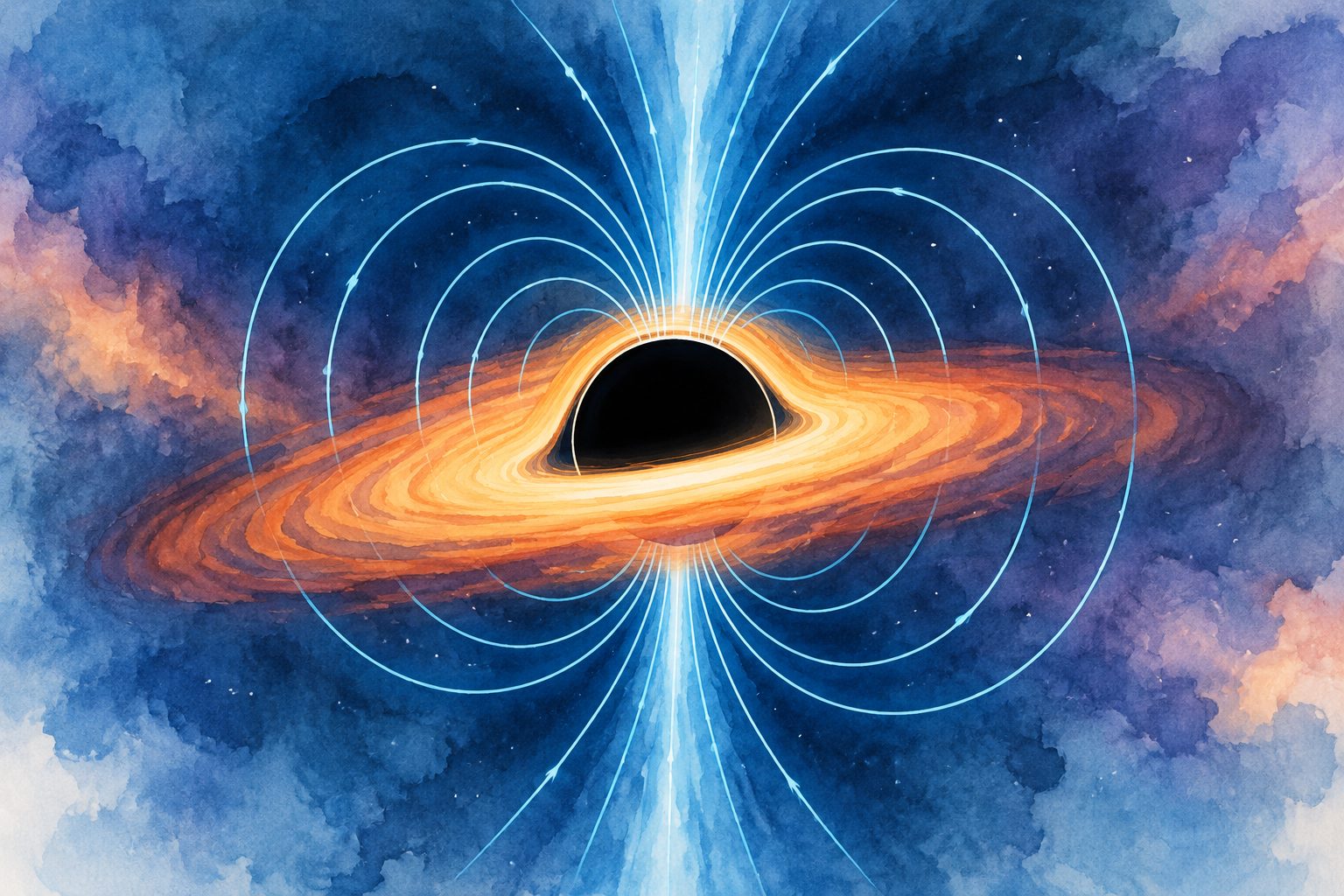
An exact study of rotating black holes finds magnetic flux remains on the horizon except in a special static limit.
The researchers examined extremal Kerr–Bertotti–Robinson black holes, exact solutions of Einstein’s equations coupled to electromagnetism. These describe rotating black holes immersed in a uniform electromagnetic environment. For a purely magnetic external field, they calculated the flux through the northern half of the horizon.
For finite extremal black holes, the flux is nonzero whenever 0 < Ba < 1. It disappears only as Ba approaches 1 from below, a limit in which the rotational twisting of the near-horizon geometry vanishes and the geometry becomes a direct product of two simpler spaces.
Magnetic flux remains
Extremality alone does not guarantee magnetic-field expulsion in this family of black holes. For finite values with 0 < Ba < 1, the exact northern-hemisphere flux is ΦN = −2πBa²√(1 − B²a²), so magnetic flux remains on the horizon. Its magnitude is greatest at Ba = 1/√2.
Complete expulsion occurs only in the static near-horizon boundary limit Ba → 1 from below, equivalently when the parameter k approaches zero. In that limit, the magnetic potential on the horizon becomes independent of latitude, making the magnetic flux density and the flux through any smooth portion of the horizon vanish.
The result follows from two exact identities at extremality. The paper also reports that the black hole’s throat has a logarithmically divergent length, consistent with geometric suppression of smooth, stationary magnetic fields near the static boundary. A schematic estimate suggests strong suppression of jet power there for smooth, axisymmetric fields, but this implication is presented with caveats.
Why the limit matters
The study narrows the conditions under which the black-hole Meissner effect occurs. It shows that the presence of an extremal horizon is not enough: in this exact black-hole family, complete magnetic expulsion requires a further limit in which the near-horizon geometry loses its rotational twist.
That distinction matters for theoretical descriptions of magnetic fields and possible jets around rapidly rotating black holes. The result also indicates that the detailed global structure of a black-hole spacetime can affect whether magnetic flux is expelled, although the paper leaves open whether topology is the decisive factor in general.
Evidence and caveats
This is an analytical result based on exact Einstein–Maxwell solutions, not an astronomical observation or a numerical survey. The conclusions apply to extremal Kerr–Bertotti–Robinson black holes and, for the flux result, to a purely magnetic external field. They do not by themselves establish the behavior of ordinary, non-extremal black holes or of all possible external electromagnetic configurations.
The discussion of jet suppression uses a schematic estimate and is limited to smooth, stationary, axisymmetric field configurations near the static boundary. The paper identifies extensions—such as charged or NUT-containing versions of the spacetime—as questions for further study, and says whether topology generally determines expulsion remains open.
// Source
The European Physical Journal C · 2026 · DOI: 10.1140/epjc/s10052-026-16539-6
Authors: Haryanto M. Siahaan
Institutions: Parahyangan Catholic University