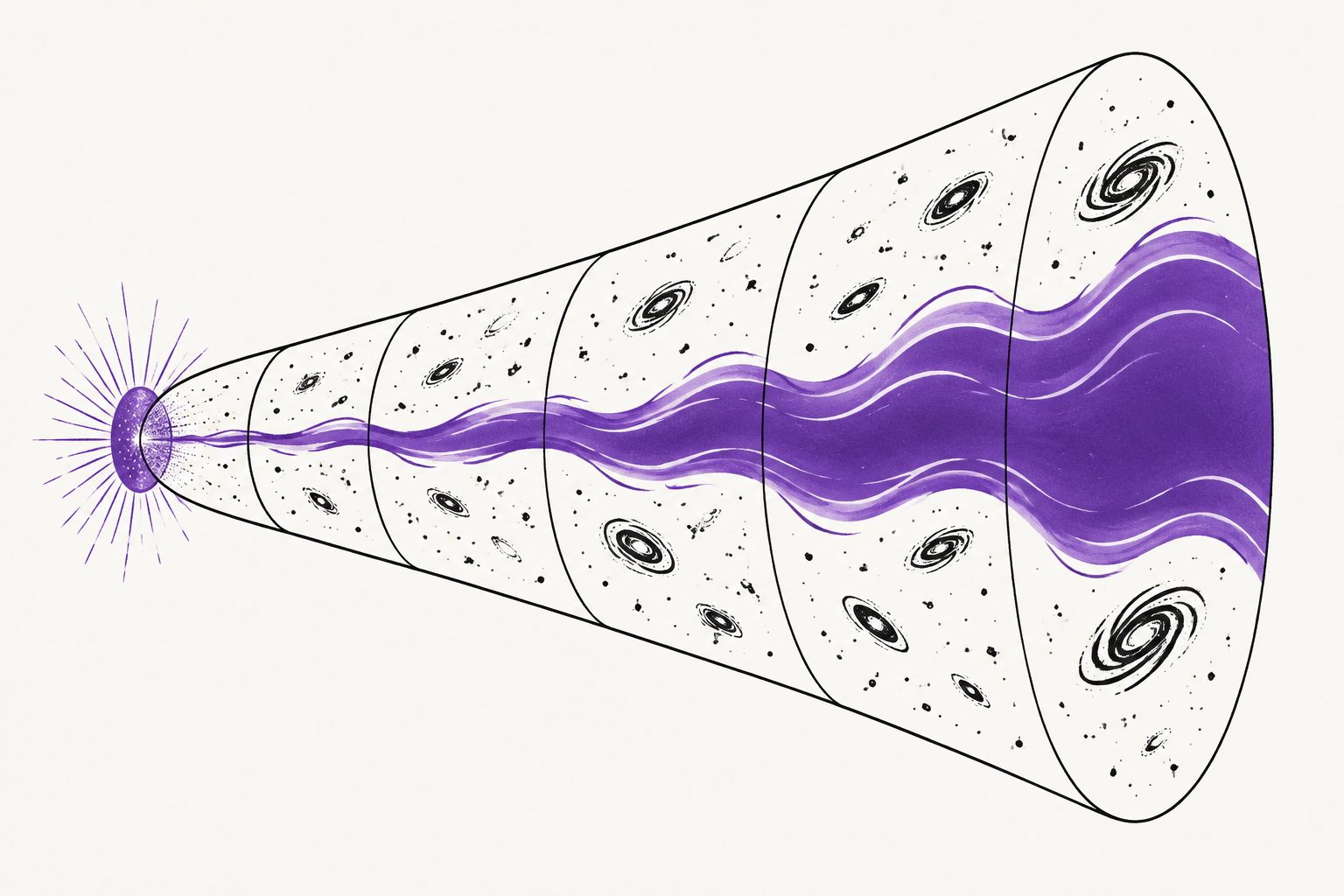
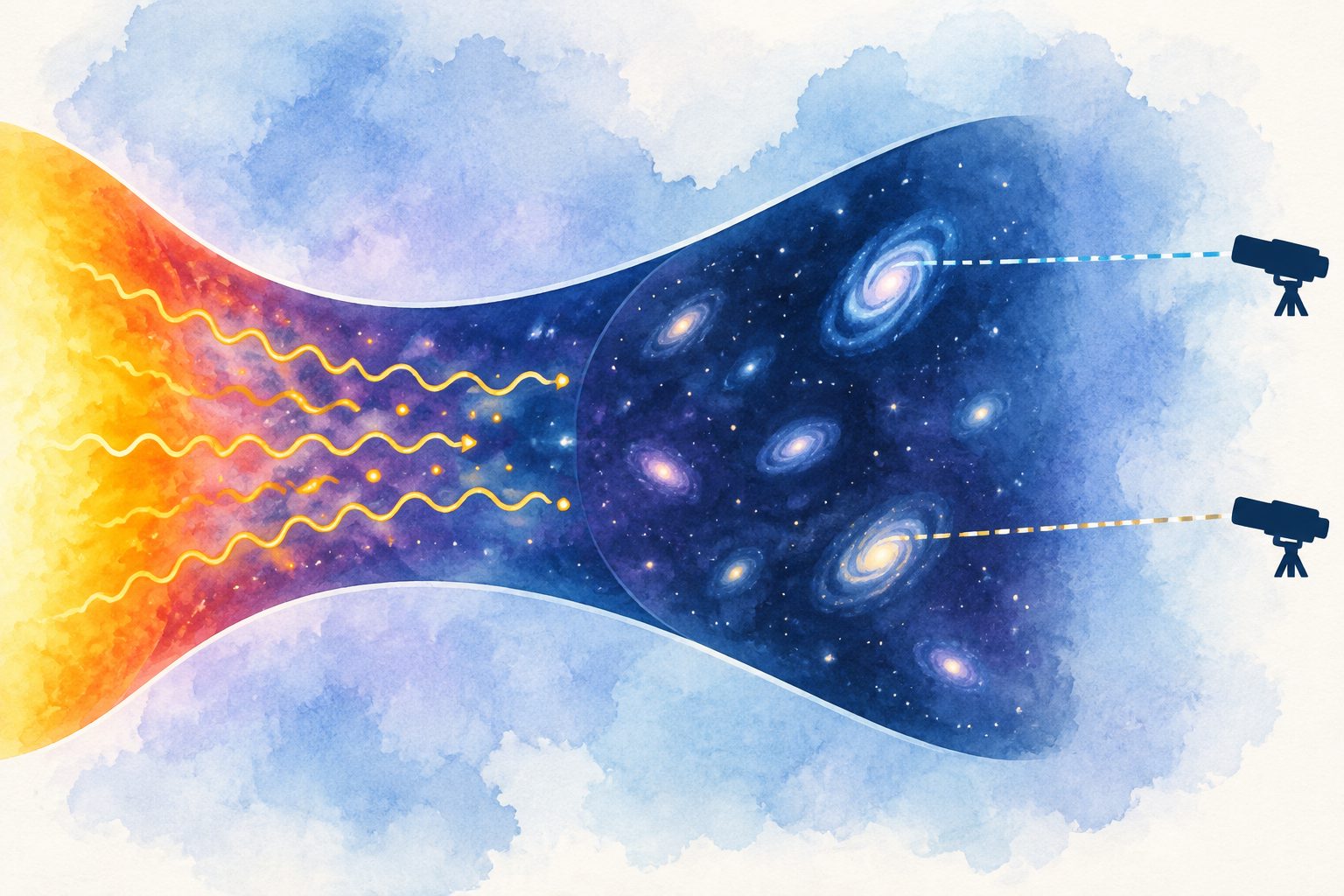
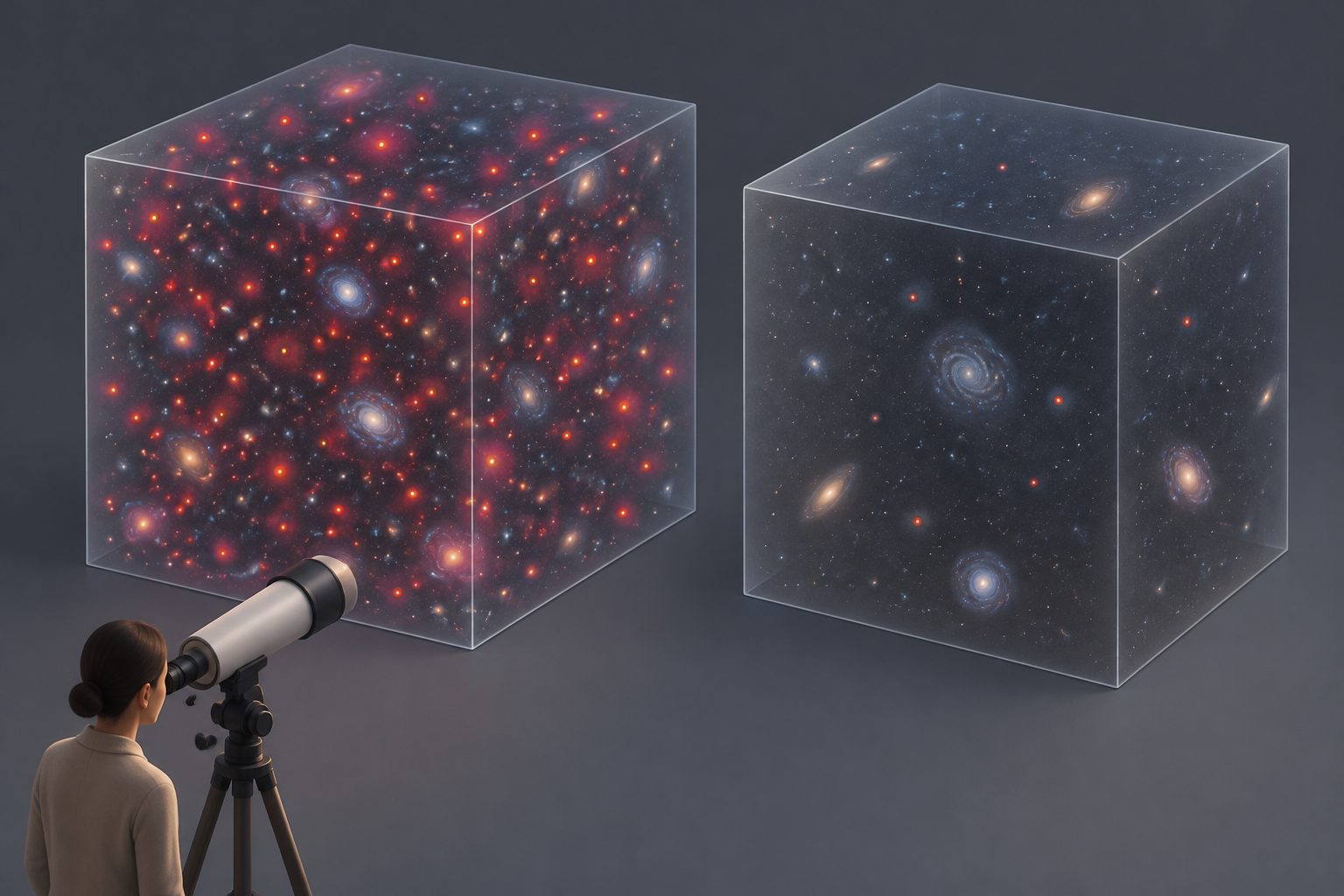
An analysis of cosmic background radiation, galaxy clustering and exploding stars finds evidence that dark energy crossed a key boundary over cosmic time.
Researchers analyzed measurements of the cosmic microwave background, the clustering of galaxies and Type Ia supernovae using a model that allows dark energy’s behavior to change over time. They found that the standard cosmological model was disfavored at more than 3 standard deviations in favor of a dark energy history that crosses the so-called phantom divide.
The same pattern remained when data from the Dark Energy Spectroscopic Instrument were replaced by expansion-rate measurements from the SH0ES project. The crossing occurred at different times depending on which datasets were combined, but models that allowed a crossing consistently fit the data best.
A changing dark energy history
Across the dataset combinations studied, the results favored a transition from an early-time phantomlike phase to a late-time quintessencelike phase. The standard cosmological model, in which dark energy is constant, was excluded at a significance of at least about 3 standard deviations in the main analysis. The no-crossing option was disfavored at significance levels ranging from 3.1 to 5.2 standard deviations.
To test whether this result was caused by the particular mathematical form used to describe dark energy, the researchers compared the crossing model with two versions that explicitly forbid a crossing. One noncrossing model, representing a freezing phantomlike behavior, performed comparably in only a few cases. The crossing model provided the best fit across all dataset combinations considered.
Why the result matters
The findings suggest that the apparent preference for changing dark energy behavior is not easily explained by the specific linear model used in the analysis. If supported by future observations, a changing dark energy equation of state would differ from the standard cosmological model and could affect how researchers describe the universe’s expansion history.
The result also shows that the preference appears with two different combinations of key cosmological measurements, despite known differences between galaxy-clustering and local expansion-rate data when combined with cosmic microwave background measurements.
Evidence and limits
This is a statistical analysis of combined observations: cosmic microwave background data, baryon acoustic oscillation measurements from galaxy clustering, Type Ia supernovae and, in one comparison, SH0ES measurements of the Hubble constant. The reported evidence depends on fitting these data with a particular time-dependent description of dark energy and comparing it with models designed to forbid a crossing.
The abstract does not give the individual dataset releases, parameter values or the redshifts of the transitions. It also does not establish that the crossing is a physical change in dark energy rather than an effect of unrecognized measurement or modeling issues; it reports that the crossing model is preferred among the models tested.