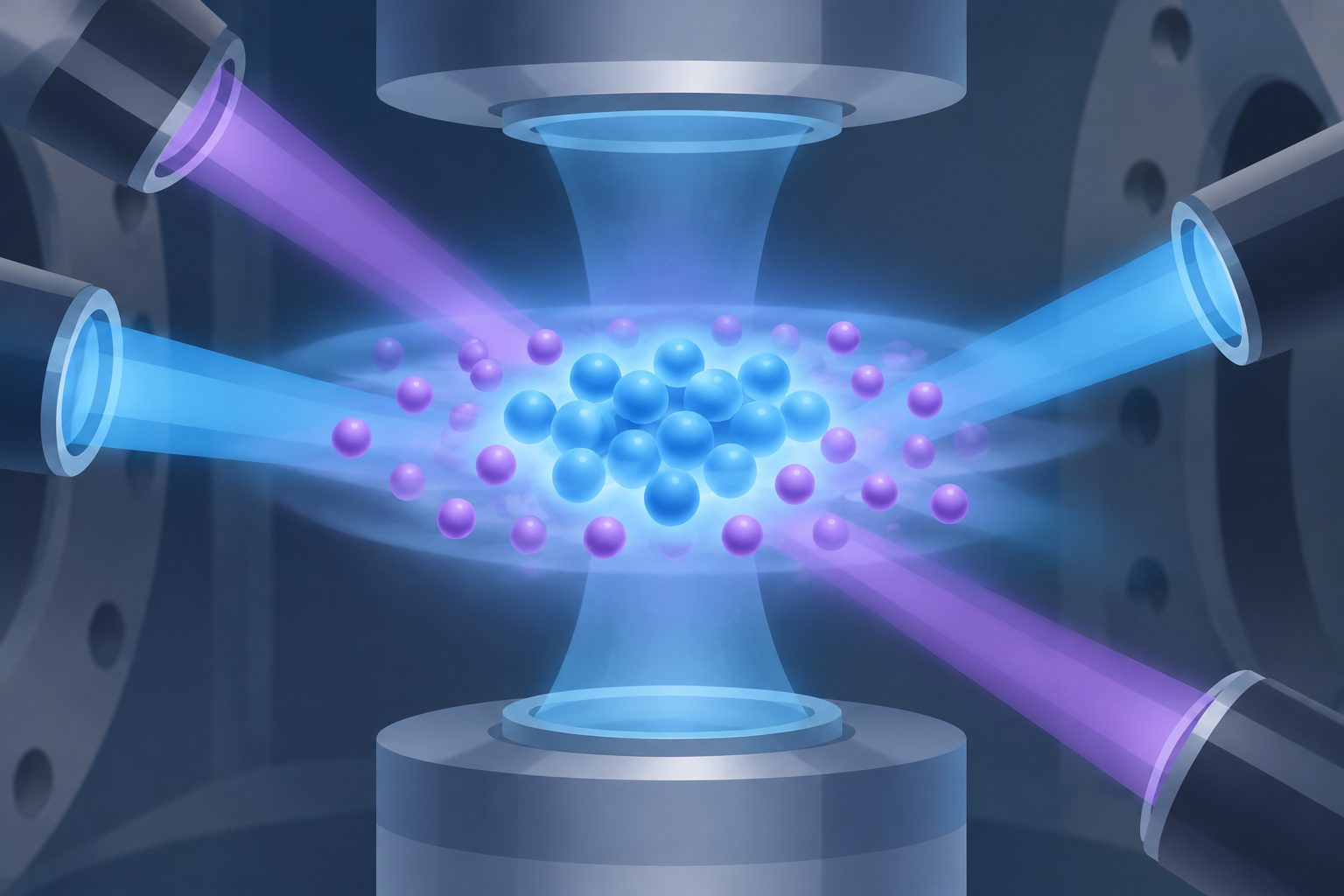
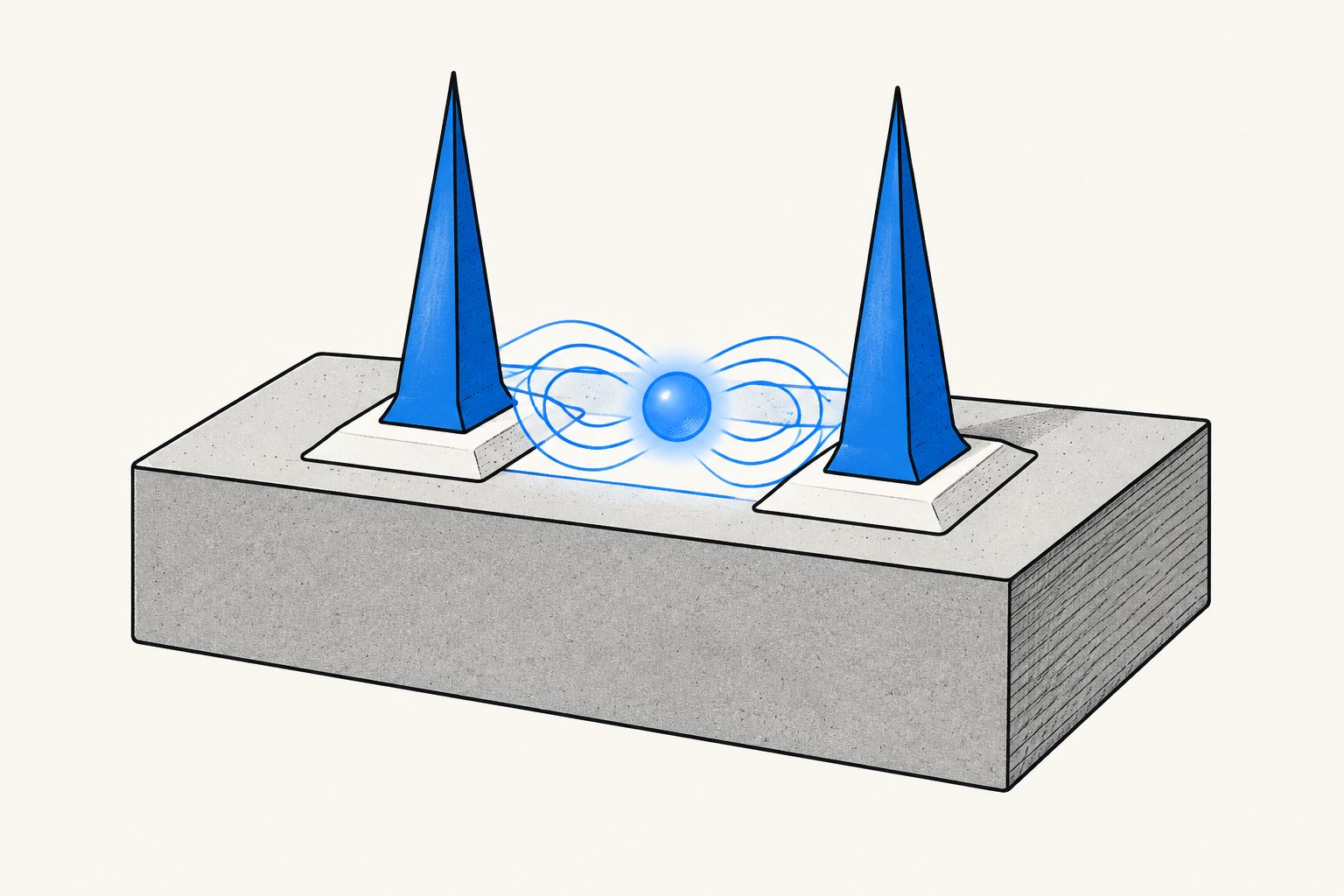
Experiments show that companion atoms can detect atom loss while largely preserving the quantum state of nearby atoms, and can lower their temperature.
Neutral-atom experiments face two practical problems: atoms can be lost, and the atoms that remain can heat up. In this work, researchers used ancilla atoms—companion atoms that help carry out measurements and operations—to address both problems in optical tweezer arrays.
Repeated readout improved detection of whether a data atom was present, while disturbing the data atoms only minimally. The researchers also transferred information between an atom’s electronic and motional states, allowing loss to be detected during an operation while preserving coherence. In a separate procedure, they transferred motional entropy from data atoms to ancilla atoms’ electronic states and observed a marked reduction in the data atoms’ temperature.
What the extra atoms did
The researchers demonstrated repeated ancilla-based readout of whether a strontium data atom was present. As the number of readout rounds increased, the signals for an atom being present or absent separated further, improving detection fidelity while minimally perturbing the data atoms.
They also demonstrated mid-circuit atom-loss detection that preserves coherence. The method maps information from the atom’s electronic state to its quantized motion before the ancilla reads out whether the atom remains. Finally, they demonstrated algorithmic cooling: a circuit sequence that deterministically transfers motional entropy from data atoms to the electronic states of ancilla atoms. The data atoms became markedly colder.
Evidence and open limits
The findings come from demonstrations in optical-tweezer experiments with strontium atoms, using entangling gates between data and ancilla atoms. The reported readout distributions separated more clearly with repeated rounds, and motional measurements showed a marked reduction in the temperature of data atoms after algorithmic cooling.
A stated limitation of coherence-preserving loss detection is the efficiency of motional shelving, the step that transfers information into the atom’s motion. The researchers identify laser-frequency noise and variations or fluctuations in trap frequencies as the main technical limits. Improving those sources of noise could increase shelving efficiency, but the excerpts do not provide a final efficiency value or establish how the tools perform in other platforms or larger systems.