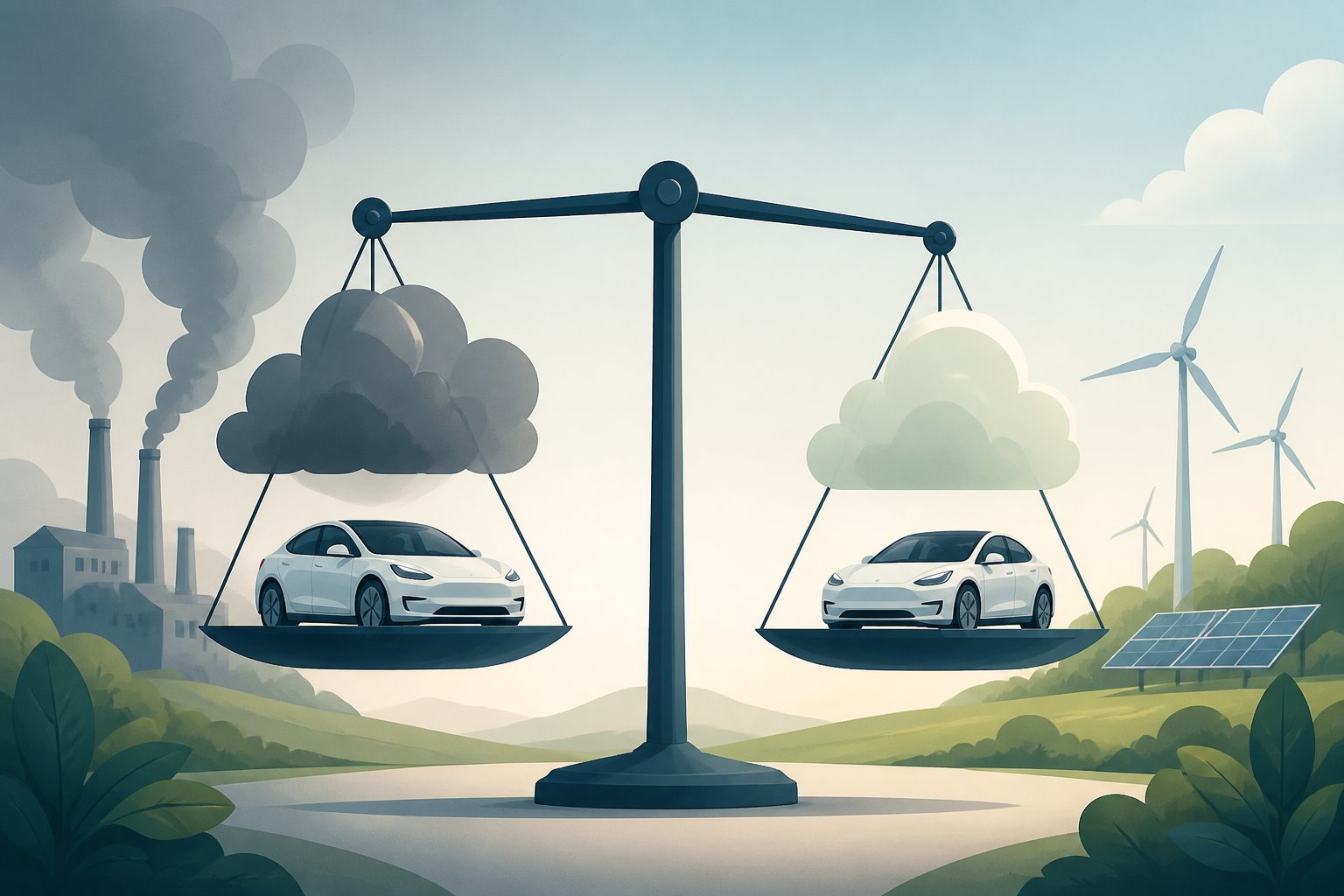
The accounting method used for electric vehicles and their batteries changed declared life-cycle emissions by as much as 96%.
Researchers compared draft carbon-footprint rules from China and the European Union, along with France’s environmental-score method, against a harmonized analytical reference. They tested 50 paired vehicle-and-battery configurations across four production-market pathways.
The differences were especially large when products made in China were assessed under destination-market rules in the EU and France. The researchers say accounting boundaries, background data and the choice of what the footprint is measured per unit of product can all change the resulting comparison.
How the rules changed results
Compared with the reference, China’s battery rule produced accounted life-cycle emissions that were 8% lower to 11% higher. The EU battery method produced values 11–21% lower. China’s vehicle rule stayed within 4% of the reference, while France’s method produced values 57–80% lower, mainly because it focuses on production and excludes vehicle use and end of life.
For China-origin products entering the EU and France, destination-market rules increased the average gap between imported and local products from 32% to 89% for batteries and from 8% to 96% for vehicles. The researchers identified choices about background data as the main source of the added divergence. They also found that the chosen functional unit—what the footprint is measured against—changed normalized comparisons and which product attributes appeared preferable. The apparent benefits of recycling and improvements in powertrain efficiency also depended on the accounting rules.
Evidence and caveats
This is a model-based comparison of accounting methods, using 50 paired vehicle-and-battery configurations across four production-market pathways. It compares draft Chinese and EU methods and a French method with a harmonized analytical reference; it is not a set of direct measurements of individual vehicles or batteries.
The results depend on the modeled configurations, the background data and the definitions used by each accounting method. The study also shows that functional-unit choices and the treatment of use, recycling and end of life can affect the outcome, so the reported differences should be understood as consequences of these rule and modeling choices.
// Source
Environmental Science & Technology · 2026 · DOI: 10.1021/acs.est.6c08170
Authors: Zongwei Liu, Jianxin Li, Zhihao Xu, Han Hao, Fuquan Zhao
Institutions: Tsinghua University