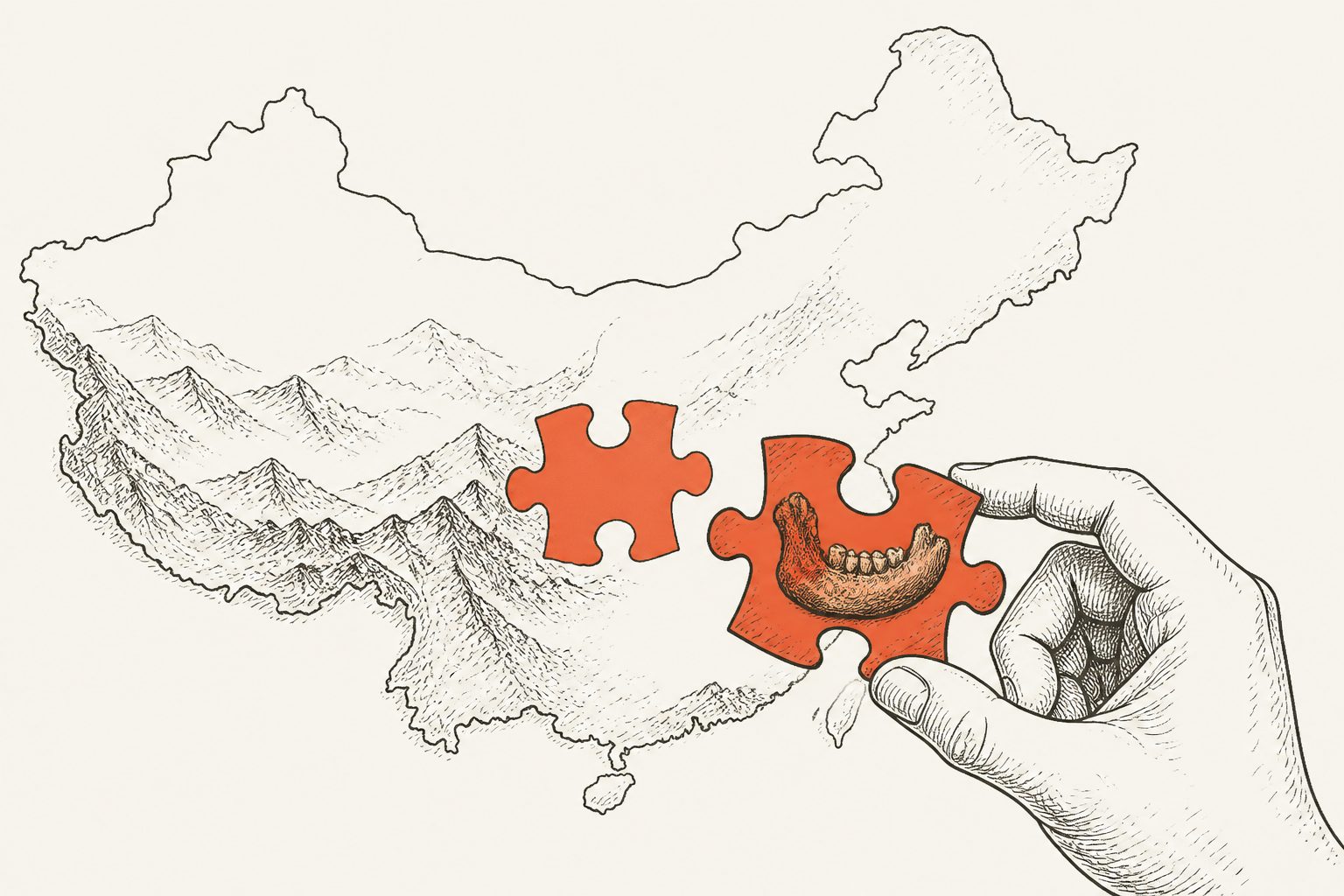
Ancient protein analysis identified three bone fragments and two teeth as Denisovan remains from Bianfu Cave.
Researchers screened more than 60,000 bone fragments from Bianfu Cave in Southwest China. Zooarchaeological and protein-based analyses identified three hominin fossils—two pieces of skull bone and part of a forearm bone—and confirmed that two teeth from the excavation were Denisovan.
The fossils come from layers dated to approximately 167,000–134,000 years ago. Bianfu Cave now has the largest collection of Denisovan remains known outside Denisova Cave in Siberia, and the forearm fragment provides direct information about the group’s postcranial, or body-bone, anatomy.
What the fossils show
Morphological screening of more than 60,000 bone fragments selected 76 for zooarchaeological analysis by mass spectrometry and 17 for protein sequencing. The analyses identified three hominin fossils from layers dated to approximately 167,000–134,000 years ago: two parietal bone fragments, which come from the skull, and one proximal radial fragment, from the upper part of a forearm bone. Further protein analysis identified these fossils and two teeth found during the excavation as Denisovan. The findings establish Bianfu Cave as a Denisovan site with the most abundant remains of this group outside Denisova Cave in Siberia.
// Source
Nature · 2026 · DOI: 10.1038/s41586-026-10976-9
Authors: Huiyun Rao, Song Xing, Qijun Ruan, Fan Bai, Yuhao Zhao, Zhongyou Wu, Siyuan Tang, E. Andrew Bennett, Xiaotian Feng, Sungui Lin, Qingfeng Shao, Xiong Yang, Zitao Li, Kai Zhou, Feng Liu, Qiaomei Fu
Institutions: Chinese Academy of Sciences, Institute of Tibetan Plateau Research, Peking University, University of Chinese Academy of Sciences, Chinese Academy of Social Sciences, Nanjing Normal University, Institute of Archaeology, Yunnan Archaeology, Institute of Paleoprimatology Human Paleontology Evolution and Paleoenvironments, Institute of Vertebrate Paleontology and Paleoanthropology, Historic Deerfield