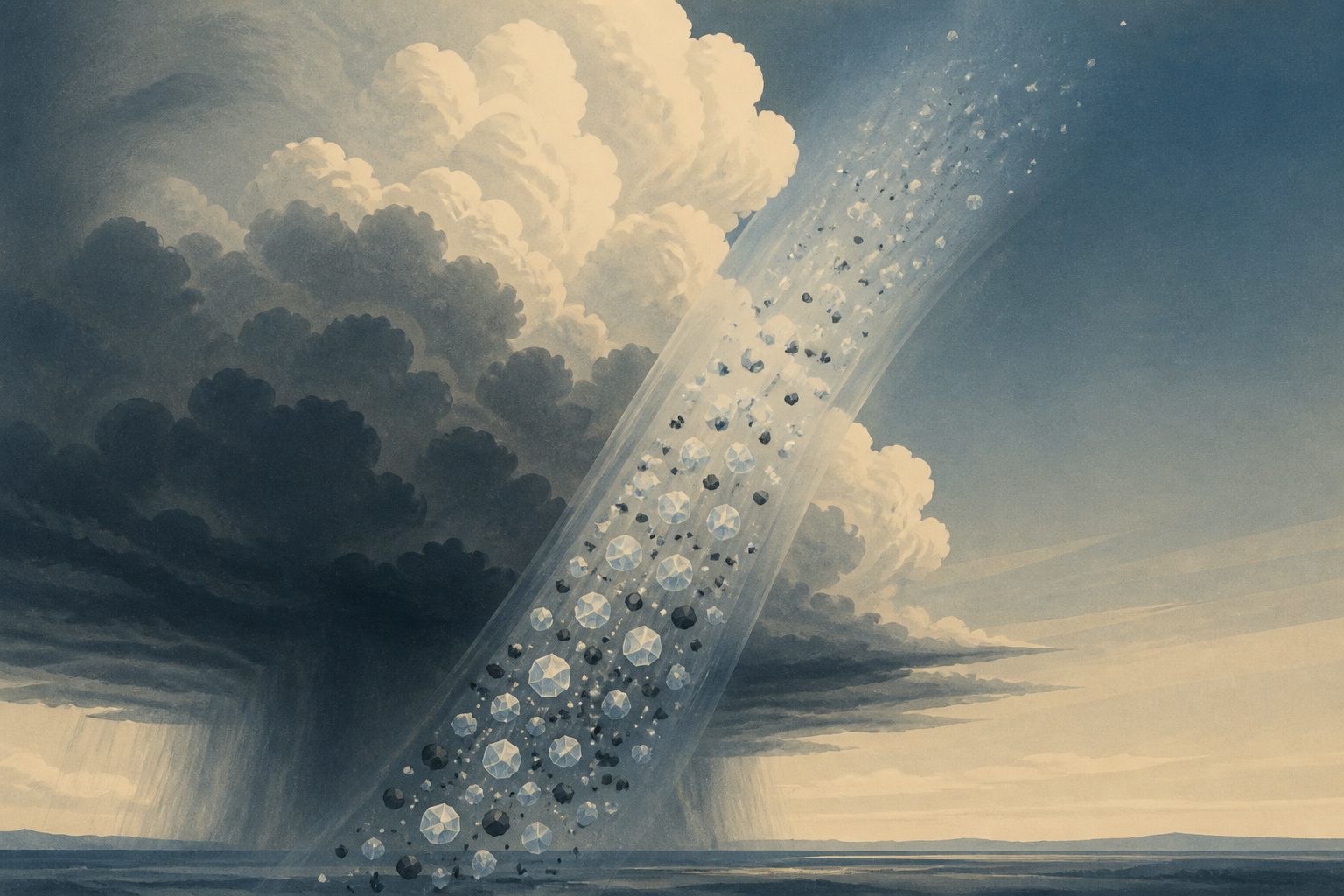
Aircraft measurements show that deep convective clouds can move some ice-forming particles into the upper atmosphere over Europe.
Researchers collected air and cloud-particle samples from an aircraft flying through the troposphere and lower stratosphere, reaching 14.5 kilometers, during a 2021 campaign over Europe. They examined particles entering and leaving deep convective clouds to determine which could help form ice in clouds.
The incoming air contained particles active at both relatively warm temperatures above −15 °C and colder temperatures below −20 °C. Samples from inside the clouds and their outflow contained only the colder-active particles. The researchers attribute this separation to precipitation removing the particles that form ice at warmer temperatures, while the colder-active particles were carried upward into very cold air.
How the particles were sorted
The study found that deep convective clouds selectively transported ice-nucleating particles—particles that help water freeze in clouds. In the cloud inflow, the particles included some that became active above −15 °C and others that became active below −20 °C. In-cloud and outflow samples contained only particles active below −20 °C.
The researchers explain this pattern by proposing that precipitation scavenges the particles active at warmer temperatures. The particles active at lower temperatures were efficiently transported into the free troposphere, where ambient temperatures were below −40 °C—far colder than the temperatures at which those particles begin to trigger ice formation. In the cloud outflow, their concentrations were at least two orders of magnitude higher than the upper-tropospheric background concentration.
Evidence and limits
The study is based on immersion ice-nucleating particle measurements from filter samples collected aboard the HALO research aircraft during the CIRRUS-HL campaign in summer 2021. Samples covered the inflow, cloud region and outflow of deep convective clouds over Europe, from the troposphere to the lower stratosphere, up to 14.5 kilometers.
The results describe measurements from this campaign and region rather than all storms or seasons. The proposed role of precipitation in separating the particles is an explanation of the observed pattern, and the abstract does not provide broader geographic or long-term measurements.
// Source
Atmospheric chemistry and physics · 2026 · DOI: 10.5194/acp-26-12505-2026
Authors: Jonas Schaefer, Sarah Grawe, Hans-Christian Clemen, Stephan Mertes, Johannes Schneider, Bruno Wetzel, Daniel Sauer, Jennifer Wolf, Laura Tomsche, Johanna Mayer, Roland Schrödner, Silvia Henning, Tina Jurkat-Witschas, Christiane Voigt, Helmut Ziereis, Theresa Harlaß, Mira Pöhlker, Frank Stratmann
Institutions: Leipzig University, Deutsches Zentrum für Luft- und Raumfahrt e. V. (DLR), Johannes Gutenberg University Mainz, Leibniz Institute for Tropospheric Research, Max Planck Institute for Chemistry