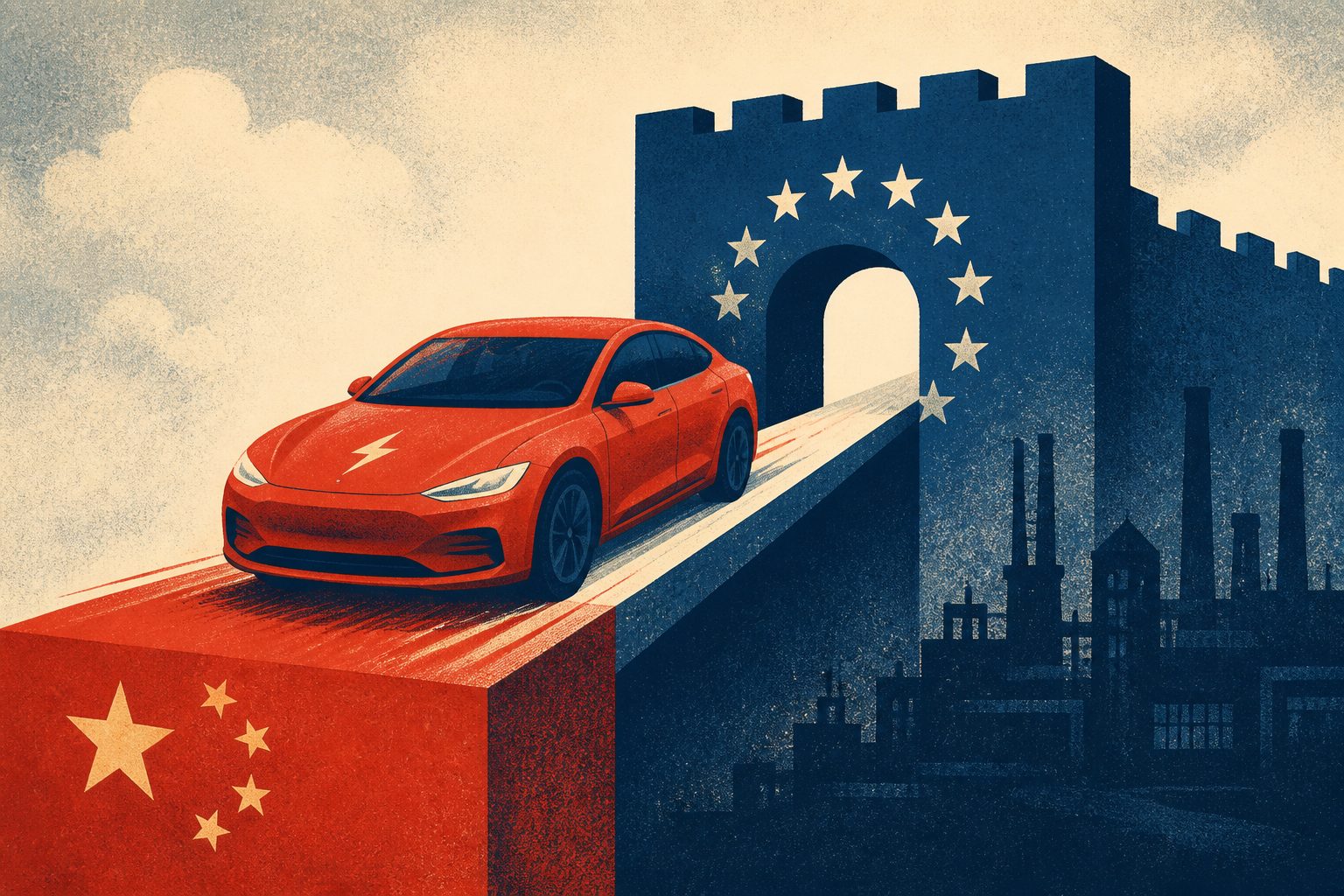
A study argues that Europe needs more domestic production, investment and innovation to compete with China.
The article examines China’s effort to rely more on domestic demand and industrial strengths while maintaining international economic ties. It uses the country’s recent electric-vehicle boom to assess whether this strategy is reducing reliance on older growth sources such as cheap manufacturing exports and fixed-asset investment.
The authors argue that China’s approach could increase its economic leverage over other countries and create pressure on European industry. For the electric-vehicle sector, they call for a combination of producing more within Europe, investing in European firms and technologies, and pursuing some technology transfers.
China’s electric-car strategy
The study presents China’s Dual Circulation Strategy as an effort to combine greater economic self-reliance with continued participation in international markets. The authors say the strategy is also intended to make use of China’s industrial overcapacity and domestic demand.
Using China’s electric-vehicle expansion as its main example, the paper assesses the strategy against a worsening geopolitical backdrop. It concludes that the European Union needs a multilayered industrial strategy to compete with China. In electric vehicles, the authors identify three parts of that strategy: onshoring production, supporting indigenous investment and innovation, and pursuing some technology transfers.
What it means for Europe
Electric vehicles connect industrial policy, trade and the transition away from fossil-fuel-powered transport. The paper’s argument is that China’s success in this sector is not only a market development but also a test of whether Europe can build stronger domestic industrial capacity while remaining engaged in global trade.
If the authors’ assessment is correct, European competitiveness in electric vehicles would require more than relying on imports or isolated policy measures. It would involve coordinated support for production, investment, innovation and selected technology transfers.
Evidence and limits
This is a journal article that analyzes China’s Dual Circulation Strategy through the example of the country’s recent electric-vehicle boom. The abstract does not provide the article’s detailed data sources, methods, sample, numerical estimates or a sector-by-sector assessment of European industry.
The conclusions therefore describe the authors’ policy assessment rather than reporting a quantified causal estimate of how the strategy has affected Europe. The abstract also does not specify which forms of technology transfer the authors recommend or how effective the proposed European measures would be in practice.