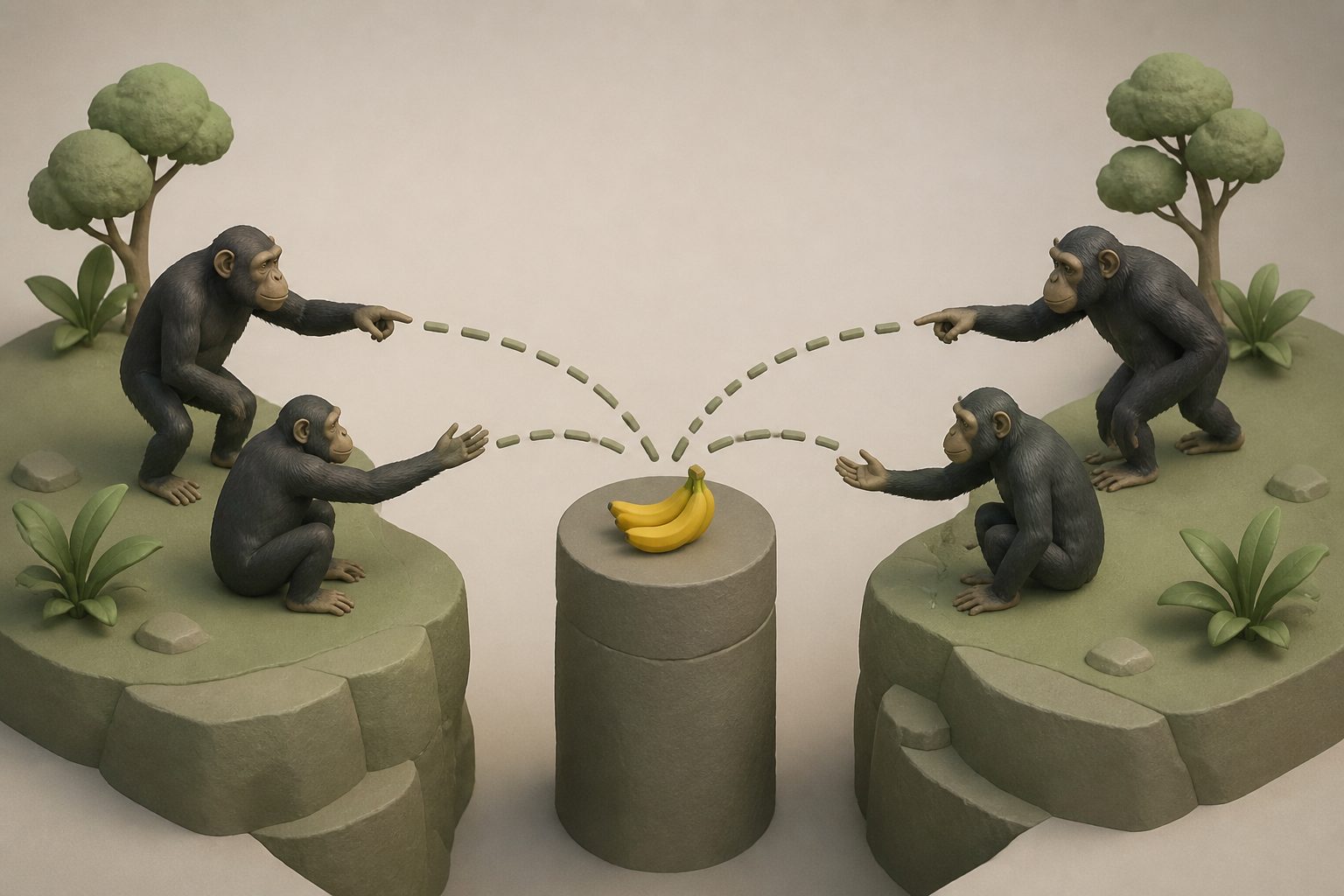
A study of 12 wild East African chimpanzees links shared gesture repertoires to cues that may help them infer what others mean.
Researchers examined the gestures and social relationships of 12 wild East African chimpanzees. They compared two explanations for why chimpanzees may develop overlapping visual gesture repertoires: repeated exposure to gestures and their outcomes, or the use of cues that help individuals work out a partner’s communicative goal.
The results favored the second explanation. Reciprocated social bonds created opportunities for repeated interaction but did not predict overlap in gesture repertoires. Instead, cues linked to self-relevance appeared alongside varied gestures in socially complex situations, and overlap was predicted by gestures used in secondary contexts rather than by gestures used in primary contexts.
How gestures overlapped
Self-relevance cues—including vocalizations, manual gestures and waiting for a response—accompanied a range of gestures during complex or uncertain interactions. These situations included encounters with non-kin, larger social parties and partners with weaker social bonds.
The cues were associated with secondary contexts and responses, rather than the primary contexts expected if repeated exposure and reinforcement were the main explanation. Gesture overlap was predicted by gestures used in secondary contexts, while gestures used in primary contexts did not predict convergence. Reciprocated social bonds did not predict overlap, suggesting that opportunities for exposure alone were insufficient to explain shared repertoires.
Why shared goals matter
The findings point to a possible way that chimpanzees can develop some shared gestures while maintaining differences in other situations. In changing social groups, individuals may align their gestures by inferring what partners are trying to communicate, rather than simply repeating signals that have previously produced a response.
This offers a possible explanation for how communication can both converge and diverge in chimpanzees’ fission–fusion societies, where group membership and social interactions change over time. It also bears on how flexible communication and social complexity evolved.
Evidence and limits
The study used generalized linear mixed models and social network analyses of observations from 12 wild East African chimpanzees. It compared patterns in social relationships, social and ecological conditions, communicative contexts and gesture overlap.
The results are observational associations and are more consistent with inferential learning than with reinforcement learning; they do not directly demonstrate what chimpanzees were thinking or prove that goal inference caused repertoire convergence. The small sample and focus on one group of wild chimpanzees also limit how broadly the findings can be generalized.