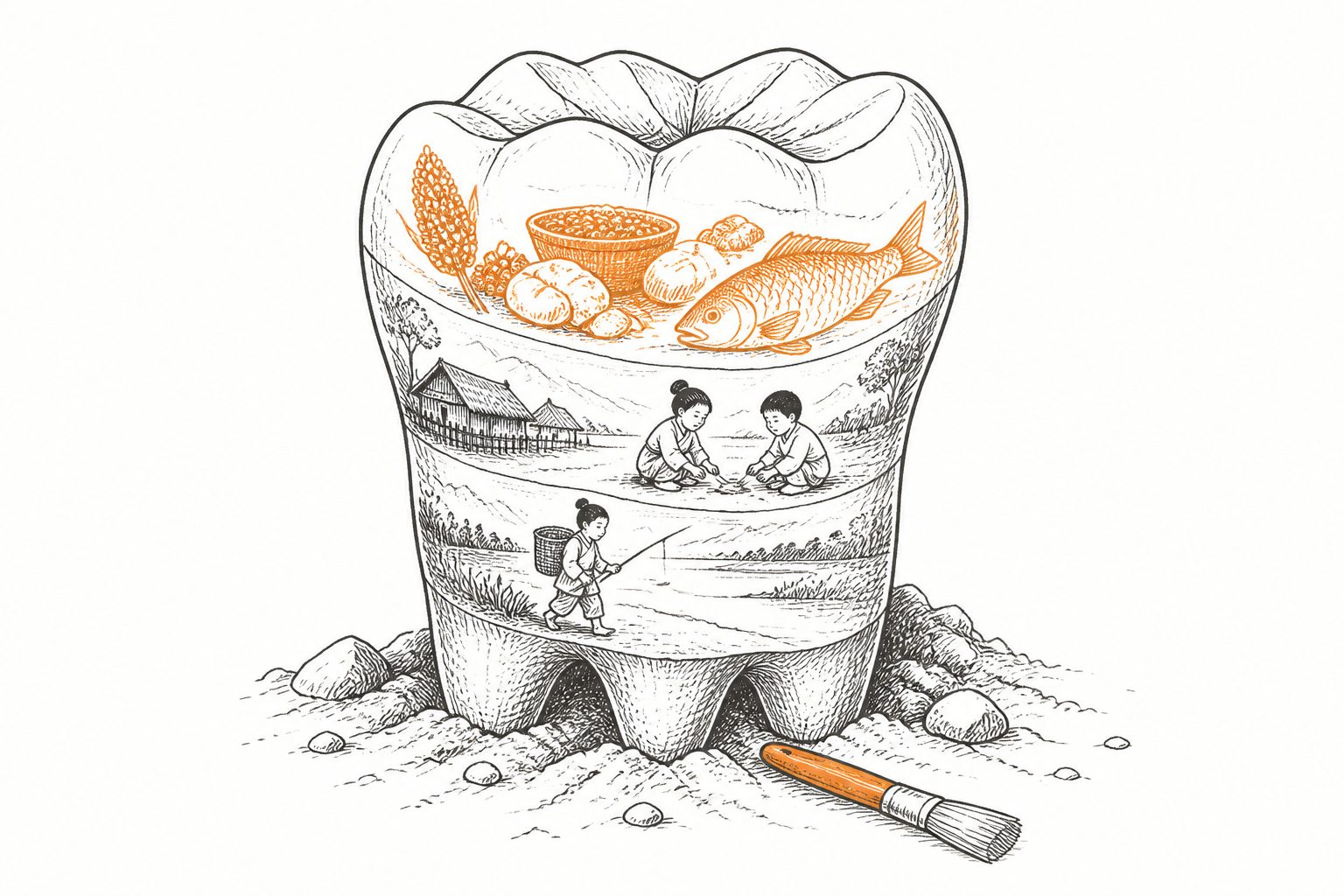
Researchers analyzed stable carbon and nitrogen isotopes in the gradually formed tooth dentin, bones and ribs of 22 people buried at the Jiaojia site in China. The individuals lived during the middle and late Dawenkou period, when social differences were developing.
Climate & Environment2 months ago
Children’s teeth reveal varied diets and childhood lives in prehistoric China
Isotope patterns in 22 people from the Jiaojia site point to different weaning patterns, diets, health experiences and burial practices.
Different childhood diets
The researchers identified four groups among the 22 individuals: people with a typical weaning pattern, people weaned on millet, people showing signs of stress, and people whose isotope patterns suggested they were non-local. Comparisons based on burial lavishness found that those identified as elites consistently consumed more high-protein C3 foods from childhood into adulthood. People in less lavish burials maintained a diet dominated by C4 foods. C3 and C4 describe different plant carbon pathways that can leave distinct chemical signals in human tissues; millet is a C4 crop. The authors link these dietary differences to the growth of privately held family wealth and social stratification. Differences in diet and mortuary treatment were visible among subadults as well as adults, indicating varied childhood socialization.
Why childhood evidence matters
The findings show how children’s remains can add information that is often missed when studies focus mainly on adults. Combining dietary evidence with signs of stress and burial treatment helps researchers examine how social differences were experienced across the life course, rather than treating status as something visible only in adult burials. At Jiaojia, the evidence suggests that emerging social stratification was associated with differences that began in childhood and continued into adulthood.
Evidence and caveats
The study used stable carbon and nitrogen isotope measurements from incremental tooth dentin, limb bones and ribs belonging to 22 people from the Jiaojia site during the middle and late Dawenkou period. Incremental dentin can preserve changing dietary signals during childhood, while bones and ribs provide information about later life. The study is limited to one archaeological site and 22 individuals, so its findings may not represent all Dawenkou communities. The abstract also does not provide the exact dates, the distribution of individuals among the four groups, or details of how burial lavishness was assessed. Isotope results indicate dietary patterns and possible periods of stress, but they do not by themselves explain every aspect of childhood experience or social status.
// Source
Archaeological and Anthropological Sciences · 2026 · DOI: 10.1007/s12520-026-02544-z
Authors: Meng Liu, Zhongming Tang, Yongsheng Zhao, Hao Wu, Shuai Yao, Yu Dong, Fen Wang
Institutions: Qingdao University of Science and Technology, Shandong University