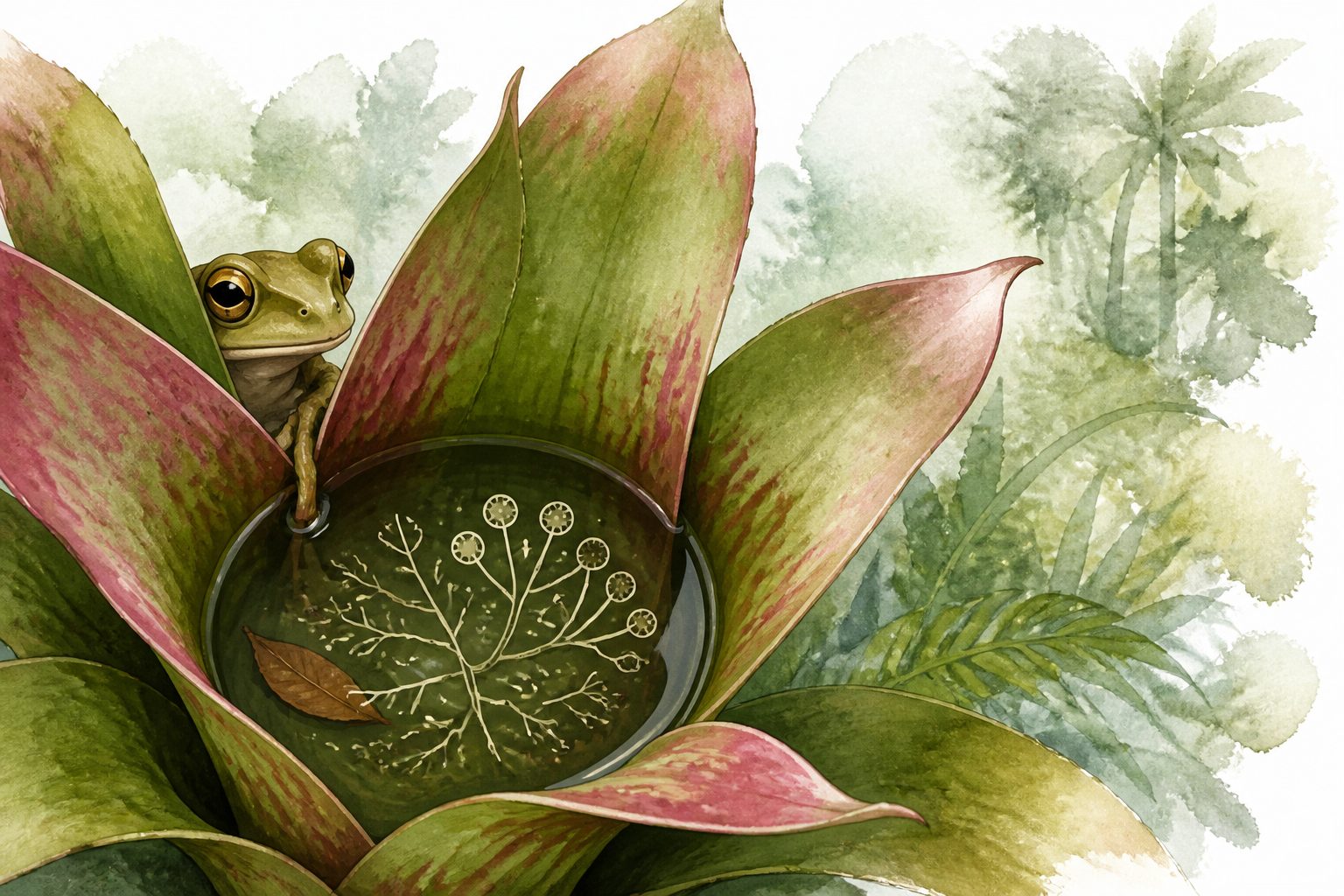
A study in Ecuadorian forests found the chytrid fungus in some bromeliad water tanks, but amphibian infection varied more with hosts, sites and climate.
Researchers sampled amphibians at eight sites and tested canopy and subcanopy bromeliads at five sites in Ecuadorian forests. They used skin swabs from amphibians and environmental DNA from water held in bromeliad tanks to look for Batrachochytrium dendrobatidis, commonly called Bd.
Bd detection was less likely in subcanopy bromeliads than in amphibians, while canopy bromeliads did not differ significantly from either group. Mid-elevation sites were more likely to test positive than high-elevation sites. Among amphibians, prevalence increased with precipitation and was highest under intermediate temperatures, while Bd detection in bromeliads was not significantly linked to the measured environmental conditions.
Where the fungus was found
Bd was detected in 23.0% of amphibian samples and 11.3% of bromeliad samples. Subcanopy bromeliads had a significantly lower probability of detection than amphibians; canopy bromeliads showed no significant difference from amphibians or subcanopy bromeliads.
Mid-elevation sites had a higher probability of Bd detection than high-elevation sites, while low-elevation sites did not differ significantly from the others. Amphibian prevalence increased with precipitation and showed a nonlinear relationship with temperature, suggesting higher prevalence under intermediate thermal conditions. Bd detection in bromeliads was not significantly associated with the measured abiotic factors. Infection intensity in amphibians did not differ significantly across host taxonomic groups or sampling sites.
Evidence and caveats
The study combined skin swabs from amphibians with environmental DNA testing of water from canopy and subcanopy bromeliads across an elevational gradient in Ecuador. Environmental DNA can show that Bd genetic material is present, but these detections alone do not establish how long the fungus remained in a tank or whether it was actively infecting amphibians there.
The sampling covered eight amphibian sites and five bromeliad sites, so the results may not represent all tropical forests or bromeliad habitats. The climate relationships are associations from field observations and do not show that precipitation or temperature directly caused changes in infection. The abstract also does not report experimental tests of Bd survival in bromeliad tanks.