A study found different information-sharing patterns across major brain networks, but it did not establish a diagnostic test.
The researchers used transfer entropy, a measure of how activity in one brain region provides information about activity in another, to compare information flow across canonical brain networks in autistic participants and healthy controls. The healthy-control group showed more feedback, while the main sources and hubs of information flow differed between the groups.
The Default Mode Network and Visual Network were the main information sources in the control group. In the autistic group, the Frontoparietal and Limbic networks were hubs. The researchers then used XGBoost, an artificial-intelligence classification method, which reached a mean accuracy of 91% in distinguishing the groups across cross-validations.
How brain networks differed
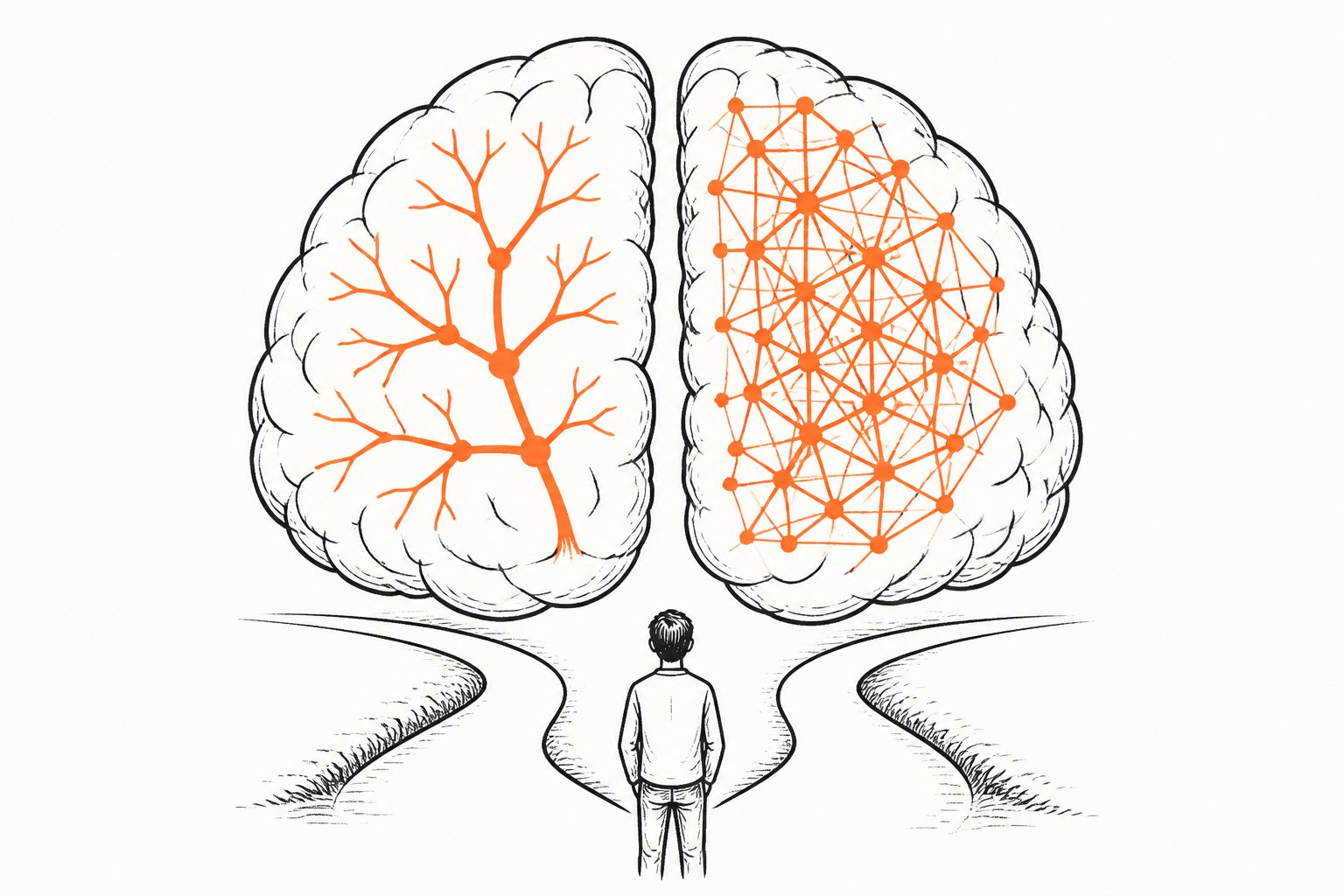
Information transfer between canonical brain networks differed between the autistic and healthy-control groups. The healthy-control group showed a higher volume of feedback. Its main sources of information flow were the Default Mode Network and Visual Network, whereas the Frontoparietal and Limbic networks were hubs in the autistic group.
The researchers also examined the backbone, or strongest underlying connections, in the information-flow graphs. Both groups showed the same modularity class, meaning a similar broad division into network communities, but the autistic group had separated fragments. Using XGBoost, the researchers classified autistic participants versus healthy controls with a mean accuracy of 91% across cross-validations.
Why the pattern matters
The findings identify group-level differences in how information appears to move among major brain networks. They also show that these patterns contained enough information for an artificial-intelligence system to distinguish the autistic and control groups in this study.
However, the abstract presents this as an exploration of whether information-flow patterns could serve as a diagnostic biomarker, not as evidence that a clinically usable diagnostic test has been established.
Evidence and caveats
This was a journal article based on brain-activity network analysis using transfer entropy and machine-learning classification. The reported 91% figure is a mean accuracy across cross-validations, rather than proof that the approach will perform the same way in clinical practice or in other groups.
The abstract does not report the number or characteristics of participants, the source and recording details of the brain-activity data, or performance on an independent external test set. It also does not establish whether the identified patterns are specific to autism or can reliably distinguish individuals outside this study sample.