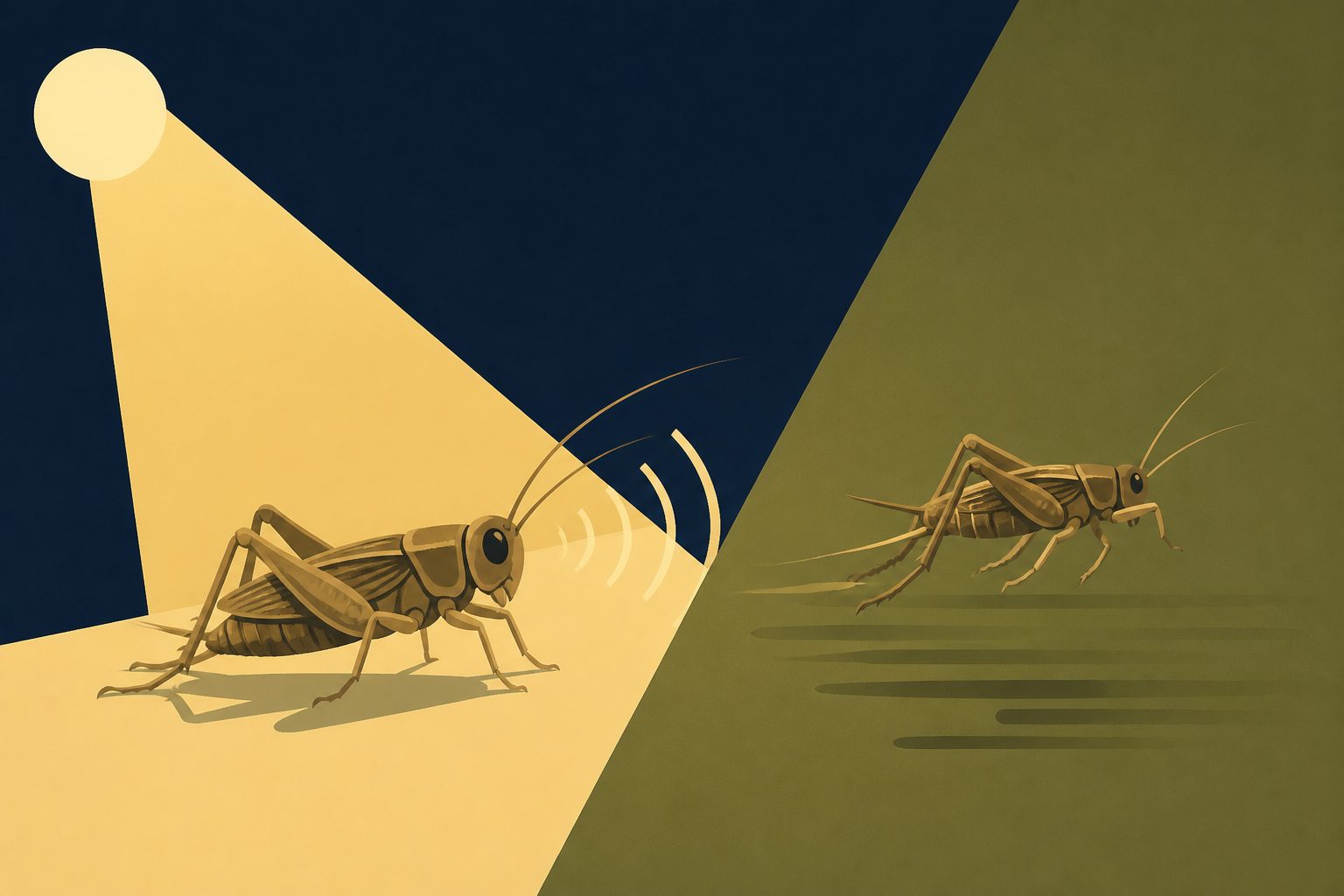
Tracking eight male crickets across adulthood found age-related changes in calling, rest and sleep-like behavior that did not affect every behavior in the same way.
Researchers continuously recorded eight adult male two-spotted crickets kept on a 12-hour light and 12-hour dark cycle. Using an artificial-intelligence-based video tracking system, they measured locomotion, resting, a sleep-like state, feeding, drinking and calling across the animals’ adult lifespans.
Locomotion, resting and sleep-like behavior differed between light and dark periods and changed with age. Calling also showed daily and age-related changes, while feeding and drinking showed no detectable differences. Reduced calling was associated with more sleep-like behavior, but not with changes in locomotion.
How cricket behavior changed
The researchers divided each cricket’s records into early, middle and late lifespan stages. Locomotion, resting and sleep-like behavior changed with age and differed between the light and dark phases. Total distance traveled varied across the lifespan stages in a way that depended on the time of day, rather than following one consistent pattern.
Male calling showed both light–dark differences and age-related shifts. Correlation analysis found that reduced calling was associated with increased time in a sleep-like state, but not with locomotion. Feeding and drinking showed no detectable age-related or light–dark differences in the reported analyses.