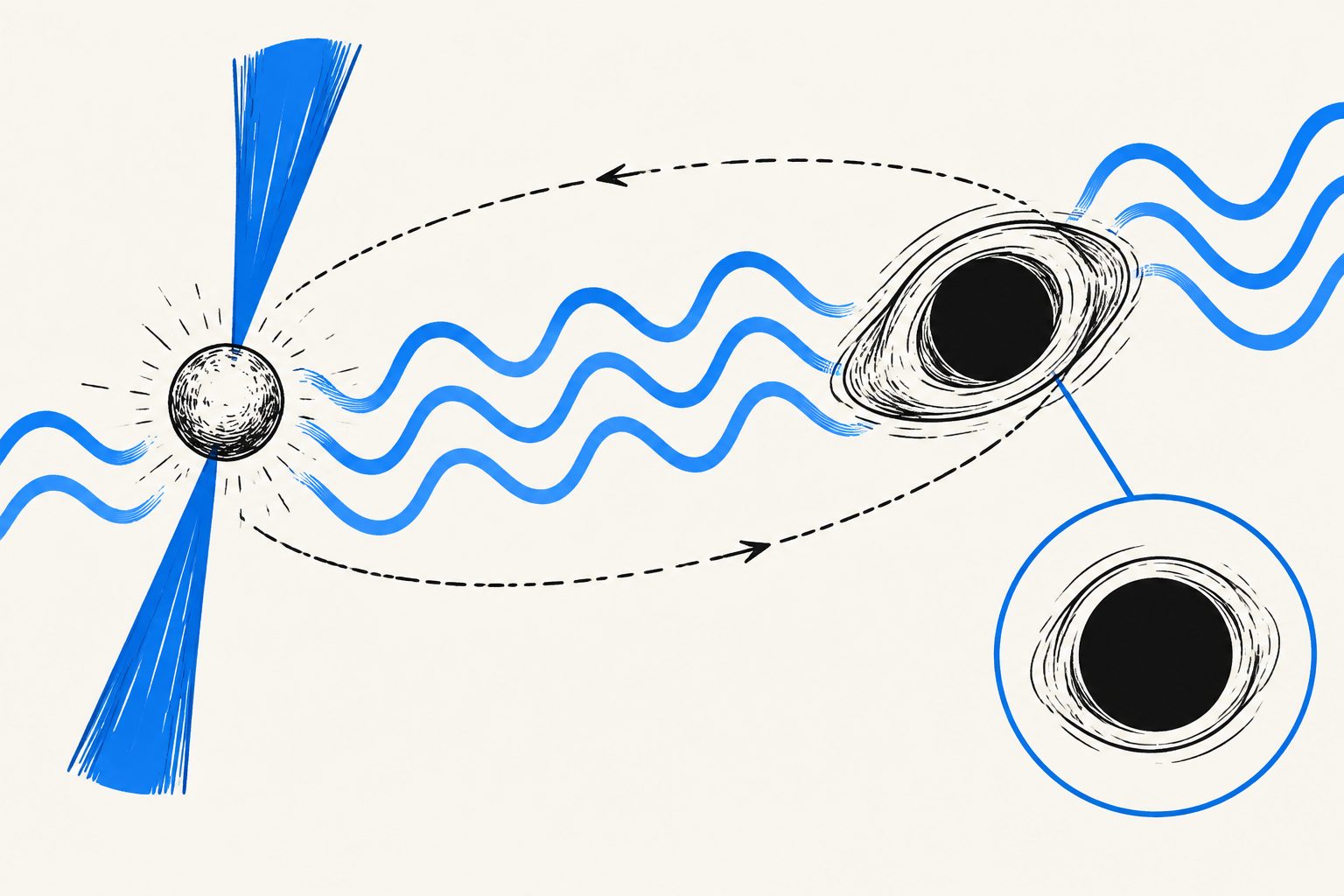
A theoretical study proposes that some protected quantum states appearing only across finite ranges of theory sizes could account for most black-hole entropy.
The researchers use supercharge cohomology, a method for identifying protected states, to compare BPS states across theories with different rank N. They call states that form continuing sequences “monotone” and those present only across finite consecutive ranges “fortuitous.” States in the second group acquire anomalous dimensions away from the special ranks where they occur.
Under the AdS/CFT correspondence, the authors conjecture that monotone states correspond to smooth, horizonless geometries, while fortuitous states account for typical black-hole microstates. They report supporting evidence from N = 4 super-Yang–Mills theory and from symmetric product orbifold theories, including examples where quantized geometric moduli spaces reproduce protected-state Hilbert spaces.
Two kinds of protected states
The paper proposes a classification of BPS states based on how they behave as the rank N of a theory increases. Monotone states form infinite sequences across increasing N, while fortuitous states occur only within finite ranges of consecutive N values.
The authors conjecture that monotone states are dual to smooth, horizonless geometries and that fortuitous states are responsible for typical black-hole microstates and the dominant share of black-hole entropy. Their supporting examples come from N = 4 super-Yang–Mills theory and the symmetric product orbifolds SymN(T4) and SymN(K3).
Evidence and open questions
The classification is formulated using supercharge cohomology and is examined in specific holographic theories rather than established for all such theories. The proposed links between the two classes of states and their gravitational descriptions are conjectures supported by examples, not a direct proof that fortuitous states are black-hole microstates.
The bulk description of a single fortuitous state remains unknown. The authors also leave open whether more general monotone states have corresponding smooth geometries and whether the approach can be extended beyond the examples studied.