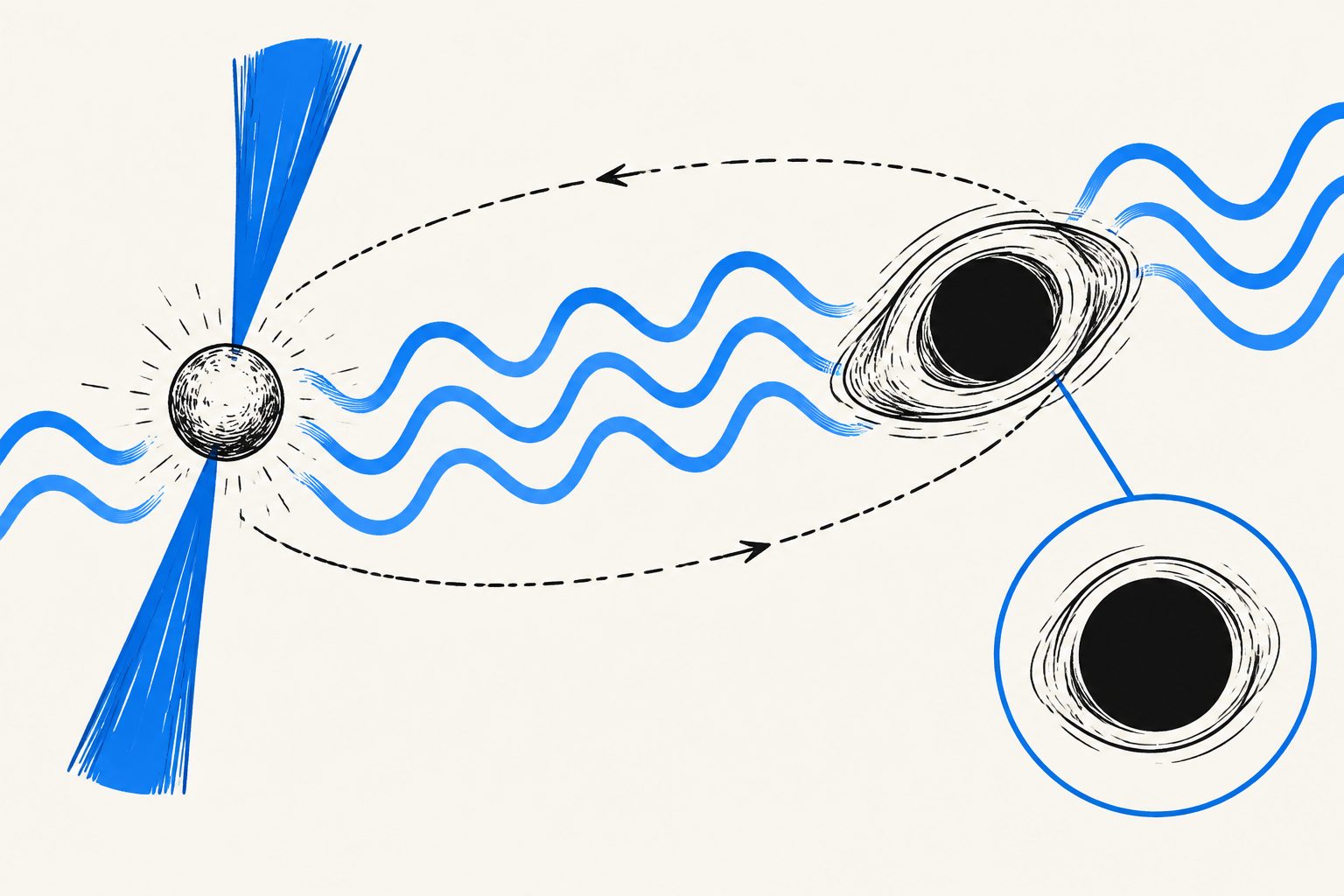
The event GW250114 sets the strongest limits yet on how much black holes could be deformed by their surroundings.
Researchers analyzed GW250114, a high-signal-to-noise gravitational-wave event detected in 2025, to look for effects that would reveal tidal deformation of the black holes. They found that the data are consistent with a binary black-hole merger and set a 90% upper limit of 34.8 on its effective tidal deformability.
The limit implies that any material or other environment surrounding the black holes contributed less than about 7 × 10⁻³ of their mass. It also rules out some models of boson stars, while leaving the data consistent with the zero tidal response predicted for Kerr black holes in vacuum general relativity.
Evidence and caveats
This is an analysis of one gravitational-wave event, rather than a direct measurement of a nonzero tidal response. The result is an upper limit, so smaller effects remain allowed. The researchers also used simulated signals to test whether omitting tidal effects could bias estimates of masses and spins; those tests showed that including a tidal model recovered injected values within uncertainties, while neglecting large tidal effects could produce biases. The conclusions therefore depend on the event's data, the waveform models and analysis assumptions, and they do not establish that every possible black-hole environment or alternative-gravity model is excluded.
// Source
Physical review. D/Physical review. D. · 2026 · DOI: 10.1103/5xhw-xk98
Authors: Marc Andrés-Carcasona, G. Caneva Santoro