Biologically made nanoparticles could clean wastewater, but key risks remain
A review finds strong pollutant-removal results, while inconsistent production and uncertain environmental effects complicate large-scale use.
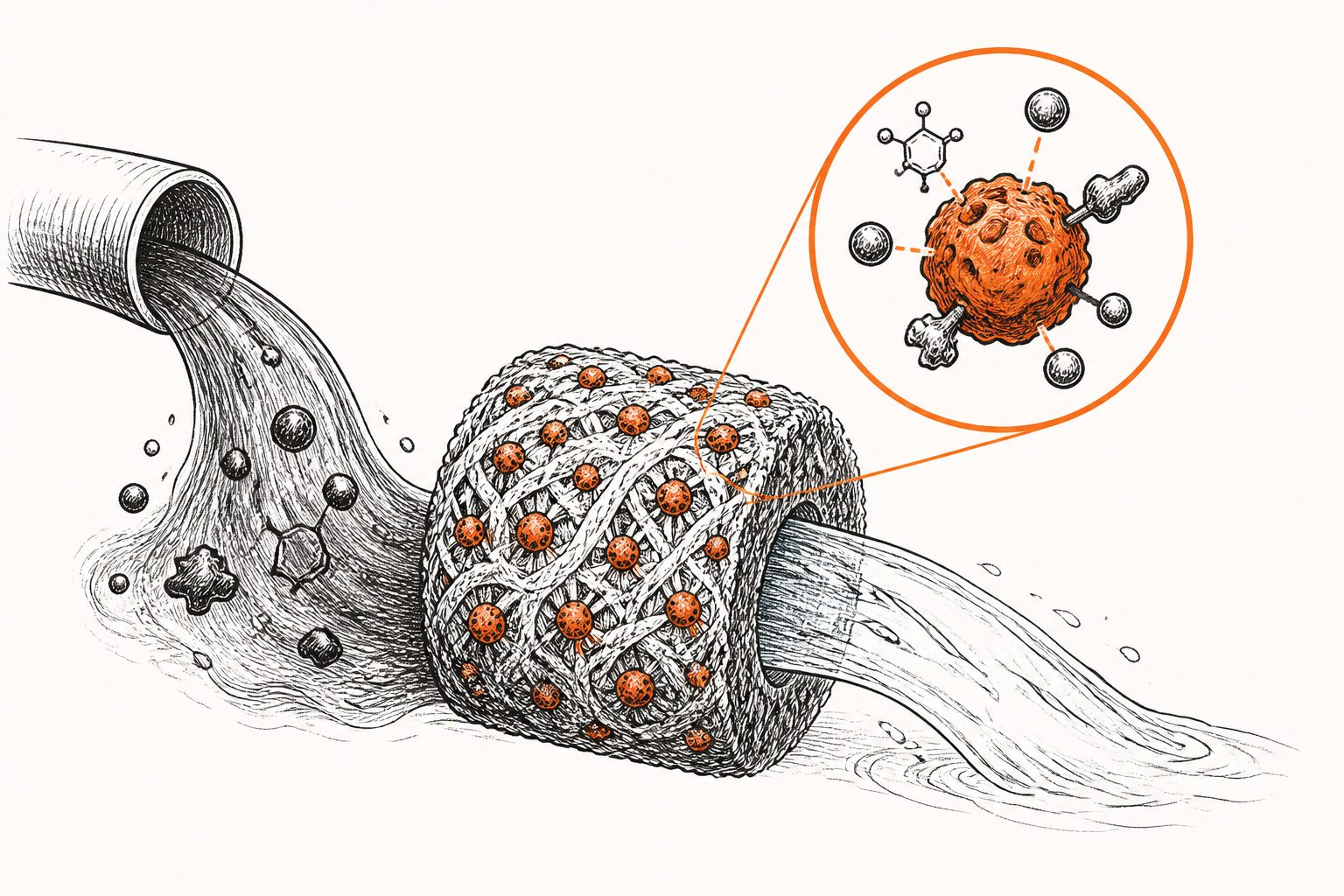
Editorial illustration — not from the study.
The review examined 72 studies published from 2019 to June 2025 on biologically produced nanoparticles for wastewater treatment. Across the literature, these materials were reported to remove 80–98% of dyes and 70–95% of heavy metals, while also acting on organic pollutants, pharmaceuticals and disease-causing microorganisms.
The authors say biological production may offer compatibility and environmental advantages over chemically made nanoparticles, but they identify major barriers to scale-up. These include inconsistent synthesis, economic and recovery challenges, uncertain regulation and community acceptance, as well as the need to understand how the particles change and persist after treatment.
What the particles can remove
The review describes biologically produced nanoparticles made with plant, bacterial, fungal, algal and yeast systems. Their biomolecule-rich surfaces can support three main treatment actions: capturing pollutants on the particle surface, chemically transforming them and inhibiting microorganisms. Across the studies reviewed, reported removal rates reached 80–98% for dyes and 70–95% for heavy metals. The literature also covered treatment of organic pollutants, pharmaceuticals and pathogenic microorganisms in industrial, municipal, textile, pharmaceutical, agricultural and hospital wastewater.
The review reports that these particles generally showed improved biocompatibility and lower ecotoxicity than chemically synthesized nanoparticles. However, their behavior after treatment depends on changes such as sulfidation, oxidation, dissolution, aggregation, surface passivation and the formation of complexes with organic metals. Such changes can affect how long the particles persist, how mobile they are and whether organisms can take them up.
Why safe scale-up matters
Biologically produced nanoparticles could provide a flexible option for treating wastewater with mixtures of chemical and biological contaminants. The review says they may be useful in settings where treatment infrastructure is limited, but only if production can become more consistent and affordable and the particles can be recovered or managed safely.
The environmental effects do not end when treatment is complete. Understanding how these materials change in water, soil and sediment is important for judging their persistence and ecological impact. The authors therefore call for long-term monitoring, better management of treatment by-products, clearer international rules and real-world pilot studies before widespread deployment.
Evidence and open questions
This was a systematic review conducted under PRISMA 2020 guidelines. The authors searched Web of Science and Scopus for studies published from January 2019 through June 2025. Of 779 records initially identified, 72 studies met the review's eligibility criteria and were included in a qualitative synthesis.
The reported removal percentages summarize results from the included literature rather than a new treatment experiment, and performance may vary with the nanoparticle source, production method and wastewater conditions. The review identifies synthesis variability, cost and scale-up, nanoparticle recovery, regulatory uncertainty, community acceptance and incomplete knowledge of environmental fate as unresolved barriers. It recommends pilot studies using real wastewater and longer-term assessments of environmental behavior.
// Source
Water Air & Soil Pollution · 2026 · DOI: 10.1007/s11270-026-09978-0
High-resolution drone maps detected early crop water stress before changes appeared in other plant measurements. The approach tracked evapotranspiration—the movement of water from soil and plants into the air—across sugar beet, potato and winter wheat fields.
A pilot-scale system removed long-chain PFAS, including PFOS and PFOA, from municipal wastewater and concentrated the compounds in a small volume of foam. Under the best-performing conditions, a subsequent treatment destroyed and removed more than 99% of measured PFAS in that concentrated foam.
Humpback whales in Monterey Bay fed more frequently when California sea lions were present. The whales appeared to spend less time searching and approaching prey, while the effort and movement of individual lunges showed no detectable increase.