Atmospheric signals preceded major earthquakes in a China study
Researchers say the signals may help estimate an earthquake’s size, location and timing before it occurs.
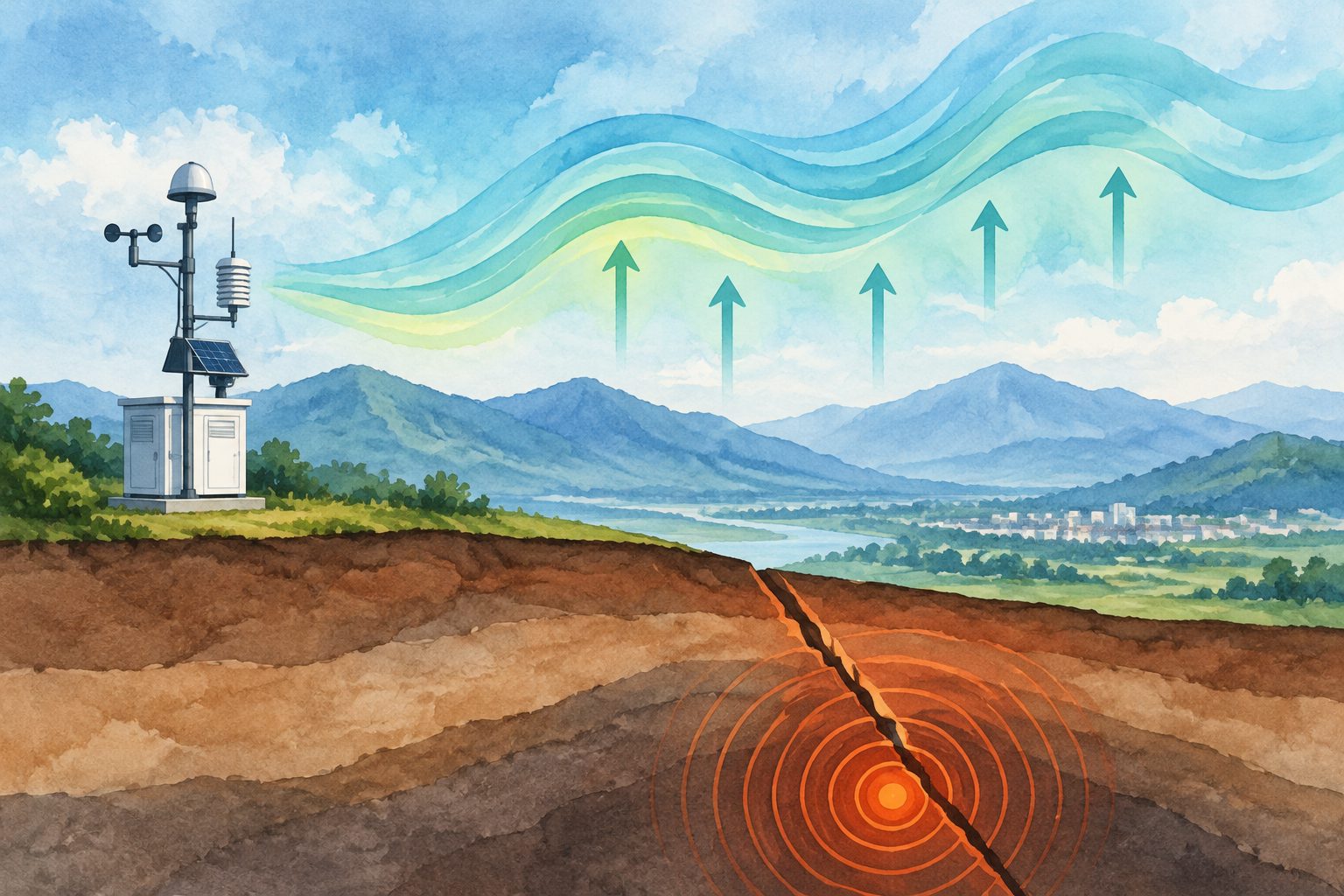
Editorial illustration — not from the study.
Researchers analyzed data from hundreds of magnetometers and ground-based satellite-navigation receivers in China, looking for resonance-like signals that appeared before major earthquakes. They also used signals from China’s BeiDou satellites to track changes in the ionosphere, the electrically active upper atmosphere, at nearly fixed locations above the ground.
The researchers report that prospective alerts based on these patterns since June 2022 showed predictive capability for numerous earthquakes of magnitude 6 or greater, with few or no reported failures. Simulations suggested that large-scale ground vibrations could produce atmospheric disturbances linked to the signals.
Signals before earthquakes
The study describes “seismo-ripples” as recurring patterns found before major earthquakes in seismic, magnetic and ionospheric measurements. The researchers report that these patterns were observed across data from hundreds of monitoring instruments in China.
They say prospective anomaly assessments made since June 2022 identified signals before numerous earthquakes of magnitude 6 or greater, with “minimal to no failure,” although the abstract does not give the number of events or a detailed success rate. The reported patterns were associated with estimates of an earthquake’s magnitude, location and timing.
Numerical simulations suggested that the signals begin with large-scale ground vibrations, which then disturb the atmosphere. The researchers also report that the patterns typically persist for two to three months and include an ionospheric signal with a period of about 4.75 minutes.
Why earlier warnings matter
Short-term earthquake prediction remains difficult, while long-term assessments generally describe the probability of an earthquake over years or decades. If the reported signals can be reliably distinguished from other natural variations, they could add information for monitoring earthquakes before they occur.
The possible usefulness is not uniform. The study indicates that location estimates depend strongly on the density and arrangement of monitoring stations, so better-covered regions may produce more precise results than areas with sparse instruments.
Evidence and limits
The evidence comes from retrospective analysis of seismic, magnetic and ionospheric records, prospective anomaly assessments since June 2022, and numerical simulations. The researchers considered changes linked to local time, seasons, solar activity, geomagnetic disturbances and weather, and argue that these influences do not match the signals’ reported regional persistence, spatial pattern or roughly 4.75-minute period.
The study’s main stated limitation is monitoring geometry. Location uncertainty is about 280 kilometers where stations are sparse, while the researchers report an accuracy of 23 kilometers for one 2024 event in well-instrumented Taiwan. Most instruments are on land, making earthquakes beneath the ocean particularly difficult to assess. The abstract also does not provide a full event-by-event account of the reported predictive performance, so the findings do not establish that the method works equally well for all earthquakes or regions.
High-resolution drone maps detected early crop water stress before changes appeared in other plant measurements. The approach tracked evapotranspiration—the movement of water from soil and plants into the air—across sugar beet, potato and winter wheat fields.
A pilot-scale system removed long-chain PFAS, including PFOS and PFOA, from municipal wastewater and concentrated the compounds in a small volume of foam. Under the best-performing conditions, a subsequent treatment destroyed and removed more than 99% of measured PFAS in that concentrated foam.
Humpback whales in Monterey Bay fed more frequently when California sea lions were present. The whales appeared to spend less time searching and approaching prey, while the effort and movement of individual lunges showed no detectable increase.