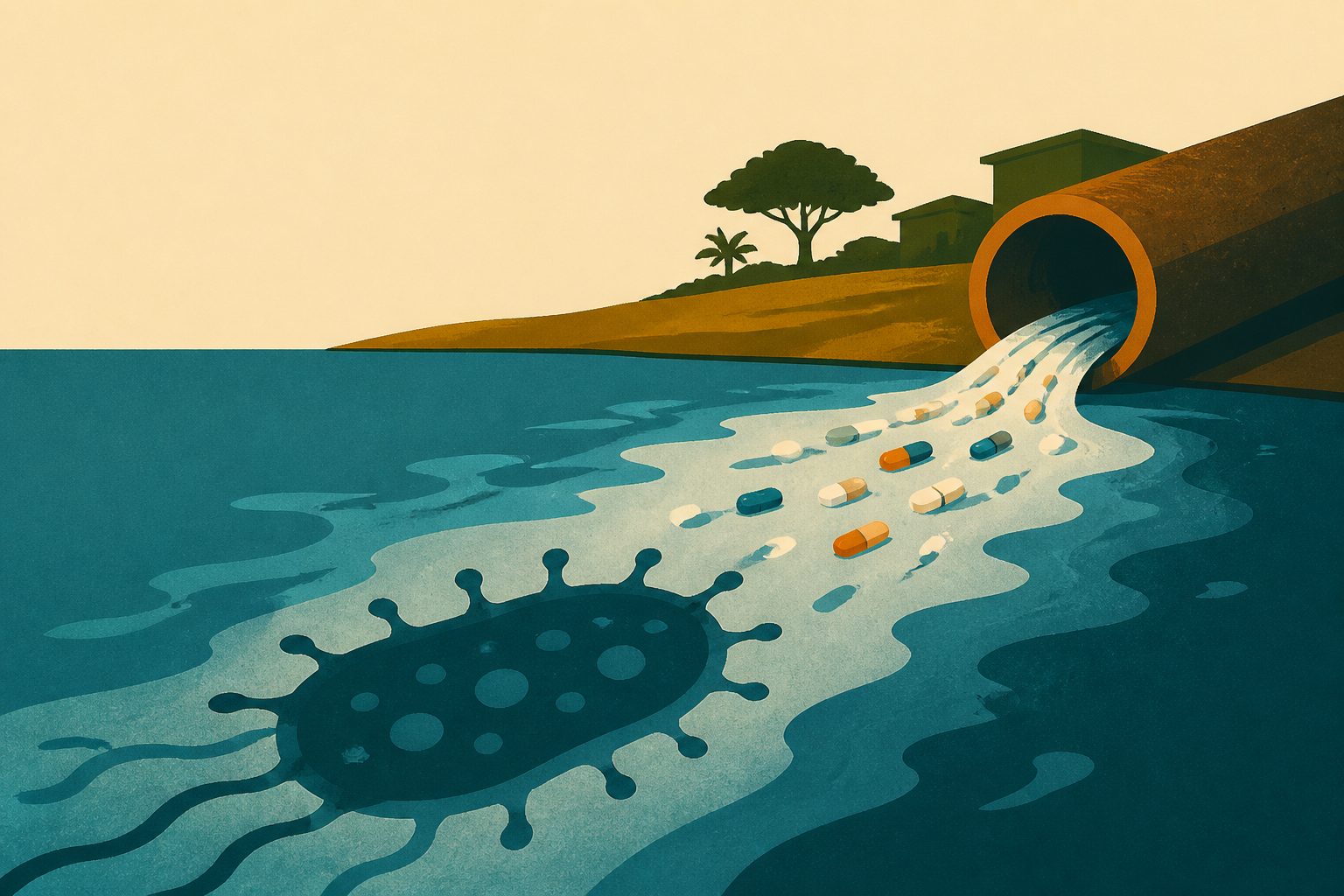
A review finds contamination across rivers, groundwater, sediments, waste sites and aquaculture systems, with the highest levels in hospital wastewater and landfill leachates.
The review examined research published from 2000 to 2026 on antibiotic residues in Ghanaian surface water, groundwater, sediments, soils, hospital wastewater, landfill leachates and aquaculture systems. Contamination was found across multiple environmental settings, although concentrations varied by location and type of material.
Hospital wastewater and landfill leachates had the highest reported levels. The review identifies Kumasi, Sunyani and Sefwi Wiawso as major contamination hotspots, linking them to healthcare activity, limited wastewater treatment and poor waste management. Lower but persistent concentrations were also reported in rivers, reservoirs, sediments and aquaculture systems.
Where residues were found
The researchers synthesised 46 studies, institutional reports and environmental monitoring studies published between 2000 and 2026. Antibiotic residues were reported in surface water, groundwater, sediments, soils, hospital wastewater, landfill leachates and aquaculture systems across Ghana.
Hospital wastewater contained amoxicillin concentrations of up to 8,760 µg/L, while penicillin concentrations in landfill leachates reached as high as 67,420 µg/L. The highest contamination levels were consistently reported in hospital effluents and landfill leachates. Kumasi, Sunyani and Sefwi Wiawso were identified as important hotspots. The review also reports lower but persistent contamination in rivers, reservoirs, sediments and aquaculture systems.
According to the review, these contaminated environments can act as reservoirs for antibiotic-resistant bacteria and resistance genes, increasing the potential for drug resistance to spread through the environment.
Why environmental pollution matters
Antibiotic residues in water, soil and waste systems can affect ecosystems and create conditions in which antibiotic-resistant bacteria and resistance genes persist in the environment. The review therefore points to environmental pollution as one part of the wider drug-resistance problem in Ghana.
The authors call for stronger environmental monitoring, better wastewater treatment and regulations that connect environmental protection with antibiotic-resistance control. These measures could help identify contamination and reduce the release of antibiotics into Ghanaian environmental systems.
Evidence and caveats
This study is a systematic review, not a new environmental sampling study or a controlled experiment. It combines evidence from 46 studies published between 2000 and 2026, along with institutional reports and monitoring studies. Because the sources examined different environmental materials and locations, reported concentrations varied substantially and cannot be treated as a single estimate for all of Ghana.
The abstract does not report a pooled national concentration or direct tests showing that the detected residues caused particular infections or resistance outcomes. Its conclusion about the spread of resistance describes the potential role of contaminated environments as reservoirs for resistant bacteria and resistance genes.
// Source
Discover Chemistry. · 2026 · DOI: 10.1007/s44371-026-00955-4
Authors: Emmanuel Kaboja Magna
Institutions: University of Environment and Sustainable Development