A spiking-neural-network system reported up to 92.7% accuracy while detecting sounds in under 20 milliseconds.
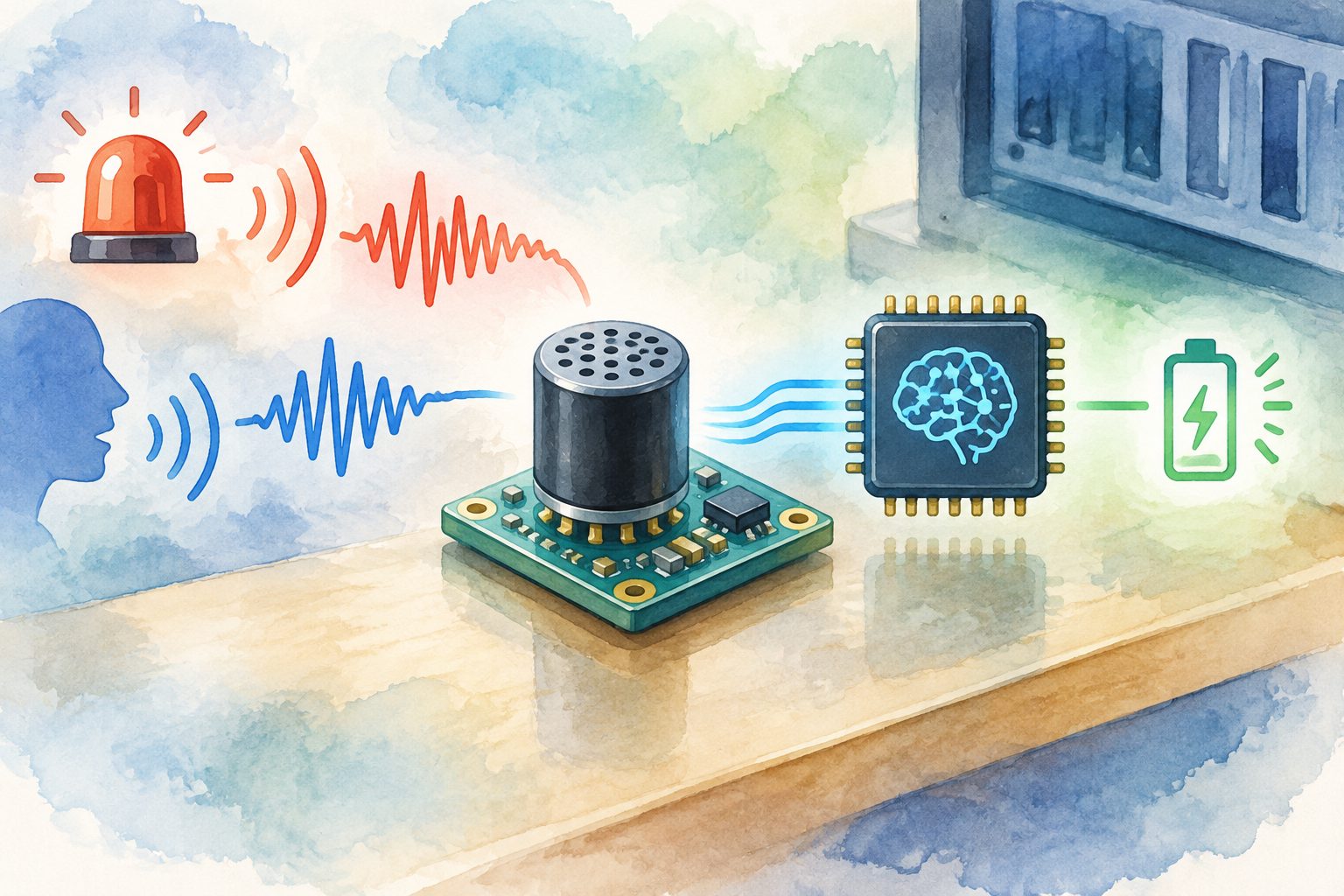
The system uses event-driven neural networks, which process changes in incoming sound rather than continuously handling all audio data. Its design includes audio preprocessing, conversion of sound into neural-like spikes and a multilayer network trained with surrogate-gradient methods, a technique used to train these networks despite their discrete signals.
The researchers tuned the system for Intel Loihi neuromorphic hardware and an ARM Cortex-M7 microcontroller. They evaluated it with the Google Speech Commands, ESC-10 and UrbanSound8K datasets and compared its performance with conventional convolutional neural network systems.
Evidence and caveats
This is an experimental evaluation using the Google Speech Commands, ESC-10 and UrbanSound8K datasets, with the system tuned for Intel Loihi and an ARM Cortex-M7 microcontroller. The abstract does not report dataset-specific accuracy, the exact comparison results for each baseline, or testing in a deployed real-world sensor. It also describes future work on hardware-aware training and improved adaptability and scalability, so the reported results do not establish how the system would perform across changing environments or other embedded hardware.
// Source
Progress in Electronics and Communication Engineering · 2026 · DOI: 10.31838/ece/03.02.05
Authors: Fateh M. Aleem, Ahmed Ulkilan
Institutions: Sebha University