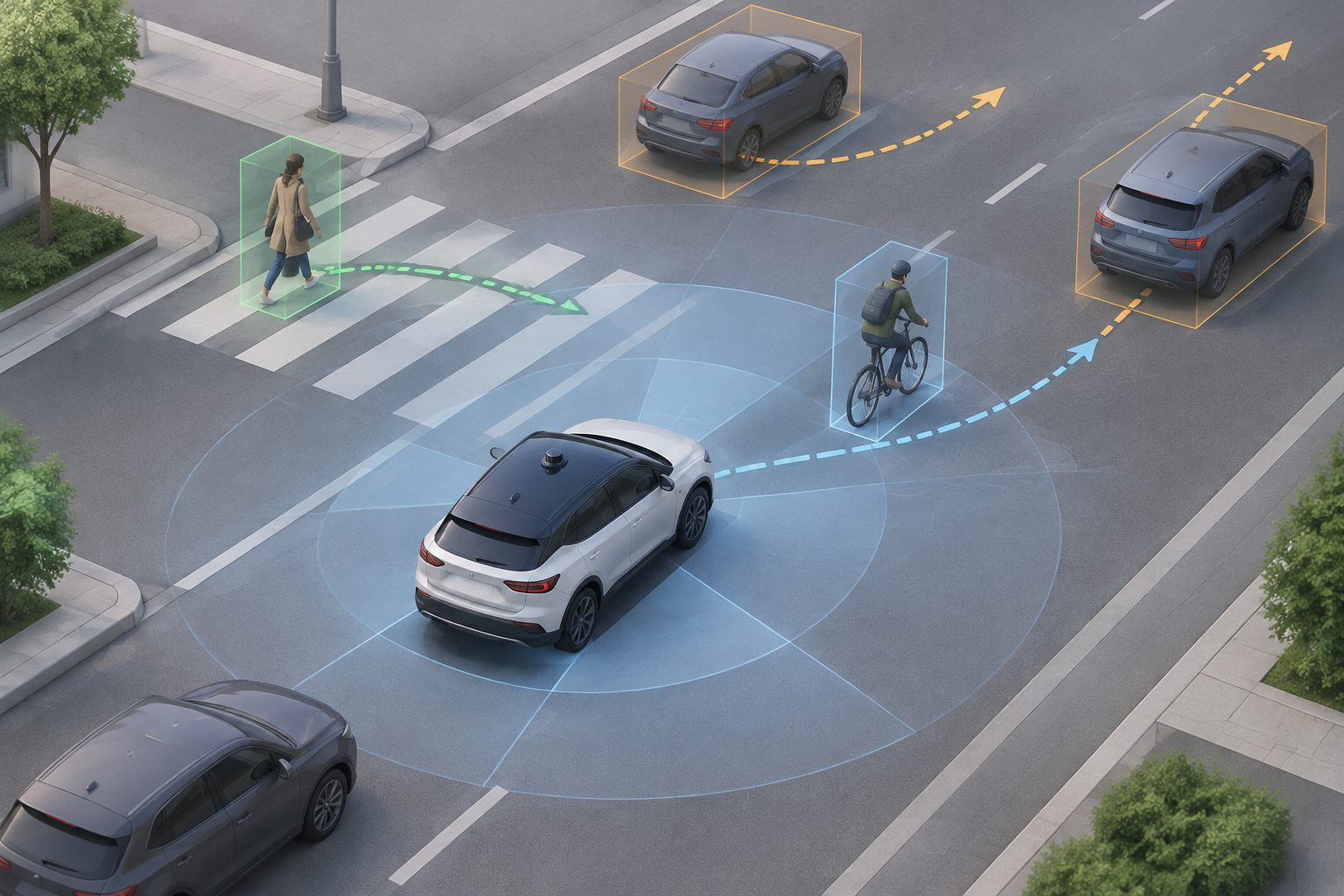
Tests on a low-power computer showed continuous trajectory predictions for autonomous-driving scenarios with a balance of speed and accuracy.
The system carries information from one moment to the next and uses the endpoints of earlier predictions to focus on relevant nearby agents and road lanes. This avoids repeated trajectory-refinement stages and is designed to meet the fixed execution requirements of low-power hardware.
On the Argoverse 2 trajectory-prediction benchmarks, the system achieved the best reported results among streaming methods in the multi-agent setting and competitive results in the single-agent setting. Tests on the Jetson Orin Nano examined two power modes and three numerical formats, including a half-precision mode that the researchers report ran three times faster than standard single-precision execution with negligible loss of accuracy.
What the system achieved
The researchers evaluated the system on Argoverse 2, which contains traffic scenarios from six U.S. cities and asks models to predict six seconds of future movement from five seconds of history. In the single-agent benchmark, the system matched the best score on the main reported metric alongside another method, while using no trajectory-refinement iterations. In the multi-agent benchmark, it outperformed earlier streaming methods on the main metrics, although a snapshot-based system had slightly lower displacement errors.
The model was adapted for edge hardware by setting fixed limits on the numbers of nearby agents and lane segments it could process. On an embedded NVIDIA Jetson Orin Nano, it maintained an inference rate above 10 updates per second. The hardware tests also found that half-precision execution produced a reported threefold speedup over single-precision execution with negligible accuracy degradation, including when power was capped at 7 watts.
Why fast predictions matter
Trajectory predictions are used between sensing and motion planning in an autonomous vehicle, so delays can affect how quickly the vehicle responds to surrounding traffic. A system that processes a continuous stream at more than 10 updates per second on low-power hardware could make this part of the driving system easier to run within fixed time and computing limits.
The results also address the need to predict several road users at once rather than forecasting each scene as an isolated snapshot. The study shows a way to retain temporal context and handle changing traffic scenes without relying on computationally costly refinement stages.
Evidence and caveats
The evidence comes from benchmark tests on the Argoverse 2 single-agent and multi-agent datasets, an additional ablation study on Argoverse 1, and deployment measurements on a Jetson Orin Nano. The hardware analysis varied power settings, numerical precision and the number of scene elements processed. The reported comparisons support the system’s performance against the methods included in those tests.
The excerpts do not describe testing on a vehicle, closed track or live road, nor do they measure the effect of the predictions on driving or motion-planning decisions. The hardware evaluation focuses on single-agent forecasting, uses fixed token limits and benchmarks batches of 32 focal agents. Results therefore describe this model, these datasets and this hardware setup rather than all autonomous-driving conditions.
// Source
Machine Vision and Applications · 2026 · DOI: 10.1007/s00138-026-01939-1
Authors: Alexander Prutsch, Erik Bonek, David Schinagl, Matthias Wess, Horst Possegger
Institutions: TU Wien, Graz University of Technology